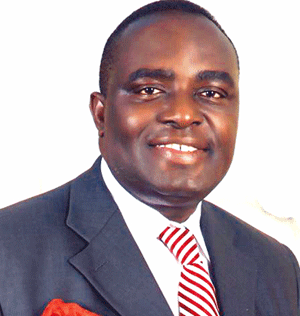
Prof. Peter Okebukola
By Dayo Adesulu
Former Executive Secretary, National Universities Commision (NUC), Chairman of Council, Crawford University and Chairman, Board of Trustees, Caleb University, Professor Peter Okebukola has thrown his weight behind President Muhammadu Buhari on the need for quality teachers, adding that to reconstruct the shattered education mirror, there are hard choices we cannot sidestep.
As a consultant to United Nations Educational, Scientific and Cultural Organisation (UNESCO), he traced the causes of decay in the system not to teachers alone, but also to other variables.

Prof. Peter Okebukola
Okebukola who noted that between 1960 and 1975, our educational system attracted respectable funding and the quality of delivery was comparable to what obtained in institutions all over the world, said that by the late 1970s, some cracks had started to develop in the system.
According to him, in the 60s, the educational system benefitted from a high dose of highly-qualified local and expatriate staff, adding that the contributions of Nigerian scholars to the research literature, patents and inventions were about the most outstanding in Africa.
Okebukola, while delivering convocation lecture on Reconstructing the Shattered Education Mirror: Hard Choices We Cannot Sidestep at the McPherson University said: ‘’Between 1965 and 1970, Nigeria contributed the highest in Africa to the international literature in science, engineering, medicine, social sciences and arts.’’
He posited that two major factors conspired to trigger off what is now regarded as the tipping point for poor quality. The first, he noted was the Structural Adjustment Programme (SAP) which brought in its wake, the devaluation of the naira, adding: “More or less overnight, the money available to educational institutions especially universities depreciated by about 200%.”
Expatriate staff salaries, he pointed out, became non-competitive and exodus back to their home countries began in earnest. ‘’Laboratory equipment and library books typically purchased with foreign exchange became increasingly out of reach on account of the devalued naira. Gradually, old equipment could not be replaced, latest books and journals could not be purchased. The decay had set in in earnest and quality nosedived,’’ he said.
He maintained that the second reason for the sharp decline in quality in the mid-1980s and the beginning of the decay in the system was the acceptance by political leaders of the advice by the Bretton Woods institutions – the World Bank and IMF, that African leaders should invest more on basic education and less on higher education.
He said: ‘’Sharp reduction in allocation to universities became common practice. Occurring at the same time as the devalued naira, universities found themselves in dire financial straits. Quality took a hard beating. As it turned out, the phenomenon described above was a feature of the higher education landscape in the whole of sub-Saharan Africa. The region suffered severe setback in the higher education sub-sector. The scars are still visible today in most pre-1970 universities in Africa.”
On policy implementation, Okebukola said that aside from policy prescription, the bigger stumbling is policy implementation. He said: “If the national policy in its present imperfect state were implemented to the full, the gap between where we are now and where we should be with regard to job creation and service delivery, would have been significantly narrowed. “For a host of reasons including shortage of political will and funding constraints, many of the prescriptions of the policy have remained on paper and failed to be anywhere near a tenth of expected implementation levels.”
Going down memory lane, the UNESCO consultant said: “From less than 3,000 primary schools in 1960 enrolling about 1.3 million pupils, there are now over 94,000 public and private primary schools with enrolment in excess of 32 million. Secondary school number and enrolment went from 1,227 and 24,640 respectively in 1960 to over 15,000 public and private secondary schools in 2017 with 12.4 million students.
“At the tertiary level, there has been similar growth. From one University College in 1960, there are now 154 universities with aggregate student population of over 1.8 million (full-time and part-time). Since population growth rate outpaced the education sectoral growth rate, such quantitative expansions failed to significantly reduce literacy rates. The education sector report card saw a leap in many of the quantitative indicators between 1960 and 2017.
“Continuing with gross morphological comparisons of the sector in 1960 and 2017, the graph takes a downward plunge. In 1960, the Standard 6 product had good skills for the workplace. In 2017, the typical university graduate can hardly be touched with a 10-metre pole by serious-minded employers. Adult literacy rate in 2017 is still a shameful 67%, 57 years after independence and we are unable to attain most of the Education for All and Millennium Development Goals relating to education in spite of the huge resources of the country to make sure we do not rub shoulders with countries on the ignoble list of poor performers in education. Now the Sustainable Development Goals (SDGs) are here and we are unsure of their attainment by 2030.”
While describing an ideal teacher, Okebukola opined that the teacher is expected to deliver the entrepreneurial curriculum that will spurn job creators and be the model of good and exemplary service. “The teacher should exude love of country and core values of honesty, shunning of corrupt practices, demonstration of religious tolerance, honesty and fear of God,” adding: “the ranks of the teachers with the foregoing attributes is thin and getting thinner by the day.”
He said: “Many teachers have shallow knowledge of their teaching subjects and worse still, and as stated earlier, shallower knowledge and skills in entrepreneurship to positively influence their students. The paradigm of preparation of these teachers largely accounts for this sad situation. First, we admit mainly the academically weak and emotionally unwilling into teacher education programmes. “With low self-esteem and minimum motivational propelling power, these teacher trainees are corralled like sheep through the machinery of the teacher preparation process and come out ill-trained and ill-suited for the challenges of 21st Century teaching in a country aspiring to be one of the 20 largest economies by 2020.
“Next, we plunge the trainee into a regime of overload with courses in Education with little space for courses in the teaching subjects. Teaching practice where the trainee should gain intense experience in what the world out there looks like in the field, is shoddily implemented. An 8-week teaching practice programme that should be supervised with rigour is implemented in about two weeks with minimal supervision. ‘’All these add up to the emergence of ‘parboiled’ teachers who are grossly deficient in teaching their core subjects and almost zero in stimulating their students for job creation.
“For the teacher, service delivery entails prompt attendance at school, not missing classes, effective class management, effective delivery of and evaluation of lessons; rendering effective learner support and general accountability to the school system and to the society.
“On these measures, the typical Nigerian teacher is not intrinsically motivated to deliver on the services unless an external force such as sanctions are applied.
“The other interplaying factors are home training and the general disciplinary tone of the work environment where the student finds himself after leaving secondary school or a tertiary institution.”
As disclosed, another factor bedevilling the sector is the challenge of facilities. Lamenting the deplorable state of facilities in schools, he said that Nigeria is too endowed to have about 12% of its basic education children sitting on the floor or under trees to learn in 2017.
According to him, less than 20% of public primary schools in the country are sufficiently resourced to deliver quality basic education, yet officials of local and state governments to which this level of education is assigned, are feeding fat through ‘jumbo’ salaries, big cars, huge personal mansions and are known for ostentatious living.
‘’In some states, notably Kwara and Edo and recently Kaduna, competency tests for teachers showed dismal performance. If conducted nationwide, the results will be alarming, yet for political gains, state governors except Kaduna are scared to take corrective action, jeopardising the future of the country,’’ he stated.
He said: ‘’Facilities are needed for effective delivery of a job-creation curriculum. The Nigerian educational system from basic to higher is characterised by acute shortage of quality facilities in the right quantity. ‘’At the primary or Basic 1 to 6 level, inadequacy of classrooms, furniture, office and laboratory equipment is prevalent. The situation is hardly different in public junior and senior secondary schools (Basic 7-12). ‘’At the university level, the findings of the 2012 needs assessment survey are particularly revealing. The severe shortage of classrooms, hostels, offices, libraries, laboratories and workshops for effective delivery of university education was documented.
On curriculum delivery, he said teachers deliver the curriculum mainly through lectures which are severely limited in their potential to enhance skills of students. He said: ‘’Practical work where students will acquire skills needed for job creation is the exception rather than the rule. At the secondary level, the handicap of facilities, large classes and teachers who lack practical skills themselves contribute to practicals not being conducted with the frequency they deserve. ‘’Projects which will equip students with skills for job creation are hardly encouraged mainly on account of having to cover an overloaded examination syllabus.
‘’The examination system is tailored to recall of facts and token application and less on problem solving which will stimulate job-creation skills. ‘’Since the system is primed to favour certificates, students and their teachers are not encouraged to venture into learning about techniques of problem solving and designing of projects to solve problems. ‘’These are considered waste of time. To them, the time is better spent on cramming short answers to questions demanding recall of facts in their biology, geography, commerce and other subjects.’’
Disclaimer
Comments expressed here do not reflect the opinions of Vanguard newspapers or any employee thereof.