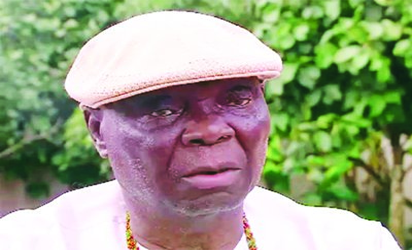
Late Pa Ayomike
“A tree has fallen! A tree has fallen! The young man said to his father. The old man looked and walked in the direction of the fallen tree. This is not just a tree, he said to his son. This is the tree, the tree of all trees. This is the Iroko.” – Anonymous
As one of the many who drank from Pa J. O. S. Ayomike’s fountain of knowledge, his death was shocking and devastating. He was a father, mentor, associate, confidant and leader.

Pa Ayomike
Pa Johnson Oritsegbubemi Sunday Ayomike, simply known as JOS Ayomike who passed on 4th of October, 2017 was born on 7th April, 1927 at Ogidigben in Ugborodo in the present day Warri South West Local Government Area of Delta State. He finished his primary school education at the First Baptist School, Sapele in 1945 and after a brief spell, went to the Government Teachers Training College, Abraka, where he obtained Teachers Grade II Certificate in 1956.
He was a Teacher in the Warri riverine area first as Teacher Oko and later a Village Headmaster; he along with his contemporaries – D. I. A. Popo, Esq (DIAP), Gab. Tsetimi, D. A. Egodo, Esq., J. E. Eyiangho, Esq (RAGA), Victor Otiri, Dr. G. I. Emiko (Ofene) (all deceased) and others had taught in some schools, including Hussey College, Warri.
He later obtained a job as a salesman in the Nigerian Tobacco Company Limited. Mr. Ayomike later went to the University of Nigeria, Nsukka, where he obtained a Bachelor’s Degree in Business Administration with Honours in June, 1966.
He was a Management staff of the Nigerian Tobacco Company Limited from 1966 – 1980 where he rose to Senior Management positions and had experience of, and exposure to, several training courses in Nigeria and Overseas. During this period, upon secondment, he was a Civil Commissioner in Midwest/Bendel State from 1975 – 1979. He served as Commissioner for Health from 1975 – 1976, Commissioner for Agriculture and Natural Resources from 1976 – 1978 and then Commissioner for Information, Culture and Sports from 1978 – 1979.
Honoures/awrads golore
He held numerous honours/awards for his contributions to the development of his Ugborodo Community, Itsekiri, Bendel State (now Edo & Delta States) and Nigeria, which cannot be fully captured in this piece.
When the Warri and Kaduna Refineries were being built and pipelines were laid by Russian contractors to carry crude oil from Gulf Oil Co. (now Chevron Nig. Ltd) Tank Farm at Escravos to the Refineries, a grave incident that put the project in jeopardy occurred. Following a complex dispute over destruction on their fish-ponds, shrines and crops, the communities along the way stopped the project and drove away the contractors for over three (3) months. On the advice of the then Head of State, Gen. Olusegun Obasanjo (1976 – 1979) as Commissioner for Warri, then in Bendel State, he was dispatched by the State Governor to sort out the complex problem. After about two (2) weeks, he resolved the problem and the pipe-laying work resumed.
In 1977, he led the State Delegation to attend the World Fishing Festival in Halifax, Canada in the Fall of that year and was admitted for one day as Honorary Citizen of the city by the then Mayor of Halifax. He was one of the leadership trios for the Itsekiri at the Vanguard of the Peace Efforts on the Warri Crisis; attended all the meetings at Warri, Asaba and Abuja.
The establishment of the Nanna Living History Museum in Koko, commissioned by the then Head of State, Gen. Sanni Abacha in 1996 was through his vision and tireless efforts. This effort is in furtherance of the National Commission for Museums and Monuments on-going national mobilization strategy to encourage communities, private and corporate participation in the preservation of our national heritage. The then Director General, National Commission for Museums and Monuments in recognition of his contributions recommended him for the National Honour.
His Excellency, Late Gen. S. O. Ogbemudia (retd.), a former Governor of the then Bendel State on his visit to the Nanna Living History Museum, Koko on 19th December, 2013, had this to say about J. O. S. Ayomike: “The Itsekiri Nation is an abiding study of how quality can roundly trump quantity. In the long unbroken chain of excellent leadership, right from the epochal exploits of Nanna to the recent Rewane phenomenon and the current robustness of Ayomike and his peers, the Itsekiri Nation has a lot to be proud of.”
A writer of distinction
A writer of distinction, a wordsmith and historian, he has authored eight (8) books in History and Ethnography (available in the National Library, most Embassies in Nigeria and Overseas Libraries, including the Library of Congress in US and the London Library).
The books are:
(a) A History of Warri
(198-page) 1988
(b) The Itsekiri at a
glance
(18-page) 1990
(c) The Ijaw in Warri
(102-page) 1990
(d) Nanna-British
Imperialism at work (58-
page) 1992
(e) Benin and Warri:
Meeting Points in History
(79-page) 1993
(f) Selected Essays – A
Mixed Grill (132-page) 2001
(g) Editor and Major
Contributor – Warri: A
Focus on the Itsekiri (159-
page) 2009
(h) Prince Ogbe
Yonwuren
2015
He wrote several published Essays (over 2 dozen) on Economics, Oil and Politics, Liberty and Democracy and favourable reactions to these publications (Books and Essays) came from several persons and institutions including the Vatican, the Oba of Benin, His Majesty Oba Erediauwa, Arch Bishop (now Cardinal) Anthony Olubunmi Okojie, US Library of Congress, State and University Libraries in Nigeria and several Embassies. In 1981, he was listed in Who’s Who in Africa.
- O. S. Ayomike was a founding member and the immediate past chairman of the Itsekiri Leaders of Thought (ILoT), the foremost socio-political organization formed since 1974 that act as the eye, nose, ear and indeed the heart of the Itsekiri Nation. As member and later Chairman of the body, he participated in stoking the fire of the great body which remains the engine room of affairs in Itsekiri; and earned the reputation thus – if you are not with the Itsekiri Leaders of Thought, you are against Itsekiri. The Itsekiri Leaders of Thought does not compromise on its three (3) cardinal principles – The protection of its People, Land and Crown. This collides with the interest of some Itsekiri political class and their hangers-on. Those who fight the Body did so out of envy not that they can do better. They are like eunuchs in a harem – they know how it is done; they have seen it done every day but they are unable to do it themselves. The Body sets the pace in everything.
At old age before his death, he still had his hands on the plough. He pushed the younger ones to work harder. He abhors laziness.
Pa JOS Ayomike, under the platform of the Itsekiri Leaders of Thought crisscrossed the country in the struggle for true federalism and ethnic self determination for the Itsekiri people. According to him, the fraud of 1914, in the words of Tatalo Alami has configured Nigeria and rigged it against rationality and political modernity, unlike modern Europe and other developing nations. That is why the leadership lottery is structured in such a way that it could only throw up the grossly ill-equipped and manifestly unprepared.
His house in Warri was a beehive – people went there for all problems, seeking advice on anything ranging from political, ethnic, cultural, regional, job recommendations and even mundane issues as marital disputes to sickness and infertility. To them, you are better when you come to his home. He was like the proverbial Iroko tree that provides shelter for all that comes under it. He was not planted in this part of the world by anybody but God, and like the Iroko tree, he lived in this clime because nature wanted it so.
As Chinua Achebe said, “You cannot plant greatness as you plant yam or maize. Whoever plants an Iroko tree – the greatest in the forest? You may collect all the Iroko seeds in the world, open the soil and put them there. It will be in vain. The great tree chooses where to grow and we find it there… so it is with the greatness of men.”
Not a Chief – a title he was twice offered, and twice declined because of his belief in a simple lifestyle. His house was attacked on several occasions. It did not deter him. As Dr. Myles Munroe once said, “True leaders don’t carry medals on their chest…They carry scars on their back.”
In the words of Apostle Paul in 2 Timothy 4:7, fondly quoted by Pa JOS Ayomike, He fought a good fight, he finished the race, and kept the faith. For these, we are grateful to the Almighty God.
The only way our Pa JOS Ayomike can be immortalized is to walk its path. The Itsekiri Leaders of Thought will NEVER, NEVER, NEVER surrender. We promised to keep the flag flying. Adieu
Omineghen-neghen, Ariogun menite, ode ju ma
Chief Edward O. Ekpoko
Chief Edward .O. Ekpoko is the Chairman, Itsekiri Leaders of Thought, Chairman, Ijaw, Isoko & Itsekiri Leaders Forum in Delta State and Chairman, Warri Study Group. He is based in Warri.
Disclaimer
Comments expressed here do not reflect the opinions of Vanguard newspapers or any employee thereof.