By Evelyn Usman
The Special Boat Service, SBS a special operations unit of the Nigerian Navy have concluded a six months training of military personnel on conventional warfare and air assault, with a view to combating security challenges in the country.

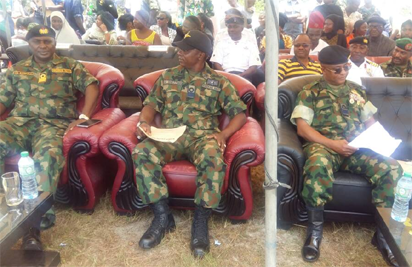
Personnelsatthe training
Seventy- nine personnel, comprising 69 Nigerians and 10 Ghanian naval personnel began the training on March 4, 2017. But only 42 personnel completed the training that was described as rigorous.
Speaking at the graduation ceremony held at the SBS camp, Navy Town, Ojo, Flag Officer Commanding, FOC Naval Training Command , Rear Admiral Obi Ofodile , explained that the purpose for establishing the SBS was mainly because of the security challenges in the Niger Delta region, adding that its services became handy owing to several other security challenges that later sprung up.
He said :“ It is not a secret that Nigeria in recent years has been faced with challenges that presented themselves in different forms. It started with militancy in the Niger Delta region and later Boko Haram in the North East. Now, in the South East , you have the Indigenous Peoples of Biafra. There are also cases of herdsmen causing havoc , as well as kidnapping among other security challenges.
“These challenges normally should have been handled by the Nigeria Police but whenever they are overwhelmed , they would want a stronger force and that is where the SBS comes in”.
But he was quick to clarify that there were no plans to deploy the trained personnel alongside others earlier trained , to the south east , pointing out that the Police was capable of handling the situation there.
He said: “We can’t say for now where the trained SBS will be deployed to. But definitely we won’t deploy them to the South East. They are deployed according to need , to identified areas where special forces are required. The SBS is beyond normal warfare. We deplore them to areas where you have very serious warfare that is beyond conventional warfare, warfare where the demarcation between the enemy and the defence is not defined, that is where you see the Nigerian Navy Special Boat Service. They are well equipped and trained to meet our security challenges.
” It might interest you to know that at the beginning of Boko Haram war in the North East, SBS was handy. Infact no commander could confidently go out without a certain SBS and we are still invoved .”
Commending the trained special force for making it to the end, the FOC however urged them to always live up to expectation , reminding that the authority that spent so much on their training was watching them.
” As we commend you, it is hoped that when you go to the field you will join others who have been there and have been flying the flag in a special way. It is hope that your performances will not be anything short of what we have been witnessing” , he said even as he expressed gratitude to the Chief of the Naval Staff, Vice Admiral Ibok Ibass- Ette for taking special interest in the SBS as well as officers and men.
In his welcome address, the Commander, SBS , Commodore Ibrahim Shetima , explained that the troop was taken through multidimensional training programmes that were designed to develop men of the strongest character that would give all it takes to accomplish an assigned mission.
The training accordng to him, included Induction phase; Tactical Riverine Operation phase which involved boat handling, diving and land warfare phase which included conventional, desert and mountain warfare, as well as assymentric warfare and air assault.
Asked what was the fate of those who backed out , Commodore Shetima replied : “ It is not a compulsory course but a volontary one. It is normal to have up to 200 personnel at the beginning but you can be sure that more than half will leave before the end because of the rigorous nature of the training. Those who graduated today were able to withstand the rigour. Usually we don’t ask them to leave except for disciplinary cases. In most cases they pick up their bags and leave on their own , without our notice. We can’t stop anyone from opting out in this kind of special course training, because at the end, we pick the best. We train our troops to operate in multidimensional at various levels.We train them in a way way that they will be able appreciate the threat level. We don’t operate on the pages of our manual but what the situation demands.”
The trained special force who had a simulation exercise ,were handed certificates which qualified them as $85 insignia and subsequently deployed as 583 operatives.
Highlight of the Basic Operating Course included five weeks of demanding physical activities that included push-ups, sit –ups, chin ups, circuit and log pt. In Basic Swimming and Sea Survival, their performances were measured by daily and weekly 300m timed swim with and without gears, endurance swimming with and without fins, droving proofing which involved swimming with both hands and legs tied , as well as underwater length that in volved covering a distance of 50metres under the water without breathing
The last week of induction phase was the push week/hell week, during which trainees underwent 132 hours of continued physical activities with a cumulative period of six hours sleep. They also , covered a distance of 322 kilometre by foot in addition to 20 hours of physical activities daily.
The next phase after the physical conditioning was the Riverine Operation Phase which lasted for 12 weeks.
Disclaimer
Comments expressed here do not reflect the opinions of Vanguard newspapers or any employee thereof.