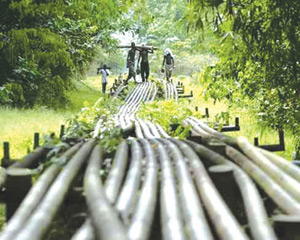
Oil-pipeline
By Simon Ebegbulem
BENIN—THE third phase ex-militant leaders in the Niger Delta from Edo State have petitioned the Federal Government, alleging that N250 million was diverted from their share of the contract money awarded by former President, Dr. Goodluck Jonathan’s administration for the protection of oil pipelines.
They accused one of the ex-militant leaders from the state, Henry Binidodogha, of alleged involvement and urged the Federal Government to investigate the matter.
In a petition by their counsel, Paul Osarenhoe Chambers, they alleged that N250 million was diverted by some of the ex-militant leaders of Ijaw extraction in Edo State.
However, reacting, Binidodogha denied the allegation, saying no such money was paid since the current administration of President Muhammadu Buhari terminated the contract on assumption of office.
How it happened—Binidodogha
Binidodogha said: “The then Coordinator of the Presidential Amnesty Programme, Kingsley Kuku, was the one that actually got the contract through his outfit, Close Body Protection Ltd.
“We were informed that the contract would be split into two parts— one part to the Benin-speaking area, while the other part will be for the youths of Ijaw extraction.
“Unfortunately, we were not privy to the details of the contract as the papers were with Kuku. What Kuku did was to allocate slots for the contract to the ex-militant leaders based on the number of youths under their command and along the lines of the communities in the oil bearing areas.
“Members of the third phase of the amnesty programme complained that the slots they were allotted were inadequate.
“Kuku called a meeting where he appealed to us to give out some of our slots to the third phase members.
“The slots, 4,000 in all, were split into two equal parts between the Ijaw and the Benin groups.
“I abided by Kuku’s instruction by allocating some of the slots to them, but some of them were unable to meet up with the demands of the contract.
“They were actually assigned supervisory roles in the project, but most of them were not serious despite the fact they were receiving their payments.”
Disclaimer
Comments expressed here do not reflect the opinions of Vanguard newspapers or any employee thereof.