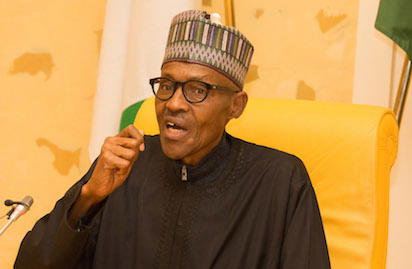
President Muhammadu Buhari
By Chioma Gabriel, Editor, Special Features
AS the All Progressives Congress, APC-led Fedral Government marks its second anniversay in office, Nigerians have, again, begun to ask questions about the administration’s performance in office especially regarding the social welfare intervention programme of President Muhammadu Buhari for which N500 billion was allocated in the 2016 budget.
Since March 28, 2015 when APC won the presidential election after a keen contest in which it defeated the Peoples Democratic Party, PDP, Nigerians had expected that the change promised during the campaign was certainly going to transform Nigeria and the social welfare programme came in handy.
A breakdown of the welfare programme as initially contained in the 2016- 2017 and 2018 Medium Term Expenditure Framework, MTEF, and Fiscal Strategy Paper, PSP, was submitted to the Senate for consideration and approval. The document stated that the Federal Government would collaborate with state governments to institute well-structured social welfare intervention programmes such as school feeding programme initiative and conditional cash transfer to the most vulnerable and post-National Youth Service Corps grant, among others.

Pupils of a primary school having their lunch, provided under the school feeding programme
Under this programme, the government said it provided N300 billion for 2016, N339.05bn for 2017, and N338.93 for 2018. The plan of the Buhari presidency was comprehensive and also took into consideration, some of the factors that led to the failure of past poverty alleviation schemes.
Acting President, Yemi Osinbajo who is presiding over the scheme said the collective wealth will be invested in phased social programmes that will lift majority of Nigerians from poverty. Six core areas included: Teach Nigeria plan in which 500,000 teachers would be hired, trained and deployed in public schools by the Federal Government under the Teach Nigeria segment; the youth empowerment programme in which between 300,000 and 500,000 youths would go through skill acquisition and vocational training; Conditional Cash Transfer programme which promised that N5,000 would be paid monthly to one million extremely poor Nigerians.
One decent and nutritious meal per day
There were also the homegrown school feeding programme that was expected to cater for public and primary school pupils as one decent and nutritious meal per day would be provided for them. Then the micro credit scheme in which the Federal Government promised to give N60bn loan to one million artisans, market women and men as well as the free tertiary education scheme where 100,000 students of science, technology, engineering and mathematics would be given access to free education.
So far, N-Power, which is the job programme for unemployed graduates was said to have received N26.418 billion, being the single largest spending item out of the four social investment programmes under the 2016 Appropriation. No less than 25 million meals have reportedly been served under the National Homegrown School Feeding Programme, SIP.
A breakdown of the total number of meals served indicated that 1,051,619 million primary school pupils are now being fed across the seven states of Anambra, Ebonyi, Enugu, Ogun, Osun, Oyo, and Zamfara. No less than 11,847 cooks were said to have been employed. Altogether 8,587 schools were recorded to be involved in those states.
The regime promised that more meals are expected to be served under the federal government school feeding scheme. The Buhari administration said it has spent N41,714,793,293 across all the 36 States and FCT implementing different aspects of the Social Investment Programmes.
In a statement by the office of the Acting President, under the N-Power job scheme for unemployed graduates said to be running in 36 States and FCT, 162,024 unemployed graduates were said to have effectively enrolled and validated, meaning they have been cleared to be receiving the N30,000 monthly stipends, out of the 200,000 originally engaged late last year.

Muhammadu Buhari
A vast majority of the validated beneficiaries were said to be receiving stipends as at March 31, 2017. An additional number according to the statement has just been added to the list of those receiving their pay in the last several weeks.
N-Power programme
The presidency promised to validate others and ensure that the 200,000 places provided for in the first batch of the N-Power programme are all effectively validated as provided for under the first phase of the programme.
Under the Conditional Cash Transfer, CCT, scheme, 26,942 beneficiaries have been funded as at March with the monthly N5,000 stipend in nine States and 84 Local Government Areas. The States are Borno, Cross River, Niger, Kwara, Ekiti, Kogi, Oyo, Osun and Bauchi. The number is expected to add up to about 400,000 beneficiaries (and in more states) in a couple of months.
The Government Enterprise Empowerment Programme, GEEP, designed for the empowerment of market women, traders, artisans and others, according to the statement, has also recorded progress with the disbursement of 57,234 interest free loans, except a one-time low administrative fee.
GEEP which is designed for more than one million Nigerians has now registered 3,162,451 people who have showed interest and are members of the 26, 924 registered cooperatives for purposes of the loans. Women participation has also been remarkable with 56 per cent of loans so far disbursed to women beneficiaries in 28 states and FCT.
The acting President who recently received the SIP Update Report noted the progress made under each of the programmes, but gave directives that the programmes be promptly expanded in coverage so that more Nigerians can start to benefit.
The ruling party at the centre, the All Progressives Congress (APC) was boastful over what it said was the fulfillment of the party’s promises to Nigerians by the Buhari administration. In a statement, the party said: “The APC views these achievements as historic and unprecedented in the history of Nigeria even as it assures Nigerians that the government is committed and working hard to make significant progress on the economy, and other sectoral areas.”
But what perhaps has left many gasping was that despite these social intervention programmes, more Nigerians have been out of job, poverty is on the increase, many children are out of school because their parents could hardly feed them, let alone pay their tuition even in the perceived free-education scheme. There are more jobless graduates than ever. More workers are being owed salaries. The value of the naira has gone south and the price of food and commodities are on the very high side. Many have gone into the dreaded field of robbery, kidnapping and money rituals while many who could not embrace such evils have taken to suicide as an alternative.
Chief Ayo Adebanjo, a lawyer and Afenifere leader sees the welfare packages as a huge propaganda. “Where are these programmes working? I don’t see these welfare packages working anywhere. I’m from Ogun State and I live in Lagos. I’ve been to Osun and Oyo severally and I don’t see these programmes working. Is it for a select group or states? If its a national programme, it should be seen everywhere. It’s propaganda aimed at capturing more votes. I have not seen it working anywhere. If you have seen, I have not.”
Asked his opinion of the programmes, Alhaji Tanko Yakassai said he is not aware of the existence of such programmes and therefore cannot assess them. “I’m not aware such programmes exist in Nigeria. Where are they happening? I cannot assess what I don’t know about their existence.”
Disclaimer
Comments expressed here do not reflect the opinions of Vanguard newspapers or any employee thereof.