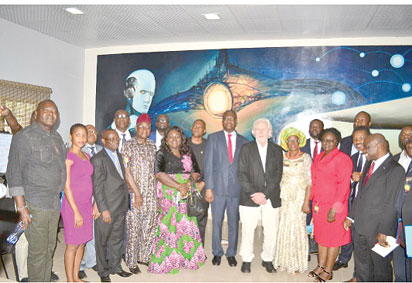
Vice-Chancellor of UNN, Prof Benjamin Ozumba and some guests at the Roar Nigeria Hub, UNN
as students present app that recommends hair style for particular make up
By Emeka Mamah
ENUGU —Google, Facebook, Huawei Technologies, Nigeria Communications Commission, NCC; National Information Technology Agency, NITDA; Computer Warehouse Group, and Exxon Mobil were among global companies which witnessed last Wednesday’s launch of Roar Nigeria Hub, RNH, at the University of Nigeria, Nsukka, UNN.
According to the university, RHN is an ecosystem that supports upcoming entrepreneurs by providing professional support to enable young minds to convert their ideas to marketable products. The innovative science and technology incubator is one of its kind in the West African sub-region and a joint effort between the university and the Benefiting Our Community, BOC, Innovations to promote science and technological break-throughs.

Vice-Chancellor of UNN, Prof Benjamin Ozumba and some guests at the Roar Nigeria Hub, UNN
Technological break-through
The hub started on a good note as three groups of students of the university presented developed apps that could curb wastage of agricultural products; use artificial intelligence to recommend hair styles that fit a particular make-up as well as notify people about happenings around them through their mobile phones respectively. However, built on the concept of triple helix, which is an interaction between the academia, the industry and the government to promote ideas, and marketable innovations among students and researchers, the launching of the hub, promises to promote inventions that would launch Nigeria as a world producer instead of consumer country.
The tone of the event was set by emotional opening prayers by Professor Patience Osadebe, Dean, School of Postgraduate Studies of the university. Osadebe asked God to cast away the spirit of consumerism from Nigerians and grant the citizens the wisdom to be productive. “We are tired of being referred to as food is ready country. God help us cook our own food for others to eat,” Osadebe further prayed.
Her prayer was re-echoed by the Governor of Enugu State, Ifeanyi Ugwuaanyi, who in his address noted that Nigeria would not attain the desired level of development if it continued to rely on technologies produced by other nations. Ugwanyi who was represented on the occasion by the state Commissioner for Science and Technology, Greg Nnaji, said the concept of the hub was in line with the effort of the state government to entrench information technology culture in the society to boost economic development and provide employment for the youths.
“By establishing this facility, the UNN, has once again demonstrated its willingness and capacity to take up the challenge to deliver scientific and technological breakthroughs, which, with the support of the private sector, would impact on the economic fortunes of the nation,”Nnaji said.
The launching was a dream come true for the administration of the vice chancellor of the university, Professor Benjamin Ozumba, who after visiting a science park in Sweden in 2016, vowed to establish same in the UNN. “We want to turn Nigeria around with inventions and innovations and very soon; you will hear about students of UNN making laudable inventions in ICT and other fields of life,” Ozumba said, recalling his first step of ensuring that students of the university are IT compliant when he mandated that every student of the university must own a laptop computer in order to meet the demands of 21st century tertiary education in 2015.
Ozumba said that although the policy attracted mixed reactions leading to the removal of the compulsory clause, he, however believed that the UNN has the capacity to assemble its own laptop. “In the next few months, made in UNN laptops will flood Nigerian market, this is the first mandate of RHN,” he said, adding that the university would also start assembling tractors for agricultural use. Part of the promises of the hub, is to assist young innovators secure funds to set their ideas in motion; provide mentorship to young innovators, and convert innovative ideas into marketable products.
In his speech, the Chairman /Director of Roar Nigeria, Okechi Igwebuike noted that the hub would enable the creation of indigenous solutions, jobs and economic growth within its environment, adding that the initiative which was private sector driven would be taken to other universities across the country.
Meanwhile, three innovative students groups have presented their proposals to the hub. The first group called “AGROMESS” developed an app that would help farmers curb the wastage of agricultural products by identifying parts of the country that have surplus agro products and link them to areas where the products are scarce, while the second group called “Malicha” developed a mobile app that uses artificial intelligence to recommend hairstyle that will fit a particular facial make-up. Also, the third group called “Thrillers” developed an app that can notify people of events happening around them in their mobile phones.
Disclaimer
Comments expressed here do not reflect the opinions of Vanguard newspapers or any employee thereof.