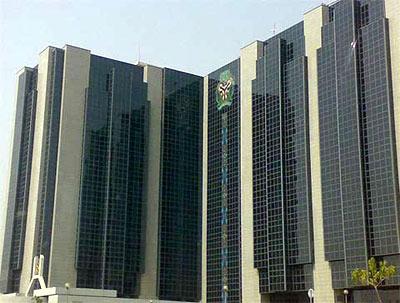
Central Bank of Nigeria headquaters, Abuja
•External reserve drops to $30.3bn, in 1st weekly decline since October •Naira stable at $390 as CBN assures of forex for invisibles•Nigeria Eurobonds appreciate as investors’ interest persist
By Babajide Komolafe
THE Central Bank of Nigeria (CBN) on Friday released the report of its Purchasing Manager Index (PMI) survey for March, which indicated continued decline in economic activities.
The Manufacturing PMI declined for the third consecutive month to 47.7 index points, while the Non-Manufacturing PMI declined for the 15th consecutive month to 47.1 index points.
According to the report, 24 subsectors out of the 34 subsectors surveyed recorded decline in activities in the month of March.
The report stated: “The Manufacturing PMI stood at 47.7 index points in March 2017, indicating declines in the manufacturing sector for the third consecutive month but at a slower rate.
Thirteen of the sixteen sub-sectors reported declines in the review month in the following order: primary metal; transportation equipment; plastics & rubber products; electrical equipment; paper products; printing & related support activities; petroleum & coal products; non-metallic mineral products; furniture & related products; cement; fabricated metal products; computer & electronic products; and chemical & pharmaceutical products.
Non-manufacturing
sub-sectors
The appliances & components; food, beverage & tobacco products; and textile, apparel, leather & footwear sub sectors reported expansion in the review period. “The composite PMI for the non-manufacturing sector declined for the fifteenth consecutive month. The index stood at 47.1 points, indicating a slower decline when compared to the 44.5 points in February 2017.
Of the eighteen non-manufacturing sub-sectors, eleven recorded declines in the following order: construction; professional, scientific, & technical services; real estate, rental & leasing; management of companies; repair, maintenance/washing of motor vehicles; accommodation & food services; wholesale/retail trade; arts, entertainment & recreation; information & communication; utilities; and health care & social assistance. The remaining seven sub-sectors: public administration; educational services; agriculture; water supply, sewage & waste management; electricity, gas, steam & air conditioning supply; transportation & warehousing; and finance & insurance reported growth in the review month”.
External reserve drops to $30.3bn: The nation’s external reserve last week recorded its first weekly decline since October. According to the CBN, the reserves fell from $30.352 billion on Thursday March 23rd to $30.297 billion, indicating decline of $50 million.
Prior to last week, the external reserve had been on the upward trend for 17 consecutive weeks since October 19th. From $23.89 billion on October 19th, the reserve rose by N6.46 billion reaching a peak of $30.352 billion on Monday March 20th, when it recorded its first daily decline.
The decline of the reserve may however not be unconnected to the CBN’s intervention in the foreign exchange market, via regular dollar sales. Vanguard analysis revealed that the apex bank since February 21st has injected $2.55 billion by intervening in the forex market 14 times as follows: Tuesday February 21st, $417 million; Thursday February 23rd, $231 million; Monday February 27th, $180 million; Friday March 3, $350 million; Monday March 6, N367 million; Tuesday March 7, $100 million; Thursday March 9, $170 million; Tuesday March 14, $190 million; Wednesday March 14, $150 million; Thursday March 16, $100 million, Monday March 20, $143 million; Thursday March 23rd, $100 million; Monday March 27, $185 million and Thursday March 30th, $100 million.
Naira stable at $390 as CBN assures of forex for invisibles
The naira closed at N390 against the dollar in the parallel market last week, which was the same for the previous week.
On Monday the CBN reduced official exchange rate for invisibles, like Personal Travel allowance, Business Travel Allowance and school fees to N360 per dollar from N375 per dollar. On Tuesday it also reduced the bureaux de change selling exchange rate to N362 per dollar from N399 per dollar. In response the naira appreciated to N380 per dollar in the parallel market from Monday to Tuesday. The appreciation was however short-lived, due to sudden scarcity of dollar which prompted the parallel market exchange rate to shot back to N390 per dollar.
To address this challenge, the CBN on Friday assured the public of adequate supply of dollars to meet demand for PTA, BTA, school fees, medical and other invisibles. In a statement titled: “There is Adequate Forex for PTA, BTA, Tuition & Medical Fees”, Acting Director, Corporate Communications Department, CBN, Mr. Isaac Okoroafor said: “Information reaching the Central Bank of Nigeria (CBN) reveals that some customers seeking to buy forex for BTA, PTA, medical and school fees are being frustrated by some banks with the false claim that the CBN is not allocating enough forex to them for BTA, PTA, Tuition and Medical fees.
This claim is totally untrue. All banks have more than enough stock of forex in their possession for the purpose of meeting genuine customers’ demand for BTA, PTA, tuition and medical fees. Indeed, on a weekly basis, the CBN has been selling at least $80m to banks for onward sale to their customers for these invisible items.
Nigeria’s Eurobonds appreciate as investors interest persist: Nigeria’s Eurobonds trading on the London Stock Exchange (LSE) appreciated last week due to increased demand spurred by renewed investors’ interest courtesy of the additional $500 million Euro bond issued by the federal government during the week. Consequently, the 10-year, 6.75 per JAN 28, 2021 bond appreciated by $.49 while yield fell to 5.51 percent; the 5-year, 5.13 per cent JUL 12, 2018 bond appreciated by $0.16 while yield fell to 3.87 per cent; and the 10-year, 6.38 per cent JUL 12, 2023 bond appreciated by $0.56 while yield fell to 6.11 per cent.
In the domestic Over-The-Counter (OTC) segment, Elsewhere, FGN bonds prices decreased across most of the maturities. The 20-year, 10.00 per FGN July 2030 debt, the 10-year and 16.39 per cent FGN JAN 2022 debt depreciated by N0.23 and N0.09 respectively; their corresponding yields rose to 15.79 per cent (from 15.73 percent) and 15.90 per cent (from 15.87 per cent) respectively. However, the 5-year, 15.10 per cent FGN APR 2017 debt appreciated by N0.13; its corresponding yield fell to 12.21 per cent (from 13.99 per cent).
NB, UPDC quote N10bn commercial papers on FMDQ
FMDQ OTC Securities Exchange Plc last week announced the quotation of Commercial Papers, CP, worth N10 billion by Nigerian Breweries Plc and UACN Property Development Company Plc on its platform.
Members of the public seeking to buy forex for the above-mentioned purposes are, therefore, advised to go to their banks and obtain their forex. Any customer who is not attended to within 24 hours for BTA/PTA or 48 hours for tuition and medical fees should call 07002255226 or send an email to [email protected], with the name and branch of the non-cooperating bank. Furthermore, no customer should accept to buy forex from any bank at more than the currently prescribed rate of N360/$1.”
Specifically, UACN Property Development Company Plc quoted N7.28 billion Series 4-11 Commercial Papers Notes under its N24 billion CP programmes.
The NB, on the other hand, quoted N2.22 billion Series 10 CP Notes under its N100 billion CP programme. The quotation of both commercial papers, according to FMDQ in a statement, has brought count of CPs admitted on its platform to 15 in the first quarter of the year.
FMDQ said that it championed the resuscitation of the CP market to provide corporate and commercial businesses the opportunity to meet their short-term funding requirements, while building their profiles in the Nigerian debt capital market space in support of the economy.
“As with securities quoted on FMDQ, these CPs will be availed global visibility and governance by the promotion of credibility and transparency of information, as part of the value-add provided by the FMDQ Listings and Quotations service.
“FMDQ remains positive about the possibilities of the Nigerian debt capital market and will continue to articulate, with the support of its key stakeholders, ways to improve and make the Nigerian markets
globally competitive, operationally excellent, liquid and diverse, in line with its mission to empower the financial markets to be innovative and credible,” the OTC Exchange said.
Disclaimer
Comments expressed here do not reflect the opinions of Vanguard newspapers or any employee thereof.