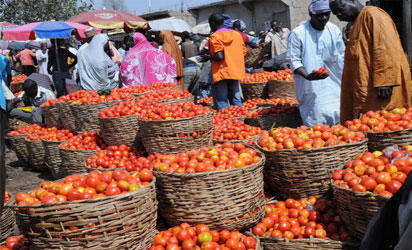
File: Tomato sellers at Mile 12 market
Emma Ujah, Abuja Bureau Chief, Chris Ochayi & Grace Udofia
The Federal government yesterday released its Economic Recovery and Growth Plan (ERGP) with a view to restoring macroeconomic stability and unleashing various sectors towards achieving the nation’s full economic potentials.
The ERGP’s core vision of the plan is sustained inclusive growth through structural economic transformation with emphasis on improving both public and private sector efficiency in order to increase national productivity and achieve sustainable diversification of production.
According to the document released yesterday by the Minister of Budget and national Planning, Sen. Udoma Udo Udoma, “The Plan envisages that by 2020, Nigeria would have made significant progress towards achieving structural economic change with a more diversified and inclusive economy. Overall, the Plan is expected to deliver on 5 key broad outcomes, namely: a stable macroeconomic environment, agricultural transformation and food security, sufficiency in energy (power and petroleum products), improved transportation infrastructure and industrialization focusing on small and medium scale enterprise.”
Agric
In the agriculture sector, the federal government agric policy objectives: Increase agriculture GDP from N16.0 trillion in 2015 to N21.0 trillion in 2020 at an average annual growth rate of 6.92 per cent (2017-2020).
The federal government also plans to “Significantly reduce food imports and become a net exporter of key agricultural products, e.g., rice, tomatoes, vegetable oil, cashew nuts, groundnuts, cassava, poultry, fish, livestock” and become self-sufficient in tomato paste (by 2017), rice (by 2018), and wheat (by 2019/2020).
Manufacturing
Manufacturing accounted for 9.5 per cent of Nigeria’s GDP in 2015. In 2010-2015 period, the sector grew at an average annual growth rate of 13.3 per cent, almost three times the 4.8 per cent growth experienced by GDP.
The ERGP seeks to improve this performance and double manufacturing’s share of GDP, largely by developing Special Economic Zones (SEZs) to attract manufacturing away from economies where the labour cost advantage is declining and re-energize local industries that have suffered as a result of, e.g., the influx and dumping of goods in Nigeria.
The ERGP will build on the Nigeria Industrial Revolution Plan (NIRP), a key pillar of the country’s industrial policy focusing on agro-business, solid minerals and metals, oil and gas; as well as, construction, light manufacturing services.
Solid minerals
Solid minerals is one of Nigeria’s most promising growth sectors. Although its overall contribution to GDP growth is small, its contribution to GDP doubled from N52 billion in 2010 to N103 billion in 2015.
Nigeria has 44 known types of minerals of varying mixes and proven quantities, some of which are concentrated in certain regions.
Consequently, the administration has planned to grow solid minerals GDP from N103 billion (2015) to N141 billion (2020) at an average annual growth rate of 8.54 per cent (2017-2020).
It also wants to facilitate the production of coal to fire power plants and integrate artisanal miners into the formal sector.
It also plans to produce geological maps of the entire country by 2020 (on a scale of 1:100,000) and encourage and promote mineral processing and value addition industries that strengthen backward and forward linkage
More details soon
Disclaimer
Comments expressed here do not reflect the opinions of Vanguard newspapers or any employee thereof.