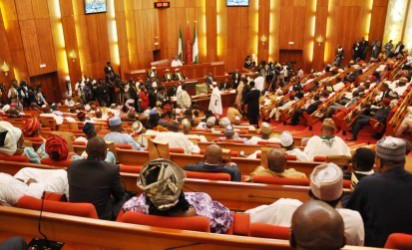
SENATE CHAMBER
By Henry Umoru
ABUJA—The Medium Term Expenditure Framework, MTEF, and Fiscal Strategy Paper, FSP, of the Federal Government was, yesterday, approved by the Senate with a significant mark up in the oil price benchmark to $44.5 per barrel, up 4.0 per cent from $42.5 per cent contained in the original document submitted by the Presidency.
The immediate implication is a significant uptick in the 2017 budgetary figures for oil revenue to over N2 trillion.
President Muhammadu Buhari had presented the 2017 Appropriation Bill (budget) to the National Assembly on December 14, 2016, which showed estimated oil revenue at N1.99 trillion on oil price benchmark of $42.5/bbl. Before the Appropriation Bill, he had also presented the MTEF with the same oil price benchmark.

President Muhammadu Buhari (M) presents the 2017 National Budget to a joint session of the National Assembly at the National Assembly Complex in Abuja on Wednesday.(File)
The MTEF and FSP covers 2017-2019, and the 2017 fiscal plan is derived from these documents.
The Senate in the passage of the document, however, retained the N305/US dollar exchange rate as proposed by the executive for the 2017 budget, but with a caveat that the Central Bank of Nigeria, CBN, should, as a matter of urgency, initiate measures that will close the gap between the parallel market and the official exchange rate.
While approving the exchange rate benchmark, the Senate had expressed reservations at the wide gap between the parallel market exchange rate which stood at N490/ $1, yesterday, as against the official rate of N305/$1.
In approving both the domestic and foreign borrowing, the Senate insisted that they should be on project-tied basis and that in borrowing more, government must remain focused and ensure it was used to fund critical projects that will increase productivity and also contribute to financing such debt.
Additional borrowing of N2.3trn
Before the approval of the additional borrowing of N2.321 trillion as it relates to 217 budget deficit funding, the Senate stated: “Globally acceptable ratio of debt to GDP is 56 percent. Nigeria still operates within its country specific ratio of 19.39 percent of debt to GDP. This implies that Nigeria can still potentially borrow or increase its country borrowing limit.
“Total outstanding external debt stock is at $11.26 billion, thus Nigeria’s external debt has been rising at an average of 9.2 percent per annum. In the case of domestic debt, the total domestic debt stock of the Federal Government is $37.44 billion. In 2017, the Federal Government is projecting an additional borrowing of N2.321 trillion, comprising N1.253 trillion (domestic) and 841.067 trillion (foreign).”
Review of legal framework of MDAs
The upper chamber, which also approved the N807.57 billion for Federal Government independent revenue for 2017, however, further recommended the review of the legal framework of relevant Ministries, Departments and Agencies, MDAs, and government-owned enterprises, to ensure that agencies pay operating surplus and remit appropriately their gross revenues into the Consolidated Revenue Fund, CRF.
They added that the step might also include repealing of existing acts of some agencies which currently allows them to utilize their revenues outside the CRF.
The Senate also approved the projected N5.122 trillion for non- oil revenue in 2017, even as it advised that revenue generating agencies should intensify their revenue collection drive in order to boost the non- oil components of the revenue.
Why oil benchmark price was increased
Justifying the Senate’s increase of oil benchmark price to $44.5 per barrel, Chairman, Senate Committee on Finance, Mr John Enoh (PDP, Cross River Central) said: “The price of crude oil in the international market fell to as low as about $25 per barrel in mid-January 2016 with an increase to more than $50 per barrel since October 2016.
“Against this backdrop, the international oil industry watchers forecast oil prices heading slowly towards an average of over $60 per barrel in the near term.”
On the exchange rate, the committee said: “The 2017-2019 MTEF and FSP projects an exchange rate of N305 per dollar for the period of 2017 fiscal year.”
Notwithstanding, a judicious monetary fiscal policy mix and deliberate government policies to expand the productive base of the economy would be expedient to improve the exchange value of the Naira relative to the dollar.”
The Senate also approved the Federal Government projected oil production volume at 2,200,000 million barrels per day as proposed by the Executive for the 2017 Budget.
Disclaimer
Comments expressed here do not reflect the opinions of Vanguard newspapers or any employee thereof.