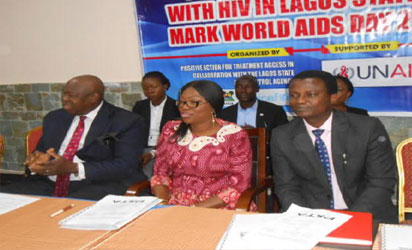
WORLD AIDS DAY FORUM: From left: Special Adviser to the Lagos State Governor on Primary Healthcare, Dr. Olufemi Onanuga; Wife of the Lagos State Governor, Mrs Bolanle Ambode and CEO, Lagos State Agency for the Control of AIDS, LSACA, Dr Oluseyi Temowo during the stakeholders’ Forum on Adolescents Living with HIV in Lagos State to mark the 2016 World AIDS Day last week.
By Chioma Obinna
It was an afternoon of tears and testimonies in Lagos last week as adolescents and minors living with HIV, narrated their experiences. The occasion was the Stakeholders’ Forum on Adolescents Living with HIV in Lagos State to mark the 2016 World AIDS Day by Positive Action for Treatment Access, PATA, and Lagos State AIDS Control Agency, LSACA with support from UNAIDS.

WORLD AIDS DAY FORUM: From left: Special Adviser to the Lagos State Governor on Primary Healthcare, Dr. Olufemi Onanuga; Wife of the Lagos State Governor, Mrs Bolanle Ambode and CEO, Lagos State Agency for the Control of AIDS, LSACA, Dr Oluseyi Temowo during the stakeholders’ Forum on Adolescents Living with HIV in Lagos State to mark the 2016 World AIDS Day last week.
It was on a day, PATA shared its 11 years experience of working with this group of Nigerians as part of efforts aimed at reducing their financial and emotional burden.
Several of the adolescents betrayed emotions as the spoke. Everyone including guests on the high table was moved to tears. Wife of the Lagos State Governor, Mrs Bolanle Ambode, embraced the children and pledged her support and assistance.
They narrated how they suffered stigma and discrimination even in government-owned schools. Their stories broke emotional barriers.
For 13-year-old, a student in an unnamed public school in Lagos State, she is not sitting for the terminal examinations because she has been sent out of the school by the Principal.
It is a day she is still hoping to forget. Struggling with tears, Bola could only mutter: “I was sent out of school because I tested positive to HIV.” One of her counsellors then took over the narration.
Good Health Weekly gathered that Bola’s case is one of many cases of discrimination against People Living With HIV.
Stigma and discrimination
Mary had a similar experience of the low acceptance of people living with HIV in society. In the Home where she resided, as soon as her HIV status was revealed, she was isolated in her own Home and within her family. She was kept in a room away from other children. Nobody spoke to her or associated with her.
“Finding myself in the Home was not easy for me. Before I went to the Home, I already knew my HIV status but my mother always told me there was nothing like HIV. She would even say ‘you that is getting fat everyday how can you be HIV positive?
“But when I got to the Home, I was asked to go for medical check up and I was tested for HIV. It came out positive. After a while I was placed on medication and I was taking my drugs.
“I was the only one that was HIV positive so I was isolated and given a room. No one spoke to me. No one touched what belonged to me. No one wanted to share clothes or shoes with me.”
Living in isolation: Mary was already getting used to living in isolation when she was transferred to another Home, and fortunately, her transfer to Mary’s Home for Adolescent Girls that caters for the psychosocial needs of vulnerable and indigent adolescent girls with HIV became a blessing in disguise.
Unlike the experiences at the former Home, life at Mary’s Home was different.
“I was welcomed like a princess. I saw other girls living with HIV. Everything changed for me. I was no longer isolated and discriminated against. Even when I tried to display self stigma and discrimination by isolating myself, I was stopped by the borders and the other girls.”
Mary appealed to the Wife of the Lagos State Governor and the State government to come to the aid of the Home.
“We need help to make the place comfortable for all the children living with HIV under the bridges and at the bus stops who think their lives are over. Help us make the Home for all. Please help us financially and in any other way you can,” she added.
Earlier in his presentation, entitled: “Addressing the Socio-developmental, Sexual and Reproductive Health Needs of Adolescents Living with HIV in Nigeria – The PATA Experience”, Programme Manager, PATA, Mr Francis Umoh who noted that it is common knowledge that HIV infections is increasing among adolescent in Nigeria lamented that pre-admission HIV test and other forms of discrimination are still being carried out against adolescents and young people seeking admission into learning institutions.
“This is also observed in orphanages/homes as they do not admit adolescents living with HIV.” He said the 2014 UNICEF report showed that an estimated 196,000 Nigerian adolescents were living with HIV while 11,000 died of AIDS related cases in 2013 out of estimated adolescent population of 38,882,000.
Umoh who expressed worry that many Nigerian adolescents do not know their HIV status disclosed that in a national survey conducted by PATA on sexual and reproductive health needs of adolescents living with HIV in 2013, as high as 80.5 per cent do not know their status.
He regretted that adolescents are yet to understand HIV transmission and prevention as well as issues of sexuality despite early sexual debut.
Peer Mentors and Advocates: He said to address the issues, PATA has established a Home that cares for adolescents with HIV, instituted peer mentors and treatment educators, while over 725 adolescents in three treatment sites in Lagos have received peer treatment adherence counselling and support services among others.
He also informed the gathering that in recognition of PATA’s efforts to mitigate impact of HIV and AIDS among adolescents, the organisation was among the 10 organisations globally awarded the 2016 Red Ribbon Award by the Joint United Nations Programme on AIDS (UNAIDS) for outstanding example.
Also speaking, the Representative of UNAIDS, Dr. Asa Olubunmi said kicking out HIV is every one’s business.
“HIV is no longer a death sentence but a life sentence because many of these children got infected through their parents. It is possible to break the transmission and once that is done everyone will be safe.
Halting HIV
“It is possible to halt HIV. We can stop the transmission, we have the drugs. If you know your status, take your drugs, the virus in you will be suppressed and become difficult to transmit to another person. Once we block that transmission every other person is safe.
“Countries like Cuba and Rwanda have done it. If we can kick out Ebola we can do it. As we look ahead, we must remember that we cannot afford to be complacent, the scourge is not over. Fundamental political, financial and implementation challenges still remain but we should not stop. This is the time to move forward together to ensure that all children start their lives free from HIV. That young people and adult grow up and stay free from HIV. That treatment becomes accessible to them.”
On her part, Mrs. Ambode said prevention efforts must be doubled, if the world is to stay on on -track to ending the pandemic.
Ambode appealed to policy makers for intervention programmes targeted at adolescents living with HIV/ AIDS because of their strategic age bracket.
Disclaimer
Comments expressed here do not reflect the opinions of Vanguard newspapers or any employee thereof.