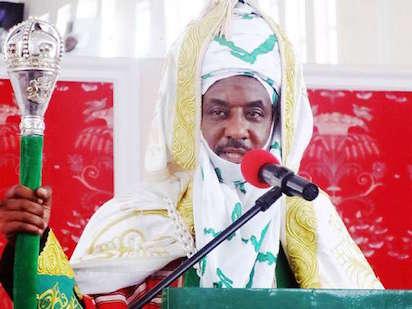
Emir of Kano, Muhammadu Sanusi II
By Chris Ochayi
ABUJA: The Emir of Kano, Sanusi Lamido Sanusi, Friday, cautioned President Mohammadu Buhari against taking the $30 billion foreign loan proposed by the administration, saying there was no guarantee the loan would be repaid in the remaining two years in the life of the administration.
He also cautioned that ‘continuous dependence on China as good ally, adding that imports from China have scrapped the nation’s local industry.
Sanusi, who spoke at a one-day dialogue forum organised by the Savannah Centre for Diplomacy, Democracy & Development (SCDDD) supported by Ford Foundation, in Abuja, advised the government to be focus and make more investment in the economy instead of seeking for foreign loan.
The Emir, who however said he was not totally against the government’s asking for foreign loan, suggested instead that, “If we can get it at concessionary it is good,” adding, “But if you want to get the money, the government should look elsewhere.”
Sanusi who said “Let me make this issue clear, I will be happy if they get the loan to invest in the power sector, energy and road,” however, expressed concerned that, if the government would pay back the $30 billion in two years even though they cannot raise $2 billion after two years in office.

Emir of Kano, Muhammadu Sanusi II
According to him, “If we cannot raise $2 billon in two years and you want to borrow $30 billion in two years to the end of the life of the administration. The government should rather pay more attention to investment and support the private sectors to grow the economy”.
He said that apart from paying back, a situation where the administration was operating five different exchange rates would make it impossible for the administration to access any foreign.
“The economy that has five exchange rates can’t borrow $30 billion. They can’t lend you the $30 billion when you have five foreign exchange rates and with the current bombing of oil pipelines by the Niger Delta militants. So, on which foreign exchange rate can you get the loan?”
He said the nation’s foreign exchange lacks credibility, thus federal government needed to embrace private sector investments as means to grow the economy out of recession.
Sanusi emphasised that oil cannot help the nation out of the current economic situation and it would “never make Nigeria rich.”
He noted that the country’s population continued to grow to over 40 million people since 2015, yet government found it hard to increase capital expenditure.
He warned on continuous dependence on China as good ally, adding that imports from China have scrapped the nation’s local industry. “We trust China too much. We need to be very careful. They are killing our textile and other industries and yet selling to us.”
However, he urged the federal government to reduce its debt service through greater loan concessionary.
He said the country in the past 15 years have been borrowing money to pay salaries, fuel subsidy and there are possibilities for the nation to keep borrowing in the next 15 years, as those borrowed were not channelled into health, power or infrastructural development.
Sanusi said the June 2016 forex reform should be implemented to unite the market through single transparent rate rather than creating four new rates.
On the problems with the current policy agenda, Emir Sanusi who asked why must Nigeria be Africa’s laggard rather than its leader?, said, “No one can deny that the Buhari Administration inherited serious problems. But are its current policies the right ones to fix these problems?
“If we accept the conclusion of the first part of the presentation, namely that: The government balance sheet is stretched; and investment is the key to growth…why has the Federal Government pinned its hope of a recovery on a strategy of massive fiscal expansion and an FX policy that deters investment?
“Federal Government spending accounts for just 5.7% of GDP, and one quarter of this is for debt service alone. The role of government spending in the broader economy is minor.
“This is particularly true of public capex: while the economy has quadrupled in nominal terms since 2005, and the population has grown by over 40 million, capex has barely changed.
“There is much talk about raising non-oil revenues, but the tough measures (like tax increases) are not being taken.The best ever out-turn for non-oil revenues was N779bn in 2014. This would be enough to fund 13% of the 2016 budget.
“Even if the government managed to increase revenue significantly, it would still need re-prioritise spending towards capex.
“Across all 3 levels of government, Nigeria collected just US$117 per capita in 2015, and invested US$17. Kenya, with half of Nigeria’s level of wealth on paper, collected almost twice as much in taxes and invested over 7x as much.
If Nigeria is going to adopt an investment-driven model, it cannot rely on the public sector alone.
“Nigeria introduced bold FX reforms in the summer of 2016, and then completely failed to implement them. The gap between design and implementation has ruined credibility. After announcing a (managed) flotation of the naira in June, the CBN instead implemented a hard peg (at a lower level).
“The FX market is now split into 4 different segments: the CBN rate (N305/US$), FMDQ (N315/US$, but not printed since 28 Nov), NIFEX (N315/US$) and the black market rate (N480/US$).
“The black market rate is the only segment with any real price discovery, and hence perceptions of “fair value” are high-jacked by where this market trades
“Fair value” of the naira is not the issue. The current crisis of confidence in NGN/US$ comes from a lack of transparency and functionality.
“On a trade and inflation weighted basis, the naira has gone from one of the most over-valued currencies in the world to one that is now under valued.This suggest that Nigeria is comparatively cheap – and indeed much cheaper than many countries with a long history of attracting capital from abroad
On the deepening macro risks, which he described as Nigeria’s wasted opportunity, Sanusi said, “Nigeria’s approach to managing its economic crisis is severely misguided: Fiscal policy is given all the attention but its potential impact is small FX policy is closed subject, yet it holds the (only) key to growth To understand the missed opportunity this represents, consider the example of Kenya:
“ It has concessional debt equal to 38% of GDP (vs 2% in Nigeria) and has attracted investment inflows from abroad of 8-10% of GDP (vs 1-3% in Nigeria) over the past several years
“Scaled to Nigerian proportions, this would represent annual investment inflows of nearly US$40bn and an external debt carrying capacity of over US$150bn
“The reality is that in H1 2016, Nigeria has managed to raise just US$543mn in external concessional debt, and has received total investment inflows of US$663mn
“If Kenya – an economy 15% our size, with an exchange rate trading more than 40% above its fair value – can raise more in concessional funding and inflows than us (in absolute terms), can we honestly say that our policies are working?”
Disclaimer
Comments expressed here do not reflect the opinions of Vanguard newspapers or any employee thereof.