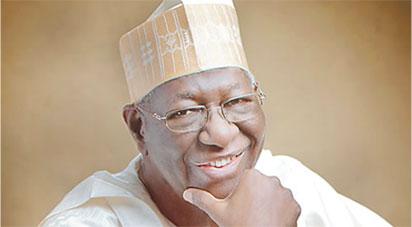
Late Chief Anthony Akhakon Anenih
By Christian Omoregie
Last weekend, Chief Tony Anenih, former Chairman of the Board of Trustees of the Peoples Democratic Party (PDP), formally bowed out of “active partisan politics”, after decades of towering political presence in the country. The High Chief of Esan Land used the occasion of the public presentation of his autobiography, “My Life and Nigerian politics”, to make the announcement to an audience that, perhaps, was not yet ready for political voyage without Anenih, who has been a mentor figure.

File: Chief Anthony Akhakon Anenih
As a matter of fact, no less a person than the former President, Dr. Goodluck Ebele Jonathan, protested Anenih’s decision to quit active politics by imploring the elder statesman to reconsider his decision. Jonathan was of the view that Anenih, as a result of age, might not always be available as before, especially during the midnight meetings and other party engagements, but that he should leave his doors open to all, particularly PDP members, for consultations. By the way, Jonathan was not the only person feeling this way! Many others present at the occasion felt the same.
At 83, Anenih deserves to be left alone to use the remainder of the years left for him on this earth to stay close to his creator and his family members who, undoubtedly, have missed his warmth due to the many years of his devotion to politics. Clearly, there is only one explanation for wanting to drag Anenih back to politics. And this has to do with his irreplaceable sagacity and stoical calculations in political strategizing.
As Professor Epiphany Azinge, who reviewed the autobiography, rightly asserted, “like Anenih or hate him, you can’t ignore” the old man. How can you ignore a man who, in the Second Republic, chaired a relatively unpopular National Party of Nigeria (NPN) in the old Bendel and transformed it into a mass party, with which he defeated a very popular Governor like Professor Ambrose Alli?
Who can ignore the man who was largely instrumental to building what, perhaps, could pass as Nigeria’s first real national party, the Social Democratic Party (SDP)? Who can deny Anenih’s deft strategy in taking his friend, an inexperienced politician, by the hand and selling him all across Nigeria as the SDP presidential flag bearer until General Ibrahim Babangida whimsically banned General Shehu Musa Yar’ Adua and his ilk?
In the current Republic, Tony Anenih’s style of noiseless but strategic politicking has not only left him achieving so much, but has also rewarded him with a staying power which no other politician of his era can boast of. Anenih helped to build the PDP into, not just an election-winning machine, but more importantly the most widely accepted political party in the history of Nigerian politics.
He has served as a Minister of the Federal Republic, the Acting Chairman and substantive Chairman of the BoT of the PDP. More importantly, Anenih’s advice, skills, sagacity, and reputation as a bridge builder across the length and breadth of the country, have come very handy to the PDP and the leadership when the party was faced with seemingly intractable problems.
As Anenih’s book reveals, the over-ambitious expectations of the former Vice President, Alhaji Atiku Abubakar, and his plot to unseat his principal, Olusegun Obasanjo, together with the fissures it created for national stability and the electoral fortunes of the PDP in the 2003 presidential election, were just some of the situations Chief Anenih was called upon, as the “fixer”, to fix.
Although those who choose to see Anenih in other light refer to him as “Mr. Fix it”, the old man says he would rather be seen as an achiever. And who can claim to have achieved more than Anenih in this country, politically, without contesting for an elective position? In about four decades, Tony Anenih, through the support of the people, produced Dr Samuel Osaigbovo Ogbemudia (the old Bendel State), Chief John Odigie-Oyegun, Chief Lucky Igbinedion and Professor Oserheimen Osunbor as Governor in his native Edo; he has also recommended many across the country for ministerial and other appointments.
Similarly, many senators, members of the Houses of Assembly and representatives since 1999 have been groomed and helped by the grand old man of Nigerian politics. In short, Anenih remains the greatest mentor for younger people finding their way around Nigerian politics and government.
And what has kept Anenih this long and successful in his career is the fact that he has built his politics around people. It is his belief that to succeed you need people around you and that explains why his home whether in his native Uromi or in Abuja is always a beehive of activities with different groups waiting to consult him. And in doing this, the man has seen different shades of loyalty and disloyalty, support and betrayal. Yet, in all, he has always come out stronger because he readily forgives and brings back acolytes who have wandered far away from him.
Anenih is one of the few Nigerian politicians who see politics as an ennobling activity. In a season where politicians cut the image of fraudsters, untrustworthy and selfish people, Anenih has put his resources and time to the service of the Nigerian people without making any noise. Although many Nigerians know him more as a leading politician, how many are aware that his generosity and philanthropy are providing free health services for many of our senior citizens and the aged in our land?
At the University College Hospital Ibadan, the Tony Anenih Geriatric Centre which takes care of the health challenges of the old, almost for free of charge, is the first of its kind in the whole of Africa. Besides, as a businessman and farmer, Anenih is providing employment for many and giving them an honest means of livelihood.
The quality of the crowd at the presentation of Chief Anenih’s book, especially now that his party is out of power, testifies to his appreciated worth and the legacies he is leaving behind. The content of the book should provide for thought for the general public, especially those who are politically inclined. They could glean some of his legacies (in politics, business and philanthropy) from the narrative.
Mr Omoregie, a freelance journalist, attended the book launch and contributed this piece from Abuja.
Disclaimer
Comments expressed here do not reflect the opinions of Vanguard newspapers or any employee thereof.