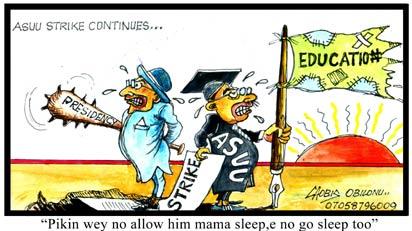
It is sad to hear that the Academic Staff Union of Universities (ASUU) is going ahead with itswarning strike, even though it is the students mostlyand not the government who take the fall.
ASUU had earlier announced a 7-day warning strike beginning from Wednesday, November 16 2016, pressing home its demand for more funding and exemption from the Treasury Single Account (TSA) policy. While I can appreciate the frustration of the lecturers over government neglect, inadequate funding and the rundown state of university infrastructure, I don’t feelthe TSA is to blame for all the challenges experienced in the university system. Long before the TSA policy, government had been breaching its agreement with the lecturers, most recently in 2009 and 2013. So the relatively fresh TSA cannot be the reason universities are in bad shape and unable to meet up with their financial obligations.
But more importantly, I think the public needs to know what the TSA really is, so they don’t go about blaming the policy for every problem under the sun, including their inability to get certificates on letterhead papers, which I saw on the social media recently.
What is TSA?
Simply put, the TSA is an account where all the taxes, levies and tariffs we pay to the government are lodged. The government adopted this policy because in the recent past,it often experienced financial problems and its ministries could not account for themonies they collected. Surprisingly, these ministries opened as many as 17,000 different bank accounts, sometimes under the name of the government.
For years, these funds were dormant in commercial banks and yielding interest,which many public officeholders diverted into their pockets. Meantime, the government was cash-strapped, often had to borrow from thesefunds and repay the commercial banks at high interest rates. Obviously, that situation had to change. Former President Goodluck Jonathan initiated the TSA and President Muhammadu Buhari fully implemented the policy on September 15, last year.
You wouldhave to judge for yourself if such a policy that creates transparency in our public sector is right or wrong. But you can be sure that section 80 (I) of the 1999 constitution specifies that this is how government monies should be collected. More importantly, the TSA has returned over N4.3 trillion to government coffers since it was adopted.
How does it work?
So how does the TSA work? Let’s say you are a student. Normally, you go to a designated bank to pay your school fee. After close of work, that commercial bank sums up all the monies received from other students including yourself for that day, and transfers to the TSA which is managed by the CBN. Subsequently, that commercial bank gets a commission for its services, and the government gets its money.
That is how the process works across all government agencies. They collect levies and pay into commercial banks for onward transfer to the TSA.To be more specific, the TSA is not an organisation or a group of persons. It is only an account where funds belonging to the government are paid.
Where am I going with this? If the process of getting money from that account to pay lecturers is tough, it has nothing to do with the policy, but everything to do with government procedure. I’m sure lecturers are already familiar with this process, because they operate a very bureaucratic system when dealing with students as well.
Some of them have been known to keep students in the university system for years over one flimsy excuse or the other. If the problem is not misplaced examination scripts, it is unsupervised final-year projects, and other times simply because the students refuse to ‘settle’.
Way forward
As far as I am concerned, some of the universities are aggrieved because the TSA has killed their cash cow. They are no longer at liberty to divert project allocations into private pockets under the guise of research projects and international fellowships that offer no direct benefits to students or the system, so they want to be excluded.
The TSA is ONLY a collection point, and has nothing whatsoever to do with promotions and shortage of letterhead paper meant for university certificates. If it has anything to do with pay cuts, I’m sure it is because of the number of ghost workers (40,000) discovered in the public sector since the policy was implemented. Ghosts obviously do not deserve payment like the rest of us mortals.
While a case can be made for more university autonomy and government adherence to the terms of agreements reached with ASUU, I can’t see another strike action as a way out of the problem – certainly not with the TSA as the driving force.
Otega Blessing wrote in from Delta State
Disclaimer
Comments expressed here do not reflect the opinions of Vanguard newspapers or any employee thereof.