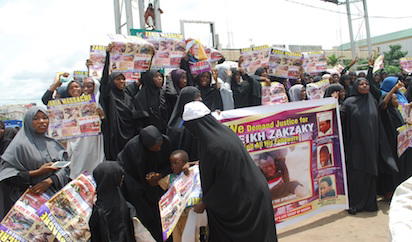
Members of Islamic Movement in Nigeria [SHIITE] in a 24-hour occupy Kaduna demanding the release of their leader, Sheikh Ibrahim Yaqub Zakyzaky in Kaduna on Friday. PHOTOS:OLU AJAYI
THE increasing clashes between the Islamic Movement of Nigeria (IMN or the Shi’ites) and other Muslim groups in the North is threatening to replace the Boko Haram terrorism which is gradually winding down, raising the possibility that the nation might simply slide from one religious conflict to another with no respite in-between.
Since the bloody clashes involving the Shi’ites and the army last year, which left scores of people dead, the month of October has been the bloodiest this year.
In Kano, Kaduna and Katsina, the Shi’ites had engaged other Muslims in one deadly combats after another over the detention without trial of their leader Sheikh Ibrahim El-Zakzaky. This was how Boko Haram started and was terribly mismanaged at great cost to the nation.
Just as with the Boko Haram insurgency, the Shi’ites have a doctrine and a leader they are fanatically committed to. Their doctrine, though strange to the rest of us, including other Muslims, drives their activities.
A significant percentage of the members embrace martyrdom and are ready to sacrifice their lives for the cause, including the deployment of suicide bombers.
Indeed, they hold their creed above allegiance to the country and are prepared to impose their doctrine on other Nigerians.
The two sects – Boko Haram and Shi’ites – enjoy a lot of international and domestic sponsorship. To that extent, they are ready proxies for imported conflicts.
The Shi’ites receive open support from Iran which is the fountainhead of the sect.
They take instructions from the Ayatollahs of Iran and have scant regard for Nigerian laws and constitution.
They only invoke the Nigerian constitution to lay claim to religious freedom which they would readily deny others if given the chance.
Affiliation with Iran provides them with almost unlimited funds and, if needed, arms to pursue the conflict. Iran sponsors the Shi’ites while the Sunni Muslims, line up behind Saudi Arabia. Obviously, if the Shi’ite conflict develops from low-intensity confrontation to a full blown war, Nigerian Muslims would be fighting a well-funded proxy war between Saudi Arabia and Iran. That could be more dangerous than the Boko Haram war.
Handling the Shi’ite challenge calls for great patience, wisdom and diplomacy by state and federal governments, rather than impulsive and strong-arm tactics.
The law enforcement agencies must watch religious groups, ensure they practice within the laws of the land and act with dispatch when they overstep their bounds, but they must also be treated with fairness and justice within our laws.
Nigeria must keep off the religious rivalries of Middle Eastern Muslim powers. We must recommit to our constitution’s demand of our non-alignment to foreign powers in matters of religion or political ideology.
Disclaimer
Comments expressed here do not reflect the opinions of Vanguard newspapers or any employee thereof.