By Sonny Atumah
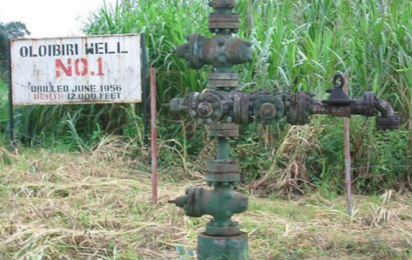
Oloibiri Well No 1. It is the display board on the first oil rig in Nigeria. The visible advertised signal of the first Oil Well relic appeared like the ‘first atomic bomb on Hiroshima’ mark of an all destroying war for residents of this lowbrow place in the Niger Delta. Shell D’Arcy discovered petroleum in 1956 at Oloibiri and with pioneer production from February 1958, progressively shipped barrels of crude oil per day to Europe.
Decommissioned Wells like Oloibiri in Bayelsa State abound in the Niger Delta; with hundreds of associated oil spills that blight the environment. Eco systemic degradation also results from burning of associated natural gas and natural gas flares that produce arcs of light separated into bands of rainbow colours of red, orange yellow, green, blue, indigo and violet radiating heat into the Niger Delta skylines. The significance of Well No 1 to antiquaries is that all around it is squalidness, shabbiness and dirtiness resulting from poverty and neglect.
International oil companies exploration and production activities have continued unabated, unattended to, and with elusive justice in the no law, no offence syndrome. Our laws stipulate that oil companies are responsible for containing and cleaning up spills and returning affected areas to their prior state. . Oloibiri Well dried up and was decommissioned but never returned to its prior state.
Communities pursue human and environmental rights in offshore courts because there is no onshore justice breeze in Nigeria. In November 2014, during a legal action in the UK, Shell was forced to admit that it had under estimated size of two major Niger Delta oil spills, after years of denials. Global Issues Director of Amnesty International, Audrey Gaughran in 2015 said the Royal Dutch Shell reported 204 Niger Delta spills in 2014 while ENI reported 349 spills in Niger Delta in 2014 giving a total of 553 a contrast of only 10 spills across Europe between 1971 and 2011.

According to Gaughran, ‘’in any other country this would be a national emergency. In Nigeria it appears to be a standard operating procedure for the oil industry. The human cost is horrific- people living with pollution everyday of their lives.” Do we blame anybody for the horrendousness? Perhaps a gentle Mr. Nobody did the mischief in Nigeria.
But former Head of State, retired General Yakubu Gowon in an assertion last week as Special Guest of Honour, at the premiere of the film ‘’Oloibiri” in Lagos had a full emotional confession, and did not mince words that all have sinned against Oloibiri and other similar communities, and come short of the glory of the Niger Delta.
General Gowon ruled Nigeria between 1st August 1966 and 29th July 1975. His administration witnessed the first oil boom in Nigeria. Oloibiri Well No 1 while alive contributed to the 98 percent export earnings, 83 percent Federal government revenue and 14 percent gross domestic product, GDP. Gowon’s Petroleum Act of 27 November 1969 altered the 50 percent royalties and rents received from mining enterprises to the component states in which mining was done. He must have laid the foundation of Oloibiri Well No.1 decommissioning without death benefit by abolishing the existing derivation formula for one based on population and size of states.
Gowon’s apology was a demonstrable proof that something was, and still wrong in Nigeria’s petroleum resources management. That admission of something being wrong and embarrassing, and appealing to Oloibiri people to forgive all past and present rulers for treating oil producing areas unfairly may pacify the angry people of Niger Delta.
General Gowon whose decrial of the resort to self-help to fight injustice however acknowledged that as a nation and as a people, mistakes were made and clearly Oloibiri as a community had not been treated fairly. To him they deserve our sympathy, compassion and collective resolve to restore the beauty of this once vibrant community.
According to him there is no doubt that there are agony and bitterness in the hearts of people of Oloibiri and other similar communities who have also been affected in one way or the other. The film has succeeded in projecting the unacceptable, deprivation of Oloibiri and such other communities into people’s consciousness.
The lamentable Gowon hoped that such new consciousness will propel those who are charged with the responsibilities to change current realities. Unfortunately he never had a political reincarnation like his erstwhile comrades-in-arms like President Muhammadu Buhari and President Olusegun Obasanjo to make amends. He should do more to assuage the feelings of communities hosting energy infrastructures who live in abject poverty and squalor.
Oloibiri needs justice and equity in terms of development as it is in other countries. The national oil company of Saudi Arabia, Saudi Aramco our equivalent of NNPC has its headquarters in Dhahran where oil was discovered. Dammam No. 7 now known as Dhahran was the first commercial oil well discovered in 1938 by America’s Standard Oil Company of California. Saudi Aramco, the world’s largest Oil and Gas Company and the world’s most valuable company according to Forbes 2015 report is worth between US$1.25 and US$10 trillion.
The tempo of urbanization and commerce in Dhahran increased with the construction of Dhahran International Airport which connects Europe and the west, with India and the east. Dhahran Techno Valley, DTV was established in 2006 for research and development, create Centres of local and international companies and to promote new businesses. DTV includes the King Abdullah Science Park, an innovation Centre, a liaison office, business incubator, industrial consulting office and a science and technology exhibition centre, Scitech.
Oil and gas is the key driver of America’s economic growth supporting 9.8 million jobs while adding US$1.2 trillion in America national economy. It contributes 8 percent of the US gross domestic product, GDP. Development of America’s oil and gas resources benefits communities across the country. According to ConocoPhillips news from its headquarters in Houston, Texas working with communities is their goal to create and maintain inclusive, honest and mutually beneficial relationships with people wherever they operate or plan to operate.
To them, ‘’working to better understand and respect the values, needs and interests of the community is crucial as we construct, develop and operate our projects. It is not only the right thing to do but also critical to our business success. Increased tax revenues mean better schools and public services. A better economy drives higher paying jobs and improved quality of life for families.” ExxonMobil on its part seeks to contribute to the social and economic progress of the local communities where they operate.
Oloibiri Well No. 1 the beautiful bride is now old and no more the toastmistress that introduced Nigeria into the petrodollar club. We hope President Buhari would embrace Gowon’s proposition and develop the large-heartedness he portrays to have planned development programmes for Oloibiri and communities hosting Nigeria’s critical energy infrastructures.
Disclaimer
Comments expressed here do not reflect the opinions of Vanguard newspapers or any employee thereof.