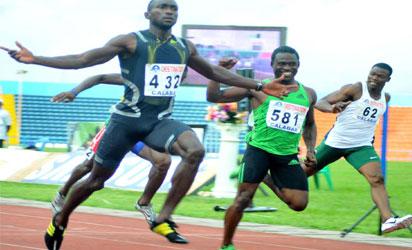
BULLET METU•••Obinna Metu (left) outpaces Egwero Ogho-Oghene to win the 100m men’s final in a time of 10.11sec at the 66th CRS Ail Nigeria Athletics Championship in Calabar yesterday. Photo by Sylva Eleanya.
By Ben Efe
So much has been said about the windling fortunes of Nigerian athletics and how it can be revived. Somehow, there seems to be lack of willingness by Nigerian sports officials to try the remedies recommended by track and field enthusiasts.
At the 1996 Atlanta Olympics, Chioma Ajunwa won Nigeria’s first track and field gold in the long jump, Falilat Ogukoya won a bronze in the 400m while Mary Onyali won a bronze in the 200m. At the Sydney 2000 Olympics, Glory Alozie won silver in the women 100m hurdles and the men 4x400m quartet won silver which was later upgraded to gold. Since then Nigerian athletes have struggled to win medals at the Olympics.
Successive sports administration in the country failed to pay attention to the development of the sport and the consequence was a dearth of athletics talents and lack of quality coaching for the small group that carried on.
The Rio 2016 Olympic Games brought to the fore the need for the country to genuinely take a look at athletics and study why Nigeria continue to lag behind even as other African countries are breaking new grounds. It was demonstrated by South Africa’s Wayde Van-Niekerk breaking the world and African records with 43.03 seconds at the Rio 2016 Games.
Nigeria’s Innocent Egunike once held the African record a 44.13 seconds, which no Nigerian athlete has ever achieved since he retired from the track almost two decades ago. In recent times young talents such as Eriyokan Urukpe and Omezia Akerele have proved that this country was not lacking in talents.
However, mismanagement of these 400m runners and others like Divine Oduduru and Odele Otega has relegated Nigeria to the status of a country that is just starting track and field in their domain unlike in the past when the country produced three athletes who competed amongst themselves in the top three of the Africa continent.
Nigerians, no doubt are at pain to see countries like Cote’d Ivoire dominating the men and women short sprints, while South Africa has taken over the the long sprints.
While it is easy to blame those in charge of Nigeria’s athletics for the prostrate position of the sport, a look at developments around the country will suggest that athletics cannot thrive in Nigeria, if a conscious effort is not made to re-establish the structures that produced the athletes that the country relied upon in the past. Here are takes by athletics persona-lities:

Toni Urhobo… athletics coach and keep fit professional
“A lot of things that we doing are wrong, and it is hard to blame it on the present administration of the Athletics Federation of Nigeria. Things have fallen apart over a long period and when experts, genuine professional experts with the right qualifications are not encouraged to come and assist then what you have is a reign of mediocrity.
“Sports are one of the biggest industries in the world and it is not something you leave in the hands of unequipped government officials. If you don’t have training for business you don’t go into it…sports is big business.”
Tobias Igwe… veteran Nigerian coach
For almost five years we have looked up to one athlete to win us medals, when in fact we should boast of 15 equally good athletes who are medal prospects. We are a country of over 150m people, there are talents in every part of the country, but if you do not consult the right coaches and technocrats, how will the sport grow?
“There are coaches like myself who are languishing away, rather than pay some foreign coaches big money to do nothing, why don’t you pay five Nigerian coaches 3,000 dollars each a month, give them three years and see what they can do.
“We have serious work to do, if we need to catch up with the rest of Africa and the world in the next four years, because we are lagging behind. If we can win silver and gold in previous Olympics what has suddenly happened? We can’t even reach the final of the events any more. We need to have at least five women doing 11.00 seconds in 100m and 50.00 seconds in the 400m. The same thing for the men.
“To achieve this, we need quality coaches who will go around the country to scout for talents and then we establish a pilot school for these young talents where they can be groomed.
“Also our higher institutions must have quality coaches. It is only University of Port Harcourt and University of Benin I see they have good coaches. The higher institutions have a higher role to play in the sports development process, but this is not the case. It is America’s collegiate system that continues to churn out quality athletes for them.
Glory Alozie… silver medalist 100m hurdles 2000 Olympics
If you ask me why Nigeria hasn’t been doing well; the answer is simple. We are lagging behind in preparations. You do not wake up one morning and say you are going to the Olympics.
The Americans, Jamaicans and Britons train for four to six years to be at the level they are; and you who haven’t done six months work want to compete with them? There has to be a long term programme if the country desires to make impact at the world level.
“During our time, we were fortunate to have quality coaches, we even had two foreign coaches from Cuba who put us through standard training. We have athletes and coaches in the country, given the right conditions they can excel. There has to be regular competitions such as the classics which we had during our time. There has to be junior championships and also identification of medal potentials for long term camping. If we can go back to the era where we did these things and they worked for us we can be a great nation again in athletics.”
Disclaimer
Comments expressed here do not reflect the opinions of Vanguard newspapers or any employee thereof.