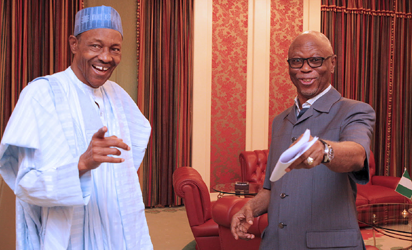
National Chairman APC, Chief Odigie Oyegun with President Muhammadu Buhari at the State House, Abuja. Photo by Abayomi Adesida
•Why politics of isolation ’ll backfire
BY CHARLES KUMOLU
THE All Progressives Congress,APC, many fear and perhaps hope may be headed for the worst on the wings of politics of isolation.
With intra-party crisis now as partisan as warfare, there seems to be some kind of growing fragmentation that appears strangulating to key party leaders.
And it is gradually polarising the party that was birthed through the sweat of some progressives thereby producing toxic developments on the capacity of the party to function effectively as an institution.
Only a few would disagree that the above does not capture the APC in the light of present realities that had seen some of its key progenitors and pillars at the losing end in some critical party concerns.
The party’s undisputed National Leader, Asiwaju Bola Tinubu, through whose vision and sagacity the APC became a reality, ex-governor Rabiu Kwakwanso of Kano State and Senate President, Bukola Saraki easily cross the mind in this regard.
Extreme internal partisanship
Perhaps, some favoured stalwarts in the present configuration might consider the latest in the series of cracks not threatening, but that may be costly given that these men constitute a critical artery in the party’s life.
Only a group that had concluded on self-destruct would not be troubled by what the seeming alienation of its key pillars holds in a political arena where parties are not permanent fixtures.
The aforesaid became imperative considering how instrumental the aggrieved party leaders, especially Tinubu were to APC’s birth and transition to the centre.
Indeed, since APC got to the centre last year, the party has had one defining attribute which is extreme internal partisanship that has gradually pushed it to the precipice.
From the crisis that heralded the emergence of the Senate leadership, Kogi governorship conundrum, Kwakwanso’s travails in Kano State, to the post-Ondo governorship primaries imbroglio, the party’s disposition is believed to have only but created and expanded faultiness.
While the effect of the Kogi conundrum and Senate leadership scenarios were seen to have stretched the party’s fabrics, the Ondo issue has brought the subtle war to a head given calls for the resignation of the party’s National Chairman, Chief John Odigie-Oyegun.
Left out of government
So alarming is the situation that the wife of President Muhammadu Buhari, Mrs. Aisha Buhari recently lamented that those who canvassed the change mantra had been left out of government.
Expatiating her position in a manner that could be likened to the consensus on the prevalence of politics of alienation in the party, she said: “This worries us a lot now because they believe they are the ones who suffered but are nowhere today. Those who didn’t do anything who don’t even have voters’ cards are the ones in position, doing everything.”
Mrs. Buhari said the power tussle resonated in many ways, especially because most of her husband’s cabinet members were not known to him.
On whether the identity of the people fanning the embers of the crisis in APC, were known she stated thus: ‘’whether he knows or not, those who voted for him know. He can see. Among all the people he selected, if he is asked among 50 people, he doesn’t know 45. I don’t know them despite staying with him for 25 years.”
With these unusual political remarks by the President’s wife suggesting that power grab could be at heart of the matter, observers think the party may be headed for the rocks if nothing is done to assuage the feelings of aggrieved chieftains.

Fence-mending gestures
Her assertion also made manifest the point at which the APC finds itself.
But there are no indications of urgent moves to resolve the matter, given the absence of empirical fence-mending gestures by neither requisite party organs nor the presidency.
Given the inherent dangers the situation portends to the party’s existence, it becomes imperative to remind the APC how internal squabbles resulted in the demise of many promising parties nationally and internationally.
Since Nigeria’s history, right from 1923 when the first political party, Nigerian National Democratic Party,NNDP, was formed by Herbert Macaulay, had been littered with demised political parties, many consider it unthinkable to treat the issue as if every party lasts forever.
Another factor that analysts feel should bother the party, is the fact that internal brinkmanship had quickened the split, bust, death and even reincarnation of parties in the country.
For instance, most parties that had gone extinct in the country were believed to have failed given the neglect of inclusiveness, ideologies, and values which are germane to the survival of political parties.
Now, consider the stories of failed parties across the globe and the lessons that can be drawn by the APC as it confronts the present internal challenges.
NCNC/AG alliance
The failure of the National Council of Nigerians and Cameroons, NCNC, Action Group,AG, and Northern Peoples Congress, NPC, to have a clear winner in the 1959 federal election created the need for an alliance in order to form a central government. The alternatives then were an AG/NCNC alliance or NCNC/NPC alliance or AG/NPC alliance.
But given what was described as the politics of exclusion which sidelined Dr. Nnamdi Azikiwe from forming the government of the Western Region, an NCNC/AG alliance was frustrated by a faction of the NCNC thereby paving the way for an NPC/NCNC alliance which was noted as the first merger of parties in the country.
The alliance, which was a marriage of strange partners like what obtains today in the ruling APC, was characterised by intrigues, manipulation, and violation of binding agreements among others.
UPGA
In the build up to the 1964 federal election, the NCNC and AG dissolved into a new party known as United Progressive Grand Alliance ,UPGA. The reason was to wrestle power from the NPC. The merger, however, failed because of intrigues over who will lead the party.
PPA
The same fate also befell the Peoples Progressive Alliance formed in the Second Republic to confront the National Party of Nigeria. The leaders of that failed party were Azikiwe, Chief Obafemi Awolowo, Alhaji Ibrahim Waziri and Mallam Aminu Kano.
These parties, it is believed, failed as a result of the failure of its leaders to be on the same page on the issues of ideology, inclusiveness, and ethnicity. Unfortunately, the same key issues, are believed to be prominent in the present crisis rocking the APC.
Similar scenarios happened in American democracy which Nigeria’s presidential system of government was modeled after. And the experiences there, perhaps, would further put the APC scenario into perspective.
Whig Party
Like most parties in Nigeria, those, who formed the Whig party in the US were said not to have been united by a unified set of values. In fact, like the APC, the aim of forming the party in 1834, was the common dislike the founders had for President Andrew Jackson. Indeed, the drive to unseat ex-President Jonathan and the PDP during the formation of the APC could pass as a handy instance in Nigeria.
Given the sole aim of bringing the party into existence, it was observed that it failed to evolve as a remarkable political fold. Hence, it was propelled by individual ambitions of its leading members like Presidents William Henry Harrison, John Tyler, Zachary Taylor, Millard Fillmore, and Abraham Lincoln.
The party eventually got factionalised over slavery leading to its extinction in 1854 when the Republican Party was formed. However, a fundamental lesson from the Whig experience is that intra-party disagreement over topical concerns could be disastrous for parties.
Federalist Party
The party was reported to have been formed by those, who wanted a national bank and a federal taxation system. Led by its founder, Alexander Hamilton, the party was said to have actualised its two key goals on the economy. But a drift towards the interest of the elite at the expense of national good, contributed to its demise.
Stating how the party died in a piece in The Week Magazine, Keith Wagstaff said: ‘’ The party eventually died out after developing a reputation as an elitist cadre that cared more about the interests of its New England base especially concerning issues like the War of 1812 and the Louisiana Purchase than the national good. The fact that its leader died in a duel with Aaron Burr didn’t help either.”
On the possible lessons from the party’s demise, he highlighted thus: ‘’Paying too much attention to your base is deadly. Also, avoid duels at all costs.”
Bull Moose Party
Irked by the refusal of the Republican Party to allow him to run for a third term in office, Theodore Roosevelt formed his own party. Known as the Progressive Party, the party did not survive despite its liberal position on issues.
To many, it was just a dissident political faction that was driven by the sole aim of having a presidential ticket. Its failure at the poll where it had 25 percent of the popular vote led to its demise and eventual reunification of the Republican Party four years later.
Analysts posit that the implication of the scenario is that any ruling party that splits ahead of an election is likely to lose to the opposition. Interestingly, such lesson played out in Nigeria when the exit of five governors from the then ruling PDP, mainly contributed to its defeat.
Anti-Masonic Party
As its name suggests, Anti-Masonic Party was formed as an opposition to the Freemason in 1826. Credited to have pioneered the culture of national conventions, it was reported to have had a national following. Its extinction was attributed to the absence of reason in its approach to national politics. The majority of its members defected to the then newly form Whig Party.
Disclaimer
Comments expressed here do not reflect the opinions of Vanguard newspapers or any employee thereof.