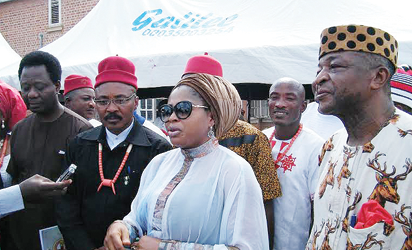
IGBO DAY CELEBRATION: Representative of Enugu State governor and state Commissioner for Culture and Tourism, Rita Mbah (middle), Deputy President-General of Ohanaeze Ndigbo, Chief O.A.U. Onyema (left), Secretary General of Ohanaeze Ndigbo, Dr. Joe Nworgu (right) and other top members of the apex Igbo association, during the Igbo Day celebration in Enugu, yesterday.
By Douglas Anele
In my view, the centre of gravity of the socio-economic and political problems facing us today is largely traceable to it. Now, half a century after the revenge coup, can Yakubu Gowon, Theophilus Danjuma, Muhammadu Buhari, Ibrahim Babangida, Jeremiah Useni and John Shagaya who either tacitly endorsed or participated actively in the ethnic cleansing of, and hate crimes against, Igbo officers and men in the army honestly claim that aside from enhancing their military and political careers the revenge coup was worth it?
More importantly, can any right thinking Nigerian sincerely accept that the senseless killings have contributed positively to our national development? As a secular humanist who deeply appreciates the ontological uniqueness of an individual human life irrespective of race, colour, gender, ethnicity and so on, the coups of 1966 are extremely deplorable. But the second one was much worse, because in January 15, contrary to popular and deliberate incendiary misconceptions, military officers from every region of the federation staged a coup in which soldiers and politicians from every region were also assassinated and the casualty rate was low, just about a dozen. When northern soldiers carried out their revenge coup six months later, they singled out officers from the eastern region only as their targets, killing over thirty of them.
It is pertinent to note that not all northern soldiers participated in the barbaric act – indeed, some of them actually tried to save some of their Igbo colleagues. This is commendable, although it did not stop the madness since, as Siollun remarked, “After some time killing the Igbo became a status symbol for some northern soldiers.”
The tragic fallout of the July 29 coup was not restricted to the military, nor were the victims Igbo soldiers alone. In fact, the killings became indiscriminate in nature and Ndigbo, whether military or civilian, became a target.
Even Prof. Chinua Achebe, whose novel entitled A Man of the People, by coincidence was published around the time the January 15 coup was launched, was hunted six months later by northern soldiers because, in their warped minds, its contents proved that Achebe either had foreknowledge of the coup or was complicit in it, because the book is a fictional story of a country terribly misgoverned by corrupt and inept politicians, who were eventually overthrown by a military coup.
In the pogrom that was carried out by northerners after Gowon became head of state, mobs (often assisted by northern soldiers and encouraged by some members of the northern elite) massacred tens of thousands of Ndigbo living in the northern region.
According to Achebe, thirty thousand civilian men, women and children were slaughtered, hundreds of thousands were wounded, maimed and violated, their homes and property looted and burned. A northern soldier gave a chillingly simple but plausible explanation of the murders and destruction thus: “The Igbo killed our leaders in January; they were taking all the top jobs; we had to get rid of them. Now, we have only got northerners in this barrack; all the southerners have run away.”
A Sierra Leonean living in the north at that time reported back home that killing of Ndigbo has become a state industry in Nigeria. In Bauchi, hometown of late Prime Minister Balewa, a ministry of information vehicle drove round appealing to northerners not to attack non-Igbo, which implies that it was still acceptable to attack Ndigbo. But there were a few isolated acts of forgiveness and kindness by northern soldiers while the massacres were going on. For instance, Lieutenant-Colonel Katsina arranged for his Igbo ADC, Lieutenant Ugokwe, to be hidden: he was eventually repatriated safely to the eastern region.
Captain Mamudu of the first brigade signals troops in Kaduna asked eastern soldiers to stop coming to work for safety reasons. RSM Ahmadu Bello who tricked Lieutenant-Colonel Okoro into being assassinated in the 3rd battalion guardroom helped to prevent some eastern soldiers from being killed after they had assembled in a hockey pitch surrounded by northern troops, whereas Major Abba Kyari also assisted some Igbo soldiers to escape from the north unharmed.
The administration in eastern region tried its best to cope with the herculean task of resettling the influx of refugees pouring into the region, estimated at about one million. Lieutenant-Colonel Chukwuemeka Odumegwu-Ojukwu was acutely aware of his personal responsibility and guilt for Ndigbo who lost their lives in the pogroms. This is because, apart from being military governor of the region, he actually went on air after the May 1966 riots and told his people that it was safe to return to the north. Unfortunately, tens of thousands of people who heeded his advice were murdered in the massacres from August to September of the same year.
Because the two military coups in 1966 had almost dragged Nigeria to the black hole of violent disintegration, the military leaders met to address the situation. The stage was set in Aburi, Ghana, under the auspices of Lieutenant-General Joseph Ankrah, the Ghanaian head of state.
Siollun reports that the meeting evolved into perhaps the best-documented constitutional debate of all time, which discussed fundamental concepts regarding the balance of power between the central and regional governments in a federation. In the wake of the second coup of July 29, 1966, Lieutenant-Colonel Odumegwu Ojukwu had consistently refused to attend any SMC meeting outside the east due to concerns about his safety. He had even taken the additional precaution of asking non-easterners to leave the eastern region because of security concerns.
For northerners that was understandable because of minor retaliatory attacks as a result of the pogroms. In the case of the Yoruba in Igboland, some survivors of the massacre were bitter that their Yoruba neighbours in the north did not do enough to protect them. Going back to the constitutional conference in Aburi, available records show that the eastern delegation led by Ojukwu was better prepared than their counterparts from the other regions led by Gowon. He came with documents where he and his team had enunciated the eastern position with admirable clarity and depth, and presented it to those present at the meeting, whereas the other side had arrived Aburi with a simplistic but unarticulated idea that somehow Nigeria must remain united.
The Aburi constitutional conference exposed the faultlines and shifting perceptions of the north and east concerning how Nigeria should be structured for effective governance. Thus, the northern led federal military government advocated a strong central government, while the eastern region proposed a weaker central government with devolution of powers to the regions.
This was essentially a reversal of each side’s standpoint a few months earlier. Northerners had been so opposed to a strong central government to the extent that, as we noted earlier, they killed thousands of Ndigbo in the araba riots of May 1966 while protesting against the unification decree promulgated when Ironsi was supreme commander to expand the powers of the federal government. Now that Gowon, a northerner, was head of state, northerners suddenly began to champion a unitarist arrangement.
On the other hand, prominent Igbo politicians had supported the concept of a strong and unified Nigerian nation because, among other things, they believed that Ndigbo, given their impressive educational and professional prowess together with the well-known upwardly mobile individualism of a typical Igbo, could be primus inter pares anywhere in the country. But after the May 1966 massacre of Ndigbo and pogroms, coupled with the fact that power at the centre had shifted from an Igbo to a northerner, the eastern region led by Ojukwu started insisting that more powers should devolve to the regions. Given his educational advantages over Gowon and other members of the SMC in the federal government’s delegation, prior serious preparations for the Aburi conference and his eloquence, Ojukwu got most of what he wanted from the encounter. The core of the Aburi agreement was that each region would be responsible for its own affairs, while the federal government would concentrate on matters that affect the whole country.
Unfortunately, the Aburi accord was not implemented for a number of reasons.
To start with, when Gowon came back to Lagos, some of the top federal civil servants were surprised at the degree of concessions he made to Ojukwu. As a result, they advised him not to implement it because, in their opinion, it was “unworkable.” The discovery of vast quantities of crude oil in the eastern region reinforced the north’s desire to maintain a united Nigeria, whereas Ojukwu and his delegation were insisting on its full implementation.
Therefore, the contradictory postures of the two sides towards the agreement after returning to the country precluded any practical steps for implementing its positive aspects. Sadly, the end result was that Nigeria missed a wonderful opportunity to reinvent itself and avoid one of the most devastating civil wars in modern history.
Disclaimer
Comments expressed here do not reflect the opinions of Vanguard newspapers or any employee thereof.