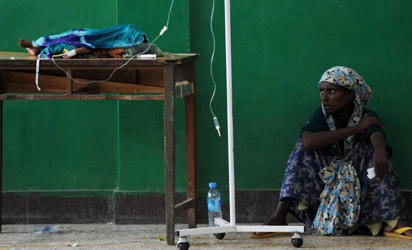
A Somali woman sits on the floor as her sick baby suffering from malnutrition lies on a desk and is fed through an intravenous trip at a local hospital in Mogadishu on August 15, 2011. Over 100,000 people have fled into Somalia’s famine-hit and war-torn capital in the past two months in search of food, water and medicine. AFP PHOTO
By Dr Femi Ogunyemi
The above title is unique, deliberate and interesting.
The juxtaposition of the three words, in any order, would still achieve the same meaning.
Try it…..medicine making money…..making medicine money….money making medicine……
I wonder if there is a term in the English language for such an arrangement of words.
During my recent travels, I met two gentlemen who were uncertain on how to invest $5m in Nigeria. I have also heard of a super-rich Nigerian ( and I am not one for hearsay or rumors ),who, apparently, stated that he had $500m and did not know what to do with it. If someone knows this person, please pass this article to him. Better still, pass ME to him!Investing in healthcare in Nigeria can be challenging but can come with some significant rewards. Nigeria has its own unique set of dynamics but our health sector is filled with opportunities for millionaires, venture capitalists and the so-called Small and medium scale enterprises (SMEs).
Public healthcare is driven by government. At Federal and State level, Government is committed to the provision of basic services to citizens. Unfortunately Government’s objectives can take a long time to set up ( the Ebola response is a laudable exception ) as funding must be sought for projects. In addition public resources are limited. Herein lies the opportunity for the private sector to improve access to facilities and also increase healthcare financing, quality of goods and services. Across every city, town and village in Nigeria, there are areas with poor health infrastructure, a
shortage of healthcare workers and substandard quality of clinical and non-clinical services.
Who are the stakeholders in this large and diverse market?
They are retailers, manufacturers, health service providers (both medical and paramedical),
distributors, health financiers, supportive service providers and health educators.
For Nigeria to achieve and sustain a vibrant health sector, services must be integrated and monitored with continuous audit of outcomes targets set by Government.
Where are the Opportunities? Clinical services: general and specialty hospitals and clinics (especially those geared towards women and/or children) like Women’s health centers, Antenatal Clinics, Under-5 Clinics and similar service providers. Tertiary services like Cardiology, Renal, Oncology, and Day Surgery Units remain rare in Nigeria. It is in these particular areas that major investors do, and should fix their names in posterity.
Some of the best medical facilities in the world originated from personal funds from people who
have lost loved ones to a specific illness.
Supporting Industries: like health education, insurance claims processing, accounts
receivables for providers, the management and administration of care facilities, as well as buildings, equipment and medical supplies.
Health insurance: especially Health Maintenance Organizations (HMOs) that combine health insurance with clinical services provision. New insurance organizations will do much better if they are able to minimize financial pressures caused by fixed tariffs and bundled payments.
Healthcare products manufacturing: including production of pharmaceuticals, IV fluids, and medical supplies.
Wholesale and distribution of healthcare products, including the distribution of pharmaceuticals, medical supplies and vaccines.
Privatization Schemes: In a document in 1999, I outlined how hospital services like catering, laundry, landscaping and even security services can be privatized. This applies also to services like mortuary services, laboratory and diagnostic services. Such contracts may be limited to a facility, Local Government Area, statewide, zonal or national. SMEs and large corporate organizations can seize these investment opportunities. Quality of service delivered and budget management has been shown to improve with this model.
Information Technology presents great business opportunities: IT can enhance continuity of care, provide easy access to patient data across multiple facilities and providers and help keep costs down. Networks are needed at local, state and federal levels, in primary, secondary and tertiary care, in private and public facilities. The market is enormous and can be filled at all levels of investment; from the single individual IT manager to corporate management of huge databases and interactive clinical activity.
From the gardener to the gateman, the cook to the computer expert, the small proprietor to
wealthy individuals, opportunities abound in Nigeria……for making money medicine.
Maybe it is medicine making money….or money medicine making….or…?
Disclaimer
Comments expressed here do not reflect the opinions of Vanguard newspapers or any employee thereof.