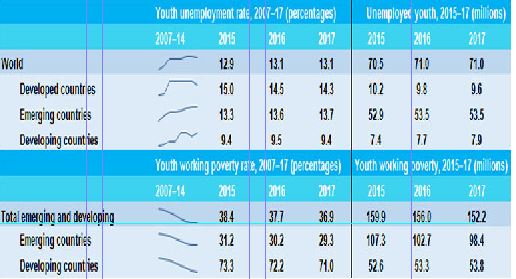
Table: Youth unemployment and working poverty trends and projections to 2017 Note: The working poverty rate is defined as the share of employed population in extreme or moderate poverty, i.e. with per capita income or consumption of less than US$3.10 per day. Youth are defined as 15-24. Source: World Employment and Social Outlook 2016: Trends for Youth .
*…Says 64.4m in Sub-Sahara Africa live in extreme or moderate poverty
By Victor Ahiuma-Young
INTERNATIONAL Labour Organisation, ILO, has raised alarm over rising global youth unemployment as well as poverty rate among working youth, lamenting that incidence of unemployment among youth in Northern Africa remains elevated at 29.3 per cent in 2016, representing the second highest rate across all regions.

Table: Youth unemployment and working poverty trends and projections to 2017
Note: The working poverty rate is defined as the share of employed population in extreme or moderate poverty, i.e. with per capita income or consumption of less than US$3.10 per day. Youth are defined as 15-24. Source: World Employment and Social Outlook 2016: Trends for Youth .
According to ILO, while the youth labour force participation rate is the highest in Sub-Saharan Africa at 54.2 per cent, the region’s enrolment rates in secondary and tertiary education is the lowest among all regions.
The ILO’s World Employment and Social Outlook 2016, just released in Geneva, Switzerland, indicated that working poverty rates among youth in Sub-Saharan Africa was nearly 70 per cent in 2016, translating to 64.4 million working youth in that region living in extreme or moderate poverty (less than $3.10 per day).
“In Northern Africa, one in four working youth is estimated to be living in extreme or moderate poverty representing a significant improvement since 1991 when almost half of all employed youth were living in extreme or moderate poverty. Youth in Africa demonstrate higher willingness to move permanently to another country: 38 per cent in sub-Saharan Africa and 35 per cent in Northern Africa in 2015 (globally the figures stands at 20 per cent).
“Youth’s propensity to migrate is significantly driven by changes in the working poverty and unemployment rate for youth. The gender gap is among the highest in Northern Africa where the female youth participation rate of 16.6 per cent is 30.2 percentage points lower than the youth male rate. Similarly, the unemployment rate for female youth in the region is 44.4 per cent—which is 20.3 percentage points higher than for youth men representing the second largest unemployment gap”, the report
Global youth unemployment rising
The report said ongoing ILO research showed that after a number of years of improvement, youth unemployment was set to rise in 2016 and young people disproportionately affected by working poverty, saying “ILO estimates that the global youth unemployment rate is expected to reach 13.1 per cent in 2016 and remain at that level through to 2017 (up from 12.9 per cent in 2015).
The ILO’s World Employment and Social Outlook 2016, Trends for Youth report shows that as a result, the global number of unemployed youth is set to rise by half a million this year to reach 71 million, the first such increase in three years.
Of greater concern is the share and number of young people, often in emerging and developing countries, who live in extreme or moderate poverty despite having a job. In fact, 156 million or 37.7 per cent of working youth are in extreme or moderate poverty (compared to 26 per cent of working adults).
“The alarming rise in youth unemployment and the equally disturbing high levels of young people who work but still live in poverty show how difficult it will be to reach the global goal to end poverty by 2030 unless we redouble our efforts to achieve sustainable economic growth and decent work.
This research also highlights wide disparities between young women and men in the labour market that need to be addressed by ILO member States and the social partners urgently,” said Deborah Greenfield, ILO Deputy Director-General for Policy.
Unequal opportunities
She noted that across most labour market indicators, wide disparities existed between young women and men, underpinning and giving rise to wider gaps during the transition to adulthood.
“In 2016, for instance, the labour force participation rate for young men stands at 53.9 per cent compared to 37.3 per cent for young women – representing a gap of 16.6 percentage points. The challenge is particularly acute in Southern Asia, the Arab States and Northern Africa, where female youth participation rates are, respectively, 32.9, 32.3 and 30.2 percentage points lower than those of male youth in 2016”, Greenfield added.
Disclaimer
Comments expressed here do not reflect the opinions of Vanguard newspapers or any employee thereof.