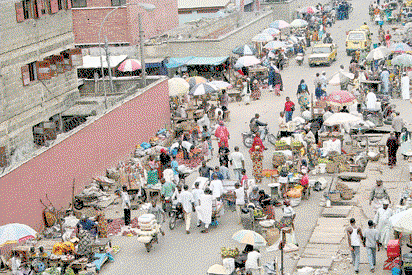
kaduna market
By Peter Egwuatu
As the Nigerian Economic Summit Group, NESG has concluded arrangements to host this year’s summit, it is expected that both Government officials and array of private sector chieftains across the sectors of the economy would grace the occasion to discuss issues affecting the economy and provide panacea to addressing the economic challenges facing the country.

kaduna market
This year’s 22nd Summit which would hold in Abuja from October 10th -12th, with the theme “Made in Nigeria” is apt as the country is faced with economic recession. This Summit is expected to focus on issues such as Manufacturing, Agriculture, Agro processing, Infrastructure, Creative Industry, Small and Medium Enterprises, SMEs among others.
Participants’ discussion should be centred on diversifying the economy away from oil to agriculture and industrialisation and that would mean encouraging local production for increased consumption and export to generate more foreign exchange earnings for the country.
Most economies that depend on commodities for their national income (especially crude oil) are going through major decline in their external earnings. But Nigeria has some peculiarities given that it is not only import dependent, it is a huge consumption economy. This has led to negative economic growth, dwindling foreign reserves, stress on balance of payment and mounting pressure on local currency exchange rate relative to major currencies.
The resulting social challenges include increasing unemployment, reducing income, pervasive poverty and a decline in funding public and social goods. The question is: how is Nigeria going to fundamentally address these challenges?
Whereas the 2014 GDP rebasing exercise of the Nigerian economy indicated that Nigeria’s economy was more diversified than previously thought as is evident in a reduction in the share of oil and gas in its GDP composition (now 11 per cent), with the non-oil sector components taking lead, it is important to note that oil and gas still plays a significant role in the economy as it accounts for 94 per cent of export revenues and 70 per cent of government revenue.
An exacerbation of these conditions have also seen capital inflows crash by more than 53 per cent addition to significant capital flight, by implication staving off alternative sources of foreign exchange needed to keep businesses, especially the real sector running in Nigeria. We must encourage more production and consumption of Made in Nigeria goods and services while maintaining a trade balance between imports and exports and recognizing the realities of globalization.
This will reinvigorate moribund industries and services that have shown potentials in the past and curtail the growing demand for foreign exchange for consumption rather than capital products and equipment. If we can achieve this, we will also conserve and potentially even add to our foreign reserves and reduce the pressure on the Naira relative to other currencies.
It will be recalled that past Nigerian Economic Summits made recommendations on self-sufficiency in local production and an export-driven economy. With our current economic realities, this is the perfect opportunity to articulate a national discussion on “Made in Nigeria” to promote the goods and services that are already up to standards for consumption, encourage exports and increase opportunities for SMEs.
The 22ND NESG should provide a platform to sharpen the focus of the conversation. The key thrust, according to the organisers of the Summit would be to facilitate stakeholders’ discussions/agreements on the practical issues, opportunities, policies and regulations needed for “Made in Nigeria” to become an economic growth and development agenda.
It will also seek to work out the strategies to achieve self-sufficiency and value-addition capacities for several products and services in the shortest possible time.
The sub-themes of the Summit shall deliberate on the macroeconomic environment; ease of doing business; stakeholders’ behaviours and attitudes; access to finance; infrastructure; quality and standards; technology and innovation; as well as job creation, skills and youth employment. Key outcomes will include a practical roadmap that will contextualize “Made in Nigeria” as an economic growth and development strategy for our short, medium and long term development.
Disclaimer
Comments expressed here do not reflect the opinions of Vanguard newspapers or any employee thereof.