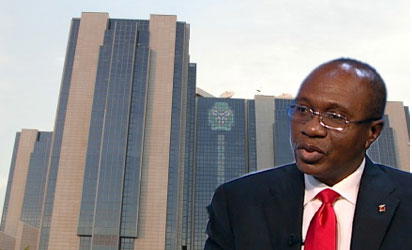
Emefiele CBN Governor
By Henry Boyo
“I was reading a story recently that there was SME intervention fund in CBN that was grossly underutilized. Why should that be when we have a lot of SMEs looking for funds to develop products? If we want to assist the SME, we must make sure that interest rate on their loans is not more than 5%. That is why Lagos State has used the benchmark of 3% interest rate for the SMEs …”

Emefiele CBN Governor
“Yes, CBN should bring down the MPR for the benefit of SME operators. Double digit lending rate is not good for these operators. If we are talking of diversification, the key lies in that sub-sector.” An interview with Lagos State Commissioner of Commerce & Industry, Rotimi Ogunleye; see “DOUBLE DIGIT INTEREST RATE NOT GOOD FOR MSME OPERATORS” in Vanguard 30/05/16.
“The aggregate bid amount by manufacturers under the former exchange rate of N197=$1 was N827.4bn, but the amount they were asked to pay based on the new rate was N1.176tn; thus, the manufacturers were required to come up with the difference of N348.6bn.”
“Some manufacturers have expressed discontent about the development, adding that they did not incur the losses in the course of doing business, but that they arose as a result of a government policy. They said more job losses and company closures would be the consequence of making them to pay the difference between the old and new exchange rate.
Confirming the story, the President, Manufacturers Association of Nigeria, Dr. Frank Jacobs, said manufacturing firms had been sacking workers massively across the nation. Jacobs, however, said the forex situation had improved and more and more manufacturers had been able to get needed foreign exchange with the new rate. The Director-General, Lagos Chamber of Commerce and Industry, Mr. Muda Yusuf, agreed that “the new forex policy meant significant shocks to investors who had matured LCs awaiting remittances and were caught up in the policy change; these include those who have high foreign debt exposures and others.
“It is, therefore, desirable to cushion the effects of these shocks on the companies, because of the wider implications on the economy, on job creation and retention; as well as on non-performing loans, which may escalate, given the exposure of the banks to these companies.” See “MANUFACTURERS LOSE N348.6BN TO NEW FOREX POLICY” in PUNCH 04/07/16.
“Traders expecting Nigeria’s currency devaluation to trigger a rush of cash into Africa’s largest economy are rapidly concluding that the Naira’s 30% drop wasn’t enough,” reports Bloomberg; “Investors got the foreign-exchange policy change they asked for; but still aren’t flocking to buy Naira assets as the Central Bank of Nigeria (CBN) keeps a grip on its currency, 9days after abandoning a 16-month-old peg.”
According to Rick Harrell, an investment analyst with Loomis Sayles, which oversees $229 billion of assets in Boston, “the fundamental backdrop isn’t positive”. “Buhari told businessmen in Abuja, on June 27, that he didn’t understand the “ruthless devaluation”. He had previously likened devaluation to “murder.” Traders on the forwards market are betting the Naira will drop to N293=$1 in three months and N328 next year. The end of the peg has failed to ignite a rally in Nigerian stocks.
“For me to get started, I’d want yields of 16% or higher on government debt,” Rick Harrell insisted. Furthermore, Nicholas Spiro, a partner at London-based Lauressa Advisory Ltd., expects consumer inflation will probably accelerate in the short term as the devaluation increases the cost of imports such as petrol, while oil production has dropped close to a 20-year low amid militant attacks on pipelines and refineries.” See “TRADERS NOT SATISFIED WITH NAIRA’S 30% DROP AFTER NEW FX POLICY KICK-OFF” in DAILY INDEPENDENT 30/06/16.
“The President of the Association of Nigeria Licensed Customs Agents, Olayiwola Shittu, said although the development (of higher import bills) was expected, he called on the NCS to be transparent with the process.” See “NEW FOREX POLICY RAISES IMPORT DUTY BY 43%” in PUNCH 06/07/16. “The price of kerosene, used by majority of Nigerians for cooking, has risen to as much as N300/litre and much more on the black market, with many depots in Lagos not loading the product.
Our correspondent gathered that the supply of kerosene by the NNPC through its subsidiary, Pipelines and Product Marketing Company, which marketers largely depend on for the product, has reduced in recent weeks. Out of 36 depots surveyed in Apapa, only one, INDEX, was loading dual purpose kerosene as of Friday. The Lagos Zone, NUPENG chairman, Alhaji Tokunbo Korodo, noted that, “it is not only kerosene; it is also affecting diesel. Diesel is now being sold at between N185 and N200/litre as against N105-N110.
The major oil marketers and DAPPMA are not bringing in diesel or kerosene; those who have access to the available supply are capitalizing on the scarcity to maximize their profits.” Korodo said the prices of kerosene and diesel would continue to go up if they were not being loaded at the PPMC depots. He said some of the marketers had refused to get involved in kerosene importation because of foreign exchange constraints.” See “KEROSENE SOARS TO N300/LITRE AS SUPPLY DROPS” in PUNCH 06/07/16.
“The Nigerian Civil Aviation Authority (NCAA) has warned all airlines selling flight tickets in foreign currencies in Nigeria to desist from the practice forthwith. The NCAA statement noted that the act contravened the CBN’s guidelines on the cost of products or services in Nigeria. “The NCAA is disturbed by reports that some foreign airlines are declining to accept Nigeria’s local currency – the Naira – as payment for tickets.” See “STOP SELLING TICKETS IN FOREIGN CURRENCIES, NCAA WARNS AIRLINES” in DAILY INDEPENDENT 04/07/16.
“However, the CBN’s new forex regime has rather served as early catalyst to edge up prices of goods. Especially affected are imported goods. An official of the National Bureau of Statistics observed that “Currently, we produce nothing as against previous years. Our last report which showed rise in headline inflation is a pointer to an increasingly deplorable situation,’ he said. “Factories are closed because of lack of raw materials and power. The consequence is loss of jobs. Again, the government is not putting money where its mouth is to rescue the economy.
“So expect rise in inflation because as you already pointed out, customs too have keyed into the new FX regime. It is not as if importers have easy access to FX now, they still struggle. “It is by extension a general crisis. The liquidity crisis that manifested in Skye Bank is also affecting other banks,” the NBS official concluded.” See “NEW CUSTOMS DUTY MAY PUSH INFLATION ABOVE 18%” in DAILY INDEPENDENT 07/07/16.
Disclaimer
Comments expressed here do not reflect the opinions of Vanguard newspapers or any employee thereof.