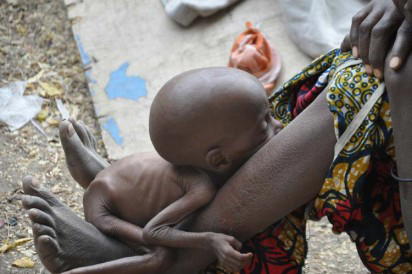
Bama IDP Camp: A baby at Bama IDP Camp in Maiduguri during Ministers Tour of Bama . Photo by Gbemiga Olamikan.
Dr Francine Watkins, Senior Lecturer in Public Health and Director of the Master of Public Health Programmes at the University of Liverpool, discusses the breadth of knowledge and skills needed by public health professionals to tackle the issues that affect the quality of health within communities around the world.

Bama IDP Camp: A baby at Bama IDP Camp in Maiduguri during Ministers Tour of Bama . Photo by Gbemiga Olamikan.
Ongoing learning is crucial in any sector, but for public health professionals it is of paramount importance. Practitioners need to ensure that they can respond to changing communities by creating strategies to tackle problems and continually research issues that affect public health.
It is well known that the poorest people in society are more likely to suffer ill health and have a considerably shorter lifespan.
It is also clear that having access to a good education, a healthy working environment, a high standard o f housing and good living conditions (such as clean water and good sanitation) can determine the quality of health and the opportunities individuals will have over the course of their lifetime. Yet health inequalities still exist.
Life expectancy
In 2015, a report by the UN indicated that the average life expectancy (for the period 2010 to 2015) in Nigeria was 50 years, compared to the UK average of 79.5 years. In contrast to this, the average life expectancy for neighbouring Ghana (for the same period) was 61.9 years.
To be effective in tackling health inequalities, public health practitioners need several important qualities. These include foundational knowledge in the field of public health; a desire to continue to research public health problems; strong interpersonal skills; advocacy and an ability to build invaluable partnerships with local community leaders; and core management skills that lead them to build communicative teams that successfully address ongoing public health issues.
It is therefore vital that public health practitioners develop the skills and knowledge needed to tackle key public health problems and health inequalities.
While there are differences in life expectancy between countries, public health practitioners should also acknowledge that there are also health inequalities within countries. Having this competency and understanding will empower them to tailor health promotion strategies to each community and provide individuals with much-needed resources.
Understanding
Effective public health professionals have an extensive understanding of the communities in which they work. Many communities will have very specific and potentially different social, political and cultural contexts that may affect the success of the strategies that are implemented.
Public health professionals understand how local and national health systems work, what resources and services are available, and how to access them.
They should also be strong advocates, able to influence local leaders and build strong local partnerships that result in the implementation of new programmes and policies, and they should have a positive impact on the community.
Strategies
Public health practitioners also use a wide range of data from many different sources to enable them to develop robust policies and strategies. Strong research skills are necessary to enable them to carry out rigorous research studies to fully explore the issues faced by communities. Public health professionals need to be able to critically appraise the quality of data sources as well as critically analyse the patterns, causes and effects of poor health and disease. By understanding the issues they face, they can begin to design new healthcare programmes to positively affect their community.
The development of all these skills is a fundamental part of the online and campus Public Health programmes that I teach at the University of Liverpool. These programmes of study aim to provide students with the skills and knowledge to not only develop effective prevention strategies and health improvement schemes, but also ensure they can confidently implement them by learning how to educate the communities in which they work. Our programme is designed to empower practitioners to help and encourage members of that community to embrace tools that are provided to tackle these issues.
Policy
It is essential for public health professionals to ensure they have the ability and confidence to influence policy and decision-making at the highest level. Through the University of Liverpool’s fully online platform, students are part of a global classroom that enables them to clearly understand best practices and learn about other projects from around the world.
Students are also given the opportunity to apply their learnings to their day jobs throughout the course of the programme, through ongoing participation, and collaborative learning and problem-solving. Our students can consider alternative yet effective systems and methods that are deployed by other countries and cultures. This approach will acquaint students with a global network of professionals who can share knowledge and help others to better understand health inequality – which in turn could help to close health gaps across the world.
Disclaimer
Comments expressed here do not reflect the opinions of Vanguard newspapers or any employee thereof.