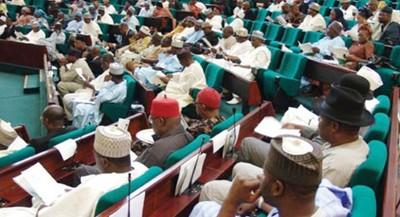
National Assembly
By Dafe Umukoro
As the 8th Senate of the Federal Republic of Nigeria, presided over by Senator Abubakar Bukola Saraki, rolled into its first anniversary last Thursday, June 9, many Nigerians have had cause to give deep thoughts on how the Senate fared in the past one year. Not unlike Nigerians, this Senate, across the land, has received kudos and knocks over its achievements and challenges.
 However, it will not be difficult for every keen and well-informed observer of this Senate to conclude that this past one year recorded commendable achievements that have contributed to the consolidation of our democratic process, and which calls for celebration.
Within this one year, the Senate passed the long-awaited Cyber Crime Bill into law. It will be recalled that in the past 10 years, several bills on cybercrime had been pushed to the National Assembly by the Nigerian Information Technology experts, but none scaled through the final reading. Many of the bills did not even get a mention, but during the past year, one of the bills eventually passed through the final reading and was approved by Senate, a development that has drawn commendations from ICT professionals in the country.
Also, the Senate passed the Federal Capital Territory (FCT) Act (Amendment) Bill 2016, to increase the number of judges in the High Court of the FCT from 37 to 75. Sponsored by Joshua Lidani (Gombe South), and co-sponsored by the Chairman of the Senate Committee on Judiciary, Human Rights and Legal Matters, David Umaru, and Sen.
Andy Uba (PDP-Anambra South), the passage followed a clause by clause consideration of the report of the Senate Committee on Judiciary, Human Rights and Legal Matters on the bill. Similarly, the enactment into law of the Insolvency and Debt Recovery Bill 2015 sailed through. There is also the on-going consideration by the 8th Senate, of the amendment to the Public Procurement Act.
And in April this year, the Senate re-introduced the controversial and long awaited Petroleum Industry Bill, PIB, which is also called the Petroleum Industry and Governance Bill, PIGB, and which seeks to give the country’s oil and gas industry a comprehensive legal framework and also provide the basis for the unbundling of the Nigerian National Petroleum Corporation, NNPC, into five independent commercial entities.
Worthy of mention is the amendment of the outdated Railway Act which is about to be concluded. There is the review of 54 laws affecting ease of doing business in Nigeria with a view to amending them. Still within this one year, 162 motions were considered and resolutions of top benefits to Nigerians passed. These include, among others, the ones on the ban on Nigeria agric export products by EU; flood and erosion disaster; and landslide in parts of the country.
During this period too, the leadership of the Senate was in the vanguard of leading efforts to restore peace in North-East via top level visitations, donations to IDP camps, establishment of Presidential Committee on Rehabilitation, and the Senate is also about to enact North-East Development Commission Law.
Among others, the Senate intervention led to a review of CBN policy to enable small business owners access to forex; the Senate probe saved Nigeria N20 billion from the implementation of the TSA policy; the Senate motion led to the abolition of fixed charges in electricity tariff; and its investigation exposed abuse of import duty waivers on rice.
For the first time, the Senate democratised debate on budget by holding public hearing with stakeholders on the 2016 budget. The Senate promoted Made in Nigeria Goods led by the Senate President. The adoption of Legislative Agenda to set a benchmark for the 8th Senate is one of the landmark achievements of this Senate.
In a bid to enhance its legislative oversight capacity and support the country’s anti-graft drive, the Senate, last month, announced plans to launch an independent Transparency and Delivery Commission.
Still under the 8th Senate, a total of 167 bills have passed first reading, 39 are in second reading stage while six are in third reading. And of the 125 petitions presented to the Senate, 32 have already been concluded, with 82 under consideration. As the 8th Senate enters its second year, many Nigerians look forward to more achievements towards the consolidation of our democratic process.
*Mr. Umukoro wrote from Benin City, Edo State.
Disclaimer
Comments expressed here do not reflect the opinions of Vanguard newspapers or any employee thereof.