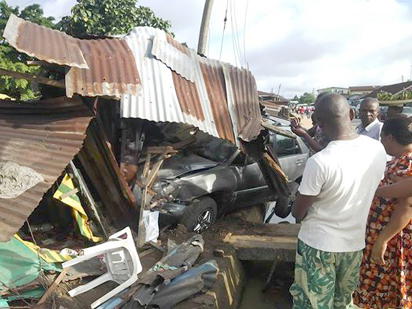
Devastation at Obubra village
By Emmanuel Una
THERE is one thing that modernity, Christianity and education have not extricated from the psyche of communities in Cross River State: the proclivity to settling scores and disagreements with one another through machetes and guns.

Devastation at Obubra village
The state is fondly referred to as “Paradise City” because of its endowment of vast arable land and rich natural resources of all sorts that make it the cynosure of many eyes. Its land stretches thousands of kilometres through forests, hills and mountains some portions of which are still virgin and have not been touched by human activity since creation.
Yet it is this rich endowment that is presently fuelling communal clashes threatening to tear the state apart. The average community has vast portions of land on which people farm mostly on subsistence and shifting cultivation pattern. Now virtually every village is pitched against its neighbours in squabble for land, and in most cases the piece of land in contention is a tiny and insignificant strip that can hardly accommodate a farm that to feed a family for a season. In fact, communities are willing to engage each other in a fight which could destroy lives and property for the sake of that piece of land.
Interestingly, apart from the Adadama/Amaku conflict and the Ukele/Izzi conflict which are between the people of the state and Ebonyi communities, most squabbling communities are nothing short of kith and kin. They are people who share same ancestral bonds, customs, traditions, traditional names, family ties, trade in the same markets and have interacted and intermarried for several decades. Often, these similarities are not taken into consideration when squabble for land is involved. Most worrisome is the fact that some elites and educated members of these communities actively take part in the conflicts which are seen as a show of strength and demonstration of superior prowess when combatants come back with fresh human heads, decapitated from the bodies of “enemy” community members.
For instance, Nkim and Nkum communities are Ejagnam speaking villages in Ikom Local Government of the state. The villages located along the Ikom –Ogoja highway have a contiguous living pattern and claim to be the offsprings of the same man. Apart from the “u” in Nkum which changes to “i” in Nkim, there is nothing to separate the two villages yet when they took on each other it was as if they were complete strangers. Lives were lost, property destroyed and the enmity subsists several months after the “war”.
The preponderance of these conflicts is worrisome even to the authorities, particularly during the planting season which stretches between January and May. In 2016, there have been over ten communities at each other’s throat feuding over land. For example 2016 opened with the Oyoba village in Wanikade and their Ehetezi neighbours of Wanihem all in Ukele, Yala Local Government Area taking up arms against each other. The conflict which raged for four days was only put to rest when soldiers from the Brigadier Ally Batallion in Okuku near Ogoja were drafted to the area to stop hostilities. The police contingent that first went in could not stop the fight because of the high caliber weapons used in the combat. Needless to say that during those four days many people died, several wounded, farm produce destroyed and houses set ablaze.
On the trail of this was the Inyima/Onyadama conflict in March where women, children, the aged and the entire houses in Inyima were set ablaze. The conflict which has become a recurring decimal was first fought in 2008, then 2014 and now in 2016. The cause of the war is as bizarre as it is weird. An Inyima man was said to have harvested cassava in a disputed portion of land with Onyadama community. Since the first outbreak of the conflict many years ago, there have been recurring skirmishes with attendant bad blood which have kept the two erstwhile sister communities at daggers drawn.
While the Inyima, Onyadama conflict raged, their friends in far away Ogoja, Ukpe and Mgbegede communities took up arms against each over a piece of land which has been in dispute between them for some time. Yams and other farm crops already planted were excavated and destroyed, while those in yam barns were set on fire. Incidentally, these two communities speak the same dialect, Ishibori, which suggests shared blood ties and ancestry. The blood ties notwithstanding, they readily shed each other’s blood through machete cuts and gun shots.
It took the spirited efforts of the police and the Ogoja chiefs before normalcy returned to the area.
A week after the Ukpe/Onyadama conflict, the fiercest of them all erupted in the central senatorial district between the Nko and Mkpani. During the “war” sophisticated weapons were used leading to the killing of several people including soldiers, pastors, women and children while educational institutions, hospitals and residential houses were set alight. Incidentally, this conflict involved the community of the Chief of Naval Staff, Admiral Ibok Ette, the Minster for Niger Delta Affairs, Pastor Usani Usani on one hand and that of the former governor of the state, Chief Clement Ebri on the other hand.
In Obudu where the state governor, Senator Ben Ayade comes from, two communities, Kutia and Okurtong, are in serious faceoff over a piece of land. The two villages fought a bitter war in 2012 over the land in dispute and to forestall another outbreak of full blown skirmishes between them, Senator Ben Ayade, the governor convened a meeting of leaders of the two communities in his office to sort matters out.
Owing to the plethora of conflicts, the police and other security agencies seem overstretched and unable to contain them. When the State Commissioner of Police, Mr Henry Fadairo, visited the Inyima and Onyadama communities at the peak of their conflict to seek to cessation of hostilities, angry combatants almost mobbed him. It took the gallant effort of his personal security before he was taken out of the place. Reacting to the incident, the Police Commissioner told Vanguard Metro that the police alone cannot maintain the peace in the several flash points in the state and that community leaders should play a more active role in curtailing the excesses of their people.
The Minister for Niger Delta Affairs, Pastor Usani, in an interview with VM said he was ashamed of the many communal conflicts in the state which he said are acts of criminality being given the coloration of political strife. He called for decisive action against communities engaged in the act of warring against other communities.
Disclaimer
Comments expressed here do not reflect the opinions of Vanguard newspapers or any employee thereof.