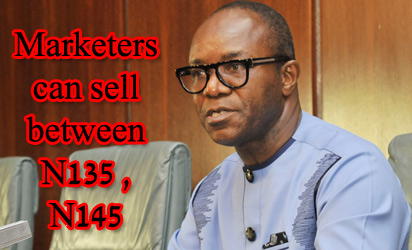
NEW FUEL PRICE—Minister of State, Petroleum, Dr. Ibe Kachikwu, briefing newsmen on the new fuel price, yesterday, in Abuja.
By Clara Nwachukwu, Energy Editor
MANY theories have been used to describe Federal Government’s announcement of a new price band for petrol not exceeding N145/litre. Some say it is deregulation, others argue it is partial deregulation since the Petroleum Equalisation Fund,
PEF, is still in force; while some others say it is market interplay. So definitions or postulations differ according to respondents. Since 1999 at the inception of the renascent democracy, Nigeria has experienced 13 pump price regimes for petrol, two since President Muhammudu Buhari took over power. This notwithstanding there had been at least 15 similar price hikes from the days of General Yakubu Gowon to the General Abdulsalam Abubakar administrations.
Each administration had given a plethora of reasons for every increase, with the most common being the need to make the product more available and affordable, while also deploying the excess funds realised into the development of other sectors. But these objectives were rarely met.

NEW FUEL PRICE—Minister of State, Petroleum, Dr. Ibe Kachikwu, briefing newsmen on the new fuel price, yesterday, in Abuja.
What Nigerians are paying for with N145/litre: At the current price band not exceeding N145/litre, Nigerians are paying for a lot of systemic weaknesses that the government is unable to deal with.
These include shortage of resources to fund subsidy; porous borders; non-functioning local refineries; foreign exchange inadequacies and import dependency; obsolete infrastructure; inability to tackle corruption, and a host of many others.
80 percent pump price increase
While government is forcing these addition costs of up to 80 percent pump price increase, it conveniently seemed to forget that the national minimum wage of N18,000/month has not had a corresponding increase, even as many states in the federation are unable to pay that little. Yet, the organised labour is proposing a new minimum wage levels of N56,000/month; where the best offer so far is about N25,000.
Product availability and accessibility: Government said the new price will make petrol more available and accessible to Nigerians, and will eliminate the acute scarcity situation witnessed in the recent past. But again, the concern is how will the market play out under the current dispensation where marketers are to source for foreign exchange, forex, on their own? The Chairman, Nigerian Association of Petroleum Explorationists, NAPE, Mr. Nosa Omorodion, who spoke in his personal capacity, argued: “There is no doubt that the new price can only encourage more people if they are allowed to join the fray of importers and ultimately you’ll see demand and supply forces at play and over time price will fall as supply increases.
“Now the challenge is the smooth process of how people will be able to access the market and I worry about asking them to go source for forex from the secondary market and not the primary market. What I see is that by the time oil price goes up again to either $60 or $70, then you’ll discover that we will be back to square one and government will start doing subsidy again.”
Subsidy is gone: Again Abiodun allays fears of possible future subsidy and forex challenges, saying “there will be no subsidy because nobody is paying subsidy anymore; if you bring in petrol to sell at your cost plus margin, where is the subsidy? When crude price rises to $50 or more, or falls below, you simply price your product accordingly.” He also noted that “the price of petrol, kerosene and diesel is directly proportional to the price of crude. So if crude price rises or falls, your price will do same. Subsidy is now out of the window completely, it was unsustainable and gone forever, God willing.”
He insisted that under the current price regime, there would be more players in the market, which would eventually force down price as the market interplay takes control. “Current unprofitable procedure cannot persist because it is not sustainable, if we must grow the economy. Let everybody go ahead and import. Go find forex and import products,” he added.
Sourcing for Forex: Against this backdrop, Abiodun lists the benefits of marketers and importers sourcing their own forex to include freeing up forex from secondary sources. He said: “It will help because hitherto, the forex we were looking for was N197 – $1, but now we can buy from export proceeds; we can buy from the parallel market and also from people who have funds who will now legitimately loan out the money.
He added that marketers no longer needed to go begging cap-in-hand to access forex, as even with the government’s intervention, NNPC was only able to make available between $200 and 300 million monthly, against marketers requirement of up to $700 million, to import about 10 billion litres of petrol. Besides, he said government was still owing marketers over N300billion from forex differentials and interests.
PPPRA template/deregulation: There are still issues as to whether the petrol sub-sector of the downstream market had been fully deregulated, as the Petroleum Products Pricing Regulatory Agency, PPPRA, put the market price of petrol at N243.05/litre, even as the Template on its official website put the price band at between N135 and N145/litre. In this regard, the Executive Secretary, Major Marketers Association of Nigeria, MOMAN, Mr. Obafemi Olawore, said: “What we have is partial deregulation because there will still be PEF, and so we have just started the journey to the Promised Land.”
PEF sources, told Vanguard that bridging claims, to enable marketers sell petrol at uniform prices nationwide, was an average of N2billion, adding that across the 95 depots operated in the country, “once the depots are receiving products, it goes into our accounts and claims are being processed immediately. The source also confirmed that PEF owed marketers hundreds of millions of Naira in outstanding claims, adding that claims were compiled on a daily basis.
The source said the claims for April were currently being compiled. But Abiodun insisted it had nothing to do with deregulation – full or partial as nobody had said the country was in deregulation. “Nobody has said we are in deregulation, what government is saying is that every Nigerian can go and import fuel. If you want to do the business, go to DPR, register your company, get a licence and find a way to bring in fuel; you will see that at the end of the day, price will crash because competition will grow among the marketers.
So now you don’t need a PPPRA allocation to import, government doesn’t need to regulate the products coming in. In fact, it will be good if there is a glut in the market because it will force down prices. So regulation or deregulation does not come into play.”
Minimum wage: With regard to how Nigerian workers will manage the 80 percent price hike in an N18,000/month minimum wage, Olawore, who did not support uniform national wage, urged labour to engage the government more in dialogue.
“If we go back to the era of subsidy, the kind of queues you will see will be unprecedented because there is no money around at all to pay subsidy. Now that government will free itself from subsidy payments, whatever gains that the government makes should now be reinvested and even if they (labour) can’t get the N56,000, they should negotiate at least. Oshiomole has said he will pay N25,000, then they look around this; states that can pay N25k, those that can pay N18k let them pay. I am not in support of having equal minimum wage throughout the country. Cost of living in Taraba is not the same as in Lagos, so we cannot have the same minimum wage.”
But in Omorodion’s opinion, “for it (price increase) to achieve some of the desired effects, there must be some immediate succour, which must be rolled out to placate the attendant effects on an already impoverished worker.” While Abiodun assured that the benefits of the new price regime would not go the same way as in the past, he said “this time around, we have the right leadership that is disciplined, focused and have the will and desire to ensure that Nigeria occupies its pride of place in the comity of nations. So we’ve had promises that failed in the past, but you can be sure that under President Buhari, whatever that will go into subsidy payment before will be more than justly utilised to ensure that Nigerians get the fullest benefits.”
Disclaimer
Comments expressed here do not reflect the opinions of Vanguard newspapers or any employee thereof.