children
By Rotimi Ojomoyela
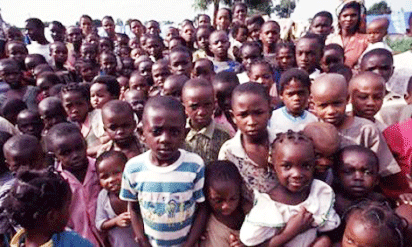
Problems of orphans and vulnerable children would continue to evoke sympathy and emotion, because this category of people are never put in consideration. Often times, they are consigned to back seat whenever government, at all levels, make plans for every sector of the society.
Little wonder, the exact numbers of orphans and vulnerable children are difficult to come by, but the National Bureau of Statistics puts the number of children in this category at about 17 million in Nigeria. Some of the children are orphaned by the HIV /AIDS pandemic whose cure is yet to be found. Most of these vulnerable children are left to suffer due to lack of adequate care.
These innocent children suffer hardship and are being exposed to various forms victimisation and Government at all levels has failed to provide for them. Ekiti State, just like other states of the Federation has its fair share of vulnerable children. Some of them have become destitute beggars without any future. These children are found in all the 16 local government areas of the State.
This is why the timely intervention of the United States of America President’s Emergency Plan for Aids Relief (PEPFAR) being anchored by Women and Children Development and Health Research Initiative (WCDHRI) is a welcome development.
Explaining the mission of the NGO in Ekiti State last week, at the inauguration of a training programme for the vulnerable children and their care givers, Dr Pius Idowu Ade-Ojo, the Project Coordinator said that the programme was all about orphans and vulnerable children, otherwise known as the “OVC.”
“We try to enrol children who are orphaned, mostly by HIV. Our project site is Aramoko here and after enrolling the children, we try to categorise them according to the kind of orphan they are.
“We have the paternal, maternal and the double orphan. The paternal children is one whose father is no more, the maternal is one whose mother is no more and a double orphan is one whose parents are no more. But there would be someone under whose care an orphan is, we call such a person, the care-giver. It is this person or persons that we try to empower with this programme so that he or she can in turn take care of the orphan.
Probing questions
“The programme does not allow us to just dish out money to the care givers, but to give them skills acquisition trainings in form of vocations such as mechanics, hair-dressing,computer studies, knitting, soap and bead making, vulcanizer, fashion designing, cabinet making and bricklaying among others, “ he said. .
According to Dr Ade-Ojo, a total number of 48 care-givers have been identified in Aramoko Ekiti and 750 vulnerable children have been marked out to benefit from the scheme. “The main focus of our programme is to reach out to those considered seriously vulnerable, you know some could be more vulnerable than others. There are the most vulnerable, more vulnerable and vulnerable. The most vulnerable are the ones we take care of first.
“The project is being funded by the United States Embassy. From our experience on this programme, we have discovered that the rate at which Nigerian children are becoming orphans is now alarming. We find out that the ones we have enrolled are actually orpahns through some very probing questions we ask them and the forms they fill,” he said.
He lamented the lack accurate statistical data of these children by the Nigerian government. Ade-Ojo expressed concerns about the alarming rate of children orphaned and made vulnerable by diseases such as Aids and other terminal ailments.
Disclaimer
Comments expressed here do not reflect the opinions of Vanguard newspapers or any employee thereof.