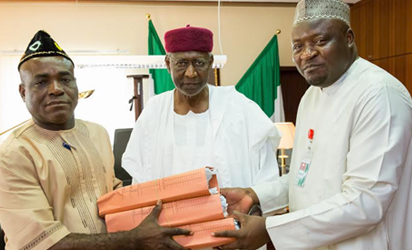
File: Chief of Staff to President Buhari Abba Kyari receives budget from Senior Special Assistant to President on National Assembly matters Senator Eta Enang and Hon. Kawu Ismaila in Statehouse on 7th April 2016
By Godwin Oghenede
ZBB Requirements
THE starting point in the preparation of Zero Based Budget is for the government to clearly define its key policy thrust. They are the pillars and foundation for any budget preparation and interpretation. These policy thrust must be well articulated and understood by all the people involved in the budget process including the NASS. The question that must be asked in this regard is how well stated and communicated to all concerned are the government policy thrusts. From available facts, it would appear that while the government has indeed articulated Six cardinal Key Policy Thrusts which include Economy and Social Development, Infrastructure, Governance, Environment, State and Regional Development, it has or appear to have failed to educate, train and communicated these key policy thrust well enough to all participants in the budget process and hence the fiascos.

Chief of Staff to President Buhari Abba Kyari receives budget from Senior Special Assistant to President on National Assembly matters Senator Eta Enang and Hon. Kawu Ismaila in Statehouse on 7th April 2016
The second key element of Zero Based Budgeting is the requirements for all items proposed in the budget to be justified, stating vision, mission, mandate, strategic objectives, challenges, strength, opportunities, threat, key performance indicators and deliverables and hence the need for Head of Departments to defend their budget before a budget committee of such at the Ministries or Agencies level prior to consolidation and for Ministers to defend the consolidated Ministry budget before the NASS. It is at this pre-consolidation level where departmental heads defend their departmental budgets that items are either eliminated or added to the budget based on set guidelines, available funds and priorities of government.
The third element is the assignment of a realistic cost figure to every element and project included in the budget.
These cost elements must be thoroughly reviewed and prioritised in line with government stated objectives and available funding. Such review must include cost benefit analysis, alternative solutions and minimum set cost for achieving the stated objectives below which the project becomes unviable or unachievable and deselected.
The 2016 budget has been characterised by twists and turns as it makes its passage through the NASS. At the budget preparatory and subsequent submission to NASS levels, there were daily reports of strange happenings alien and unknown in any civilised budget circles. There were reports of missing budget copies, existence of fake and original copies of the same budget that requires a forensic analysis of such to differentiate the fake from the original. There were reports of budget padding and of missing headings that were initially included but later found to be missing from the final version of the budget. There were reports of items that were not in the budget originally but smuggled in through the back in the final version. Such reports include the:
*N4 billion that was removed from Ministry of Health Budget and added to Code of Conduct Tribunal
*Cost of 80 illegal roads added to Works Budget.
*73 Illegal projects added to Education Budget with no project design or costing
*50% slashed from Educational Budget for poor students and added to state constituencies.
*N60 billion for Calabar- Lagos that was rumoured to be included but later removed.
These are kindergartens stuff that makes us a world laughing stock and exposes our weaknesses to govern as a nation. They are counterproductive and a negation of the proclaimed Change Agenda of the current administration. A change that is not well articulated or thought through. A change that failed to adequately train and build capacity of staff responsible for the budget preparation. A change that is not well understood by all concerned. A change that is resisted by the old guides within the Ministries, Agencies and Department of government. A change that is equally resisted by the legislative arm.
Under the new system, ZBB, the NASS cannot add items that has not been budgeted or planned for in the budget. To do so will be a deviation from the three cardinal requirements of Zero Based Budgeting as earlier stated. In the same vain the NASS cannot remove projects that has been included in the budget as a reflection of the key government policy thrust nor can they reduce a project cost below a minimum set level necessary to carry out the project if we are to move away from the era of abandoned projects. In this regard, President Buhari is right and clearly justified in withholding assent to the budget and returning it to NASS for NASS to do the right thing. If this is done the Executive and the Legislative arms of government would have learn some lessons while embracing a change for the better as part of our democratic learning process.
*Mr. Oghenede, an accountant, wrote from Lagos.
Disclaimer
Comments expressed here do not reflect the opinions of Vanguard newspapers or any employee thereof.