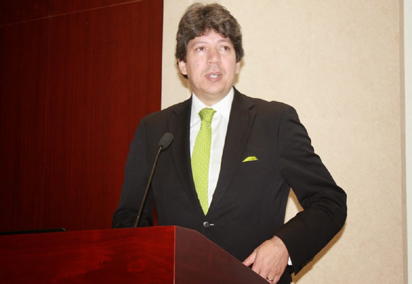
IFAD boss, Oscar Garcia
By Gabriel Ewepu
ABUJA- THE International Fund for Agricultural Development, IFAD, has disclosed that it has spent $317.6 million on 10 development projects in Nigeria for the past 30 years.
This was stated by the Director, Independent Office of Evaluation, IFAD, Oscar Garcia, during a Round-Table Workshop, at the conclusion of the IFAD-supported country programme in Nigeria.

IFAD boss, Oscar Garcia
Garcia explained that the purpose of the evaluation of IFAD projects in Nigeria was an assessment of performance that can help the government, IFAD and other partners to develop the next country strategy- COSOP-and new projects financed by IFAD.
In highlighting the findings of the evaluation, he said there was considerable improvement in incomes and quality of life of the rural poor, and also the partnership between the government of Nigeria and IFAD has grown stronger.
He said: “The evaluation finds that partnership between the government of Nigeria and IFAD has grown stronger in the period covered by the current IFAD country strategy, or COSOP. Over the last 30 years, IFAD has supported 10 projects in Nigeria for a total cost of $795.3 million, of which IFAD has provided $317.6 million.
“In general, projects supported by IFAD over the past five years have been effective in improving the incomes and quality of life of the rural poor. Results were clearly visible in the communities where programme investments were focused. The single greatest achievement has been the strengthening of farmers’ social capital through the creation of community-level organisations.
“Programme investments led to a significant increase in physical and financial assets in hard-to-reach villages, and to increases in food production and productivity. The evaluation found that community development associations are registered and they continue to function. Most of the assets created are being managed in a sustainable way.”
However, he said there are still some areas that deserve further attention.
“Firstly, unreliable flow of funding and delays in implementation has been major factors affecting the delivery of such results.
“Secondly, efforts to document and disseminate those results have been insufficient. In general, such efforts were hampered by poor quality data available from monitoring and evaluation. Even though substantial efforts were made to produce baselines and impact studies, the quality was disappointing and the studies were of limited use for knowledge management.
“Thirdly, effective targeting has been hampered by lack of credible data at the sub-state level. The participatory methods used to select the poorest locations and households, did not demonstrate the clear criteria and consistent documentation required for a transparent and consistent process.
“And last, but not least, the evaluation also finds the partnerships were built on ad-hoc base and around the specific needs of individual programmes rather than at a more strategic level. Stronger coordination capacities at federal level would have supported a more strategic approach to partnership building,” Garcia said.
In his advice upon the findings and evaluation, the challenges of rural poverty reduction are huge and require concerted effort of local, federal governments, civil society organisation, private sector and the international cooperation community.
“The partnership between IFAD and the government of Nigeria is strong but as the results of this evaluation show, there is room for improvement and a stern call for action for better development results is needed”, Garcia stated.
Disclaimer
Comments expressed here do not reflect the opinions of Vanguard newspapers or any employee thereof.