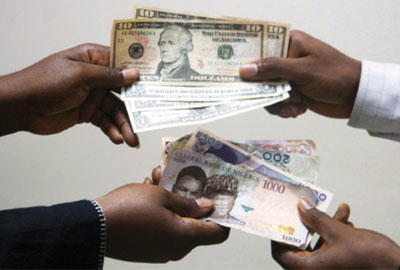
Indeed, Naira devaluation is probably the most potent weapon against the prosperity of Nigerians. Nigeria’s migration from a potential industrial power house with bustling social affluence, to a subdued and stumbling economy clearly began with the adoption of IMF’s Structural Adjustment Programme during Babangida’s regime: the chorus from International Agencies, at that time, was also that falling oil prices with an unserviced debt burden and the consequent restriction of trade credit to Nigeria, were the products of an allegedly overvalued Naira exchange rate.
By Babajide Komolafe
LAGOS — The Nigeria Economic Summit Group (NESG) has queried the 22 commercial banks over what it describes as illegal fixing (cap) of the interbank foreign exchange rate.

Naira-Dollar
Among other things, the group complained that the cap on the interbank foreign exchange rate was impacting negatively on member companies and contravened the Foreign Exchange Act of 2004.
The group also alleged that the development was being exploited by some banks to engage in unethical practices, such as extorting customers in a bid to maintain the stagnation.
Entitled, “Reports by the Organised Private Sector on the Current Practices by Banks in the Nigerian Foreign Exchange Market,” the query was signed by the Chief Executive of the NESG, Mr. Laoye Jaiyeola.
Copies of the query were also sent to the Central Bank of Nigeria (CBN), Chartered Institute of Bankers of Nigeria (CIBN), Financial Market Dealers Quote (FMDQ), OTC Securities Exchange and Nigerian Bar Association (NBA) Section on Business Law.
The query stated: “Our members have brought to our attention certain issues and practices in the Nigerian foreign exchange market which are impacting negatively on their business activities and the economy as a whole.
“We are informed that over the last year (February 13, 2015 to date), the foreign exchange rate quoted by banks to authorised sellers (such as, International Oil Companies (IOCs), importers, etc.) has remained consistent at N197/$ regardless of the transaction amount or timing of the transaction.
“Despite recent events in the FX market, which has led to exchange rate volatilities, the purchase price quoted to authorised sellers has remained stagnant, thus not providing a true reflection of the current state of the FX market.
“Our members have also reported that the apparent cap in FX rates has also motivated some banks to indulge in unethical practices, such as extorting customers in a bid to maintain reconciliation with the perceived rate cap.
“Upon thorough review of the CBN guidelines and circulars, we find no indication of any regulatory action/directive imposing a cap on the rate at which banks can buy foreign currrncy from authorised sellers. Indeed, Section 9 of the Foreign Exchange (Monitoring and Miscellaneous Provisions) Act 2004 (The FEMM Act) provides that ‘the rate at which each transaction in the market shall be executed shall be the rate mutually agreed between the applicant and purchaser and the authorised dealer or authorised buyer concerned’.
“The foregoing provision suggests that the purchase rate ought to be based on bilateral agreements and, as such, is inconsistent with the current practice of quoting a fixed FX rate.
“Based on the foregoing, we request an explanation of your institution’s adherence to this practice, despite no precedent or directive to this effect. We would be grateful to receive your response within 48 hours of receipt of this letter.”
How CBN, few banks fixed interbank rate
Investigations, however, revealed that the cap in the purchase of FX rate in the interbank market was one of the outcomes of a secret meeting between the CBN and some banks a few days to the general election of last year.
A few weeks to the general elections, the foreign exchange market experienced volatilities occasioned by the uncertainty about the general election and the exchange rate of the naira. To address these volatilities, the CBN, according to industry sources, held a secret meeting with the Chief Executive Officers of some banks.
The CBN was said to have prevailed on the bank CEOs to assist in pegging the interbank rate to a maximum of N2 above the CBN rate. The bank CEOs were to direct their treasurers not to trade and the foreign exchange dealers not to deal in the two-way quote interbank market.
Consequently, the banks involved stopped offering two-way quote in the interbank market and offered only a one-way quote. By so doing, they controlled or determined the rate at which anybody can sell foreign exchange in the market.
Investigation, however, revealed that the arrangement was informal with no circular or directive to that effect and it was supposed to be temporary, till after the general election.
But it has remained in force for more than a year due to the reluctance of the CBN to revert to status quo. Also, the arrangement created opportunities which many banks have exploited to either extort customers or engage in round tripping of foreign exchange
Banks earn N100/$ roundtripping forex
Investigations revealed that though banks purchase foreign exchange from authorised sellers like IOCs and exporters at N197 per dollar, they, however, sell the same dollars at exchange rate as high as N300 per dollars through overseas ATM withdrawal or PoS transaction made by customers via their debit Mastercard or debit Visa card.
Confirming this, an importer, who spoke on anonymity, said the exchange rate charged for his debit card transactions had always been above N300 per dollar.
Disclaimer
Comments expressed here do not reflect the opinions of Vanguard newspapers or any employee thereof.