By Henry-otis Amurun,
“Our progress as a nation can be no swifter than our progress in education.” – J.F. Kennedy.
IN 2010 our NECO (National Examinations Council) National Average was said to be 2.8%; in other words, over 97% failure. This was a national disaster of course, though not as far as government was concerned.
The statistics have tended to look better in recent years, that is, if you consider statistics such as: 2012 38.81%; 2013 44.60%; 2014 31.28%, to be worthy of a country which prides itself as a continental giant.
Experts have attributed our consistent, egregiously parlous WAEC performance in large measure to problems with lesson comprehension due to failure of tuition.
In a Punch interview of May 9, 2010 Mrs. Solarin, a foremost educator said: “We are going wrong from the primary level. .. lf they (the children) are going on to secondary school, they have to learn to read in English … English has about 44 sounds and 26 letters, and tends to use these letters in various ways to represent the sounds. But most teachers don’t have any idea how these are taught.”
It is difficult to see how a nation hopes to develop when it has not the academic capacity to provide its children with the basic skills for reading and developing vocabulary.

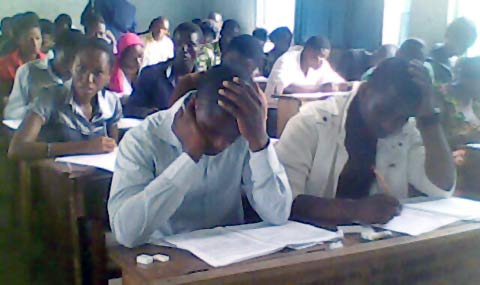
Some candidates during Unified Tertiary Matriculation Examinations
Developing vocabulary
Analogous views have been expressed about Mathematics.
In a Vanguard interview of
April 5, 2013 Prof. Ngozi Azuka Osarenren of the Faculty of Education, University of Lagos, said: “In a subject like Mathematics, there are four key concepts which many of the Maths teachers themselves do not know. There are some aspects of the Syllabus which come out in their examinations that are not taught by the teachers because they do not even know it themselves … “ Frightful report!
If the children have not been taught to spell and to read, how can they be expected a few years later to pass examinations set in English? How would they understand geography? How can any nation proceed into a new millennium on such educational credentials as a 97% failure in a regional examination?
We must begin from scratch, the process of redeeming our education, because “our progress as a nation can be no swifter than our progress in education.”
Glen Dorman, renowned author of the book, Teach Your Child to Read, said: “Lack of reading and lack of intelligence go hand in hand in individuals and in nations.”
It is obvious then that we have a fundamental and urgent national problem. If it is not tacked quickly, all the talk about “Change” will remain mere political sloganeering designed to distract the people.
At a Reading and Writing Skills (RWS) workshop organized by The Pulitzar Reading Club, Nigeria (TPRCN) in a secondary school at Eruemukowharien (an oil producing village near Ughelli in Delta State), I was explaining the need for every student to create a personal compendium of new words and phrases.
The word “COMPENDIUM” had been deliberately chosen in an effort to demystify so-called ‘big words.’
Asked to spell that word,
several students could not. The next step in an RWS lesson would be to syllabify the word and attempt to spell each syllable. Thus I asked the next student (a boy in JS3) to spell the first syllable of ‘com – pen – dium.’ He could not, or perhaps did not understand me. So I asked him to spell a related word which means: ‘move to me’ or ‘move towards me.’ The poor fellow could not spell ‘come’ either.
The English teacher explained that most parents objected to their children repeating classes when they failed. This was in fact government policy at some point.
If our national pass in WAEC/NECO is averaging 2.8 to 30%; if our children cannot spell; if our university graduates are being disparaged for showing low comprehension levels, these are clear evidence of a dysfunctional education system.
In a series on ‘Research-Based Practice in Early Reading’ published by the Regional Educational Laboratory at Pacific Resources for Education and Learning, Honolulu, Hawaii, the research laboratory concluded as follows: “Of the many compelling reasons for providing students with instructions to build vocabulary, none is more important than the contribution of vocabulary knowledge to reading comprehension …
“Given that students’ success in school and beyond depends in great measure upon their ability to read with comprehension, there is urgency in providing instruction that equips students with the skill and strategies necessary for lifelong vocabulary development.”
Steep descent to certain calamity
The private sector evidently recognizes this need as well as its urgency, hence the scramble by proprietors of private schools, falling over one another to recruit Ghanaian teachers who appear to be better grounded than their Nigerian counterparts.
Unfortunately the
education authorities in Nigeria do not seem concerned. Parents who can afford private schools or schools abroad have turned in those directions, while the Nigerian school system continues to careen in a steep descent to certain calamity.
About the same time as the momentous NECD failure of 2010, one new generation Bank stated that it would no longer recognize certificates from Nigerian universities. Other than a mild response from Prof. Charles Soludo, (then the CBN Governor) who enjoined banks to provide requisite training for their fresh in-take, there was no reaction from government.
It must have been around the same time also that the National Universities Commission (NUC) announced the de-accreditation of certain courses in some frontline Nigerian universities. These three events happening contemporaneously would have blown the dome right off Parliament in some climes. Not in Nigeria however.
As far as the authorities here were concerned, nothing had gone amiss.
Several years ago, a committee of the American Senate, (or Congress) lamenting what it considered to be the fallen standard of American education said: “If the present standard of education in the United States of America were imposed on this country by a foreign power, it would have amounted to a declaration of war on the United States.” (Quoted from memory).
Yes! That is how conscientious governments react to impending danger; but not Nigeria, unfortunately where everyone (government, the university professor who certifies the unqualified teacher; the Nigerian who watches in silence) has made a declaration of war on the State through the imposition of a deleterious standard of education on our nation. Was it Chinua Achebe or Wole Soyinka who said: “Many words do not fill a basket”? It would be sad to envision us as one huge basket nation, but enough has been said.
We must quickly proceed to action, take Sheila Solarin’s advice and start today to teach our children to spell and to read. Even the Bible (Proverbs – 22: 6) is clear on the matter.
As the world celebrates World Book Day, we must begin to read again; we must give the book its pride of place in the family and in our nation.
We must be the examples to the children. Let us all make a binding commitment to begin this task today. There is no time to lose, because the rest of the world will not wait for us to catch on, or catch up.
Henry-otis Amurun (0812 198 1104), is the President of The Pulitzar Reading Club, Nigeria.
Disclaimer
Comments expressed here do not reflect the opinions of Vanguard newspapers or any employee thereof.