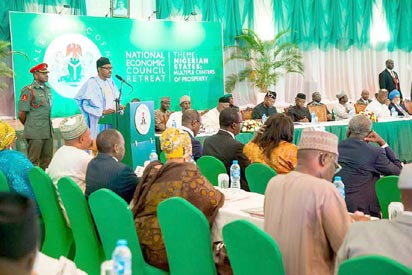
•President Muhammadu Buhari addressing participants at the retreat
lNo, 70 resolutions reached to revamp economy —Presidency
By Emma Ujah , Abuja Bureau Chief
The Abuja Chamber of Commerce and Industry, ACCI, has expressed disappointment with the outcome of President Muhammadu Buhari’s Economic Retreat in Abuja, saying it failed to address fundamental issues.
The chamber, which is the umbrella body of all manufacturers and industrialists in the Federal Capital Territory, said what transpired at the retreat did not meet the expectations of Nigerians who advocated it, alleging also that the Organised Private Sector, OPS, was not carried along in the organisation of the summit.
President of ACCI, Mr. Tony Ejinkeonye, said: “We had expected the National Economic Council to discuss possible ways of dragging out the Nigerian economy from the present recession.
“We expected to witness a conference where economic experts and stakeholders would join hands on approaches that would be geared towards rejuvenating the economy of our dear nation.”

•President Muhammadu Buhari addressing participants at the retreat
The ACCI boss added that it was time to bring in the Organised Private Sector, OPS, to work with state actors in order to fashion out a realistic, measurable national economic recovery strategy, with clear milestones.
“We also believe that it is time to co-opt economic experts into the National Economic Council, given the current economic crises,” he said.
Mr. Ejinkeonye said that in the developed world, there were specific groups such as the German Economic Team, White House National Economic Council and United Kingdom Government Economic Services that were saddled with the responsibility of making sure that governments’ economic policies were strictly implemented.
“These sets of individuals also ensure that the government agenda are incorporated in the policy implementation. We believe that the government can emulate this model, which in our opinion can yield positive results,” he said.
The President regretted that the increase in the Monetary Policy Rate by the Central Bank of Nigeria from 11 per cent to 12 per cent would negatively affect the manufacturing sector.
Ejinkeonye said: “We were astonished with the development. The CBN had in November 2015 eased the MPR from 13 to 11 per cent and the CRR from 25 to 20 per cent in order to advance the economy and boost critical growth sectors.
When contacted, a Presidency official, who pleaded anonymity said: “There is no way the federal government would leave out the private sector. In the first place, the ACCI did not mention what the fundamentals were but about 70 resolutions were reached at the economic retreat and government would work with these resolutions to revamp the nation’s economy.
Disclaimer
Comments expressed here do not reflect the opinions of Vanguard newspapers or any employee thereof.