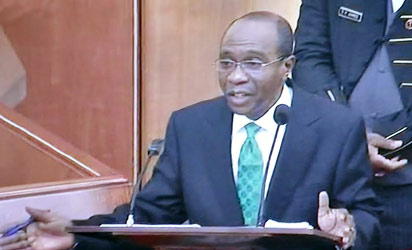
Mr Godwin Emefiele answering questions during his screening by the Senate for Central Bank Governorship in Abuja on Wednesday
There were indications that a complementary interplay of fiscal and monetary policy may have begun with last week’s policy actions from the authorities in both arms.

Mr Godwin Emefiele answering questions during his screening by the Senate for Central Bank Governorship in Abuja on Wednesday
Following the passage of the 2016 Appropriation Bill by the National Assembly on Wednesday last week Federal government through the ministry of planning indicated that it would commence its expansionary fiscal measure which primarily was predicated on infrastructure and other capital expenditure programmes.
The expansionary budgetary implementation would also involve deficit spending to the tune of N2.2 trillion, aimed at stimulating the economy.
The fiscal action came on the heels of a special retreat of the National Economic Council which was driven by a singular focus on steps to address the troubled economy and the financial condition of the sovereign states. The Council outlined eight thematic areas and 71 specific proposals that signposts the economic policy direction of the President Buhari administration to rescue the economy from its current southwards trajectory.
Also early last week the monetary authority, Central Bank of Nigeria, CBN, rolled out a new policy aimed at price and exchange rate stability through monetary tightening.
Economy analysts said these developments signal a resumption of balanced approach to solutions and strategy for addressing economic challenges.
Hither, it was only CBN that was active in battling the increasing headwinds the economy had witnessed in the past 10 months, a situation which had made results fall short of targets since CBN was not structurally equipped for the dual roles.
In its bid to fill the gap created by long absence of a federal cabinet last year and consequently play the dual role, the apex bank had adopted an expansionary monetary policy since third quarter 2015, by reducing its monetary rates, cash reserve and liquidity ratios, so as to release more money into the economy.
Some analysts believed CBN now focusing on monetary policies may have reversed its expansionary monetary policy in favour of monetary tightening as a preemptive strategy to contain the anticipated inflationary impact of government’s expansionary fiscal regime expected to kick off with the passage of the Appropriation Bill.
Alluding to this reasoning, analysts at Afrinvest West Africa, a Lagos based investment house, said ”the tightening move is more of a precaution (than a correction of previous price spiral) to moderate the demand pressure for foreign exchange, goods and services that could arise from the liquidity impulse of the record expansionary budget.
”The 2016 fiscal year is expected to run on N6.06tn budget while deficit was retained at N2.2 trillion, 2.1 per cent of gross domestic product, GDP.
”It could be a signal that monetary policy, which had hitherto been the only game in town, will return to its conventional objectives of price and exchange rate stability while fiscal policy escapes from its tardiness to anchor the recovery. This could mean a return to inflation targeting”.
Disclaimer
Comments expressed here do not reflect the opinions of Vanguard newspapers or any employee thereof.