By Japhet Alakam
A persuasive speech is defined as a specific type of speech in which the speaker has a goal of convincing the audience to accept his or her point of view. The speech is arranged in such a way as to hopefully cause the audience to accept all or part of the expressed view.
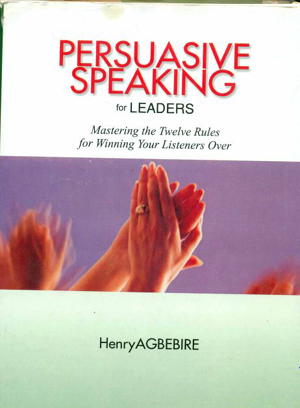
If this definition is anything to go by, then the book Persuasive Speaking for Leaders: Mastering the Twelve Rules for Winning Your Listeners Over is a very good attempt by a seasoned Communication Skills instructor, Henry Agbebire at solving some of the pressing problems of all who wants to improve their speaking skills to win their audience in this competitive world.

Thus, in the 253 page book published by Greenfield Publications, Lagos, the author who is the founder and principal facilitator of Greenfield consult, a specialist training centre where individuals and professionals learn how to speak and write well after many years of teaching decided to put the courses in print hence the book.
According to the author, who is of the view that no matter the position you occupy, your speeches and presentations will amount to nothing if you cannot win the respect and trust of those you lead through what you say, said “the business of speaking is prominently the business of persuasion. Persuasive Speaking for Leaders is based on the philosophy that many of us have the aptitude for speaking, but ultimately need to master the underlying techniques for persuasion in speech.”
Divided into twelve essential principles or rules where factors that would facilitate persuasion in speech are discussed exhaustively.
Rule one tagged Show that you know the topic, here the author opened with the first rule which is to speak on a topic you know, or essentially a topic of your choice. Stating that if it is a topic you are not conversant with ,you have to make adequate preparation, study and research very well on the topic. And after that practice and rehearse the topic several times before presentation.
Rule two, Ensure your message is clear, from the beginning to the end, points to the fact that every good speech delivery must have a central message, a thesis or purpose, so to capture your audience you have to apply the followings, state your purpose, break them into parts, use illustrations and vivid examples, use metaphors and similes to capture vivid images, engage them with questions and others.
The third rule is to tell them what they stand to benefit, with these tips, convince them that you care for them, show them that you understand their needs, tell them what they stand to lose, talk about their strengths and make the benefits real and tangiable.
Rule four points the need to speak audibly and here he highlights some of the requirements like improve your voice, watch the pace of your speech, don’t imitate accent and others.
The next rule is to present logical and reasonable arguments. Here again, the author explains the importance of facts and advice speakers to ensure the points are tied together, avoid incongruous statements and dogmatic expressions.
Rule six and seven talks about the use of simple and effective language and the need to be confident and personable, pointing out their importance to a good speaker.
While eight and nine, points the need to speak for a short and keep to time, and building trust, by sharing your personal experience, provide proofs and evidences and emphsize on integrity.
In rule ten, the author takes a look at the importance of emotional and empathic speech as it touches the audience very well. Here, the power of your voice, the right language and the style and technique of great speakers makes a difference. While rule eleven , be optimistic provides steps to build the self esteem like looking at the brighter side of life,inspire your listeners to take action, use positive words and others.
Applying his experience as a seasoned communication skills instructor, the author sums up the eleven rules in rule twelve, titled Never be boring, and concluded that if one can be able to master them, one will never make a boring presentation.
Written in very simple language with examples for easy understanding, the book, Persuasive Speaking for Leaders is a valuable manual for all leaders and anyone who may be engaged in the overriding business of public speaking like corporate executives, politicians, preachers, student, leaders, broadcasters, toastmasters, master of ceremonies, and all individuals aspiring to excel in the art of public speaking and presentation.
Disclaimer
Comments expressed here do not reflect the opinions of Vanguard newspapers or any employee thereof.