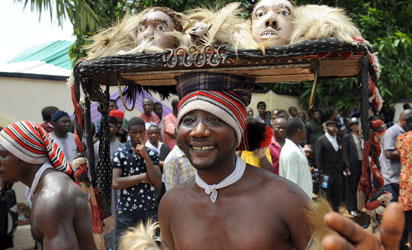
(FILES)- A March 2, 2012 file photo shows an Ohafia cultural troupe entertaining bystanders during the burial of Nigeria’s secessionist leader Odumegwu Ojukwu at his native Nnewi country home, in Anambra State eastern Nigeria. Odumegwu Ojukwu, who championed the campaign for an independent Republic of Biafra in eastern Nigeria in the 1960s culminating in a 30-month civil war which left more than a million dead was buried at his Nnewi family home in Anambra State. Its name is synonomous with the declaration of independence and updates on the brutal conflict that followed, but nearly 50 years after Nigeria’s civil war, Radio Biafra is again making headlines. AFP PHOTO
By Chinenyeh Ozor
The Centre for Black African Arts and Culture (CBAAC), is an off shoot of FESTAC where an assemblage of the world anchored in Nigeria, explored the history of Africa, culture, existence and ways of demonstrating the African culture, showing the unique contributions, qualities of African arts and culture.

(FILES)- A March 2, 2012 file photo shows an Ohafia cultural troupe entertaining bystanders during the burial of Nigeria’s secessionist leader Odumegwu Ojukwu at his native Nnewi country home, in Anambra State eastern Nigeria. Odumegwu Ojukwu, who championed the campaign for an independent Republic of Biafra in eastern Nigeria in the 1960s culminating in a 30-month civil war which left more than a million dead was buried at his Nnewi family home in Anambra State. Its name is synonomous with the declaration of independence and updates on the brutal conflict that followed, but nearly 50 years after Nigeria’s civil war, Radio Biafra is again making headlines. AFP PHOTO
CBAAC Director General, Chief Ferdinad Anikwe in a brain storming lecture at the University of Nigeria, Nsukka shortly after signing memorandum of understanding (MoU) with University on African Arts and culture, noted that 1977 Festival of Arts and Culture (FESTAC) remained the best collection of arts in the world, both in songs, music, drama and demonstration of the rich cultural African heritage, most importantly collection of beautiful ideas, origin and what Africa can offer to humanity.
‘’FESTAC was the best forum for pan- Africanists to energise the contributions of African cultural heritage of all ages’’ he remarked.
Chief Anikwe pointed out that diverse Nigerian languages should be encouraged for tribal orientations, noting that Alhaji Ahmadu Bello made Hausa language a linqua Franca in northern Nigeria by making sure that any Hausa descent who wants to study any course in the university, must pass Hausa language.
In that instance, Hausa language became the most important subject in the northern Nigeria.
He said: “State governments in the south east geo-political zone should as a matter of necessity come up with programmes that will make study of diverse languages in south east compulsory at primary and post primary schooll as the pride of the zone.”
The University of Nigeria first started linguistics studies but Nnamdi Azikiwe University, Awka now offer first degree, master’s degree and Ph.D in Igbo language. We are not talking of only Igbo language but African languages in practical terms’’ he noted.
‘’For the African continent to achieve growth, it must have a template to ensure that the continent graduates from one cultural development to the other and eventually emerge as total Africans’’ he stressed.
Chief Anikwe urged generation of Africans to emulate the ideals of the late nationalist leaders of the likes of Nnamdi Azikiwe, Kwame Nkrumah, Patrice Lumuba, Jomo Kenyatta, Amilcar Lopes da Costa Cabral, Nelson Mandela among others who were the foremost anti colonial leaders.
The CBAAC director general who is also the president of the pan- African cultural congress, (PACC) stood against the belief in the west countries that many African leaders do not want democratic change as they want to be in power for life., explaining that the western countries had leaders who stick to power for 30 years and above.
He stressed that neo- colonialism was worse than colonialism. The simple things Africans would do to uphold the tenets of African cultural heritage is to prove to the Western world that they are proud of their culture, speak the African languages at all times, wear the African attire, play the African music and tell tales of African folks.
‘’The western countries oppress African culture, fighting for the African culture is what is needed by depression. Every Black Country in the world should value what Africans have’’ he said.
He pointed out that CBAAC has good number of programmes that would re-orientate African children, partnering with Nigerian Television Authority ( NTA) to showcase African culture so that rather than seeing the western culture, Africans who are going through the African process would have proper education and respect for elders. Moving Festival of Arts and Culture (FESTAC) to country in Africa is a top priority for the Centre for Basic African Arts and Culture (CBAAC).
Chief Anikwe commended African Nollywood industry for her efforts in x-raying African culture to the larger world, stressing that the present and future African generations should imitate the late African leaders, look inwards and return to the roots, listen to elders, research on areas of African culture that are gradually fading away.
Disclaimer
Comments expressed here do not reflect the opinions of Vanguard newspapers or any employee thereof.