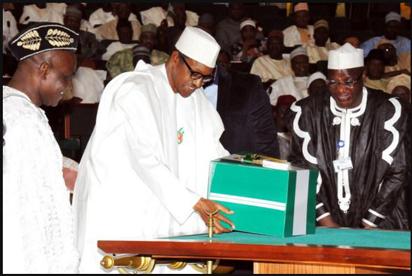
File: Buhari during the 2016 budget presentation to the National Assembly.
By Dele Sobowale
NOTE: This article was written on March 8, 2016, two weeks after it was announced that President Buhari had agreed to organize an Economic Summit. Even then, it was clear to some economists that this government was not really interested in the summit. The summit failed to take off on Thursday, March 10, 2016 as scheduled and no new take-off date had been established. Obviously, there is no commitment; only an attempt to silence critics of government.
“Alas, my lord, there’s many a sycophant
And flatterer that fill your courts with cant
And give more pleasure with their zeal forsooth
Than he who speaks in soberness and truth.”
Geoffrey Chaucer, 1342-1400.(VANGUARD BOOK OF QUOTATIONS.
When late Harold Wilson, the late British Labor Party Prime Minister pronounced in the 1970s that “A week in politics is a long time” (VBQ p 271) he left politicians in the modern age a time metric to determine the tide of events as they affect their popularity with the electorate.
As you are reading this article, President Buhari and the All Progressives Congress, APC, on whose platform he rode to power, would have consumed nine months, or 18.75 per cent, of the time given them by Nigerians to bring about the changes they shouted from the roof tops and everywhere during the elections. If according to Wilson’s arithmetic, a week is a long time, then Buhari and the APC have spent the equivalent of political eternity in office. That is startling enough.

File: Buhari presents N6.08trn 2016 budget to NASS
What should be shocking to Nigerians is the fact they are just now getting ready to sit at another talkfest to discuss the economy. This is simply scandalous for reasons too numerous to discuss in one article. But a few will demonstrate the anguish any economist – irrespective of whether conservative, liberal or socialist — must feel when confronted with the stark naked fact that Nigerians had elected a government and political party which had no economic programme for governance while campaigning for office and which compounded that colossal error by not hastily assembling an Economic Management Team, EMT, the week after former President Jonathan conceded. But, the most inexplicable was the fact that in the five months Buhari took to select a mere fifty-odd assistants and Ministers, it never occurred to anybody in Aso Rock that one of the cardinal functions of a President and government, if not the most important, is to manage the economy.
That, invariably, means selecting those people who would be his advisers and who would develop the Economic Blue Print for economic policies. Here we are, with close to 20 per cent of the first term gone and we are being told they are just about to sit down to discuss the “way forward” – at a time when we should be undertaking the first review of the plans and policies which they have been implementing since June 1, 2015.
Whoever says “history does not repeat itself” has never heard of a country called Nigeria – where the sordid history of failures recurs almost with every change of government. When Professor Wole Soyinka, not an economist, was reported to have canvassed for an economic summit, and the government latched on to it to organize one, the first thing that should have occurred to anyone familiar with our record for economic summits is to ask the question, “Another one?”
“A pessimist is a former optimist who finally got all the facts.” Dele Sobowale, 1991. (VBQ p 186). It is quite possible that those calling for the economic summit, now about to get underway, and Professor Soyinka, don’t have a deep knowledge of the history of economic summits in Nigeria – otherwise they would not have set great store on it. On this one, blessed are they that expect nothing – for they shall never be disappointed. Below is a brief history – just from 1992.
In 1992, when military President Babangida, appointed Chief Ernest Shonekan, GCFR, as the Head of Government, the first thing, the old technocrat did was to organize the First Economic Summit and to create the Nigerian Economic Summit Group, NESG – which still functions today. NESG had not only held annual economic summits, except for two or three years since then, they have contributed several cabinet members to various governments. Buhari’s administration is actually one of the few that had been (un)fortunate to have one of their members on board. If ever there was a group that specialized in organizing annual gabfests, ending in communiqués that are widely praised by government and totally ignored, it is the NESG.
Like most intellectual masochists, it was my sad lot to attend the first two summits on behalf of the Nigerian Institute of Management, NIM. Five more followed; spent representing VANGUARD, until it dawned on some of those in attendance that, apart from being mainly a “billionaires’ forum”, it was a bloody waste of time. For almost seven years, nothing new was added to the basic outlines of the first communiqué. And, for almost seven years none of the recommendations of the NESG was implemented. Incidentally, one proposal that caught the fancy of a government – Abacha’s government – was the most useless.
It was the VISION 2020 idea which was introduced to Nigeria by a guest lecturer from Malaysia, who was in charge of Malaysia’s VISION 2020 programme. The fellow left a lasting impression because he was the contributor of the words, “It does not matter if the cat is black or white as long as it catches rats.” (VBQ p 26). The man made clear that VISION 2020 was not possible in a society where square pegs end up in round holes and where corruption is institutionalized as in Nigeria. Yet, the first government to pretend to adopt the idea was the most corrupt up to that time – Abacha’s regime. Abacha not only grabbed it with both hands, he reduced the number of years which a more advanced Malaysia had allotted to itself to achieve the feat by launching VISION 2010. There is a lesson for Buhari in this story – before he falls into the trap of the praise-singers — his “assistants, Ministers and advisers”.
Abacha assembled the cream de la cream of Nigeria’s thinkers for the fraud and coaxed Chief Shonekan to head the project. Even before the members of VISION 2010 were inaugurated, adverts had flooded all the media congratulating Abacha for “having the vision” to introduce the revolutionary idea which would make Nigeria one of the twenty leading economies by 2010 – yes 2010. Those who cautioned against such unrealistic expectation were branded as unpatriotic. VISION 2010 repeated almost verbatim everything in the first NESG communiqué.
Last week the National Assembly, NASS, sensibly asked Buhari to shelve the idea of spending N500 billion on his Social Welfare Programme, SWP – which some of his sycophants had called “revolutionary”. One national newspaper published an editorial on March 4, 2016 titled” Lawmakers Kill Buhari’s N500bn cash for the poor”.
It was expected from that quarter – where providing everything “free” has been used to deceive the electorate for years. One of the states they govern which started providing “free meals” to school kids is now completely broke and cannot pay its workers. But, the contractors who provided the “free meals”, party members, while it lasted had made millions. If the verdict of history is anything to guide us, less than half of the N500bn will reach the poor and they will all be party supporters. That swindle was what the National Assembly sensibly stopped because the N500bn proposal is so embarrassingly loose as to provide sufficient opportunity for one hundred billionaires to emerge among those who will execute the projects. It is totally selfish.
The fact is, sycophants employ the same words – trail blazing, giant foot steps, visionary, iconic — in every era to mislead Nigerian leaders and the supporters of the N500bn SWP are nothing but a bunch of sycophants trying to pressurize the country to part with N500bn for a wooly-headed programme which will present them with opportunity for self-enrichment.
Today, as you read this column, Nigeria has not moved a step forward towards solving our most urgent economic problems because those in power don’t consider it an emergency. But wait a while. On May 29, 2016, or before, the Ministry of Information will release documentaries telling Nigerians that we have never had it so good. That is the stock in trade.
Disclaimer
Comments expressed here do not reflect the opinions of Vanguard newspapers or any employee thereof.