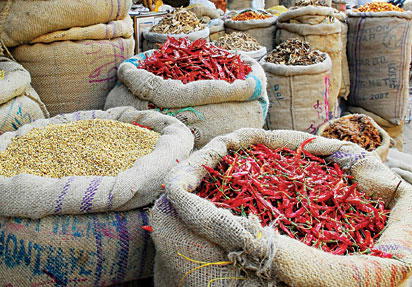
food-items
Panic as hard time worsens
By Charles Kumolu & Faith Ake
FOR Bartholomew Ugonabo, living in Lagos has never been a comfortable decision, but there is no better option available to him.
The commercial motorcycle operator who resides in a two-room apartment in a public compound at Baruwa, located in a cluster of suburbs off Old Ojo Road in Amuwo Odofin Local Area takes care of his family of five with the meagre funds he makes daily.
Barring unpleasant circumstances, especially encounters with the Police, the 42-year-old secondary school leaver makes N3000 on a good day.
In spite of the harsh economic realities of his life, Ugonabo, who pays N10,000 monthly for his two-room apartment in a public compound otherwise known as Face- Me, I-Face-You would hardly entertain the suggestion of relocating to the village.
As far as he was concerned at the time, Lagos was the only city in Nigeria that has a place for the poorest of the poor, that even the most wretched of the earth could afford a daily meal in the city. It is this belief that had kept him going in spite of the fact that his family is in the category of those who live on less than $1 daily.
Time, however, seem to have changed for the Anambra State-born secondary school leaver as he is presently nursing the thought of relocating his family back to his village in Dunukofia Local Government Area.
Recent encounter
This was a surprising decision given the fact that he had earlier told Vanguard Features, VF, that doing that would be suicidal. So why does he want to embark on a suicide flight?
Giving insight into that during a recent encounter with VF, Ugonaba painfully said in Pidgin English: ‘’My brother I dey situation. This Okada business don spoil. No be even Okada sef, na the country. The small money wey I dey make no dey reach me do anything for my family again. You remember say I tell you say my wife get belle. Before my wife dey take N2000 go market, but now the thing no fit buy anything again. Every body go dey say na dollar cause am. I swear na village I dey plan send my family o make I know wetin I dey do. ’Before na only police and fuel we dey suffer, now na every thing. Even tissue paper sef don add money. Which kind country be this sef?”
His lamentation underscores the plight of most Nigerians following the general increase in the price of goods and services.
Checks across the country by VF show that the prices of virtually all commodities have skyrocketed, leading to financial pressure on most families.
Coming at a time when the salaries of both public and private sector workers are not longer paid as at when due, makes the experience more excruciating to the extent that virtually everyone is lamenting.
This is one development that has made both the rich and the poor speak with one voice even though the latter is worst affected.
Sadly, the situation is steadily reducing the real income of N18,000 minimum wage of an average Nigerian worker.
Accordingly, market surveys at the Trade Fair Complex, Idumota, Ebute Ero, Balogun, Iyana Iba, Oyingbo and Mile 12, among others, confirmed that prices of commodities have actually increased by over 70 percent.
At the Trade Fair Complex, it was discovered that prices of imported food items, cosmetics and beverages, among others, witnessed over 60 percent hike from November last year, climaxing in February. The ripple effects of this price increase automatically provoked price hike by middlemen and retailers.
At Idumota and Balogun Markets, VF learnt that importers and retailers of fashion wares and textile materials have increased the prices of their products as a result of the volatile exchange rate. The prices witnessed over 50 percent rise as a result of this, resulting in low sales.
Prices of commodities

File Photo
Painting a gloomy picture of the situation, a businessman who imports fashion wears from China, Hong Kong and India, Mr. Chidebere Onyeachonam, told VF thus: ‘’The prices of our goods have gone up nearly 70 percent of what it used to be late last year. It is only a few people who can afford to travel, and they are the ones fixing the current prices. Majority of us don’t travel any more; some products that are in the market were bought at exorbitant prices.”
Findings at Oyingbo, Iyana Iba, Ikotun, Cele and Agboju markets revealed that prices of food items have gone up geometrically.
Specifically, prices of commodities like rice, garri, beans, yam, wheat and semovita, among other basic items, have soared beyond the reach of many families since January 2016. A bag of lower grades of rice which sold for N9000 in December, now sells for N13 000, while the high quality grades now sell between N14,000 and 15,000.
Also a big basin of gari which had sold for N1,500 now sells for N2,000 while one paint bucket of it which was selling for N200 now sells for N500.
A five kilogram and 10 Kilogram of semovita which was selling for N1,100 and N2, 200 before, now sells for N1,400 and N2,500, respectively, even as the price of a five kilogram of wheat which previously sold for N900 now goes for N1,000.
A five litre of groundnut oil which was selling for N1,700 before, is now selling for N2,200, while its 3.8ltr now sells for N2,000, as against former price of N1,600. A bottle of groundnut oil previously sold for N220, now goes for N350, just as a big keg which formerly sold for N6,500, now stands at N10,500.
At the aforementioned markets, a 20- litre keg of palm oil that sold for N6,000 is now selling for N7,500, while a bottle which was selling at N200 before, now sells at N450. Also, a three litre keg of same product which then sold for N1000 at Ore, Benin and other points along Benin/Ore Expressway, now goes for N1400.
Similarly, a cartoon of turkey which sold for N7000 in December now sells for N10, 000 while a kilogram previously sold for N750 now goes for N1100.
One of the selling noodles, which had its big and small packets selling for N50 and N35 now goes for N60 and N70, respectively. In addition, a bag of sachet water otherwise known as pure water, which earlier sold for N80 now sells for N130.
Perishable food items
Though yam is not expected to be expensive at this time given that the item is experiencing a glut in various markets, five tubers which previously sold between N1,500 and N2,000, depending on the size, are now being sold between N3,000 and N4,000.
The survey also showed that the price hike affected the price of beef, as VF noted that one goat leg which formerly sold at N1,500 now goes for N2,500 while the neck now sells for N1,500 against the former rate of N1000.
Perishable items like tomatoes, pepper, pumpkin leaves and spinach, among others, are not left out. For instance, a paint bucket of tomatoes which on normal times sold for N400 now sells for N800, though it was gathered that but for the recent ethnic crises at Mile 12 Market, the price of tomatoes and pepper would have remained relatively low.
Apart from the aforementioned items, further investigations showed that the price of virtually every item has gone up from the point of production down to the final retailer.
While the volatility in the exchange rate occasioned by the slump in crude oil prices is primarily responsible for the soaring prices of imported items, the increase in the prices of other locally produced items seems to be a puzzle to many.
Expressing disappointment at that, a trader in Iyana Iba Market, Mrs Chinenyenwa Okonkwo, said: ‘’I have to be truthful to you; what we have now is a situation whereby people increase prices because prices of imported items have increased. Yes, I can say that most things I sell are not imported because some are produced in Lagos, Agbara, Kano and Aba but this is an opportunity to make money.
‘’In any case, the raw materials of some of the things sold in Nigeria are sourced outside the country. So looking at the big picture, the exchange rate is responsible. The government needs to act now because things are getting out of hand; it may get to a level where it would become uncontrollable. Do you know that some customers who hardly buy on credit, now sometimes buy to pay at a later date? ‘’
A house wife, Mrs Joy Inegbedion, corroborated Okonkwo’s revelations, adding that ‘’the situation is frightening.”
Continuing, she said: ‘’I had most things at home and only went to the market to buy meat and a few things with N10,000 only to discover that I could hardly buy much things. The prices of most food items have tripled, thereby affecting the purchasing power of most homes like mine. My husband earns about N160,000 monthly while my take home at my place of work at the firm where I work at the airport is N45,000. How do we cope when our children are all in school? It is hell living in Nigeria now.”
Desperate measures
Speaking on the matter, an economist and Managing Director of Brokers Assets, Dr. Tayo Moyegun, expressed sadness over the general soaring prices, noting that the situation demands desperate measures.
‘’ It is a terrible situation. Daily, it is getting out of hand. I don’t think the response to this by concerned authorities is satisfactory. From experience, it could be said to be understandable that the scarcity of dollars has affected the propensity to import. That, by extension, has affected the prices of imported items because people can fund imports,” he noted.
However, he said: ‘’What baffles the market now is that other products that could be sourced locally without foreign exchange have also witnessed a sharp rise in the prices. What is the justification for that? What concerns the fisherman and yam farmer at Ilussi in Edo State with exchange rate?
‘’You may be shocked to know that people has capitalised on the dollar issue to inflate prices of items that ought not to have gone up.”
On his part, a member of Abia State Chamber of Commerce, Chief Marcilunus Chilaka, said since Nigeria is a mono-product economy, the current hard times should not be suprising to anyone.
He, however, suggested government should urgently look into the artificial price hike with a view to sanctioning those exploiting the masses.
‘’The very poor are the most affected because the rich have enough; the poor whose income have remained stagnant are paying out of nothing. That is why the situation is pathetic and calls for government intervention,” Chilaka said.
In addition, he said: ‘’The authorities should not look the other way and pretend as if people are not suffering; Nigerians are suffering. How can civil servants, whose pay are lean and irregular, cope at a time like this? Some have suggested price control board, but while I am not calling for it, I think it is not a suggestion that should be discarded. Though it was not much of a success when we had it in the past but who knows if it could make the needed difference now?”
Exploitation by the suppliers
Indeed, VF checks showed that most consumers, with layman’s understanding of the economics of the recent soaring prices, want such a measure put in place.
‘’Commodity price control board can save the masses from the current hardship where a woman who sells fish and pumkin leaves would tell you that dollar is high and for that reason, the price of what she sells has to go up,” Mr.Gbenga Oluwabamise, a banker with one of the old generation banks said.
Continuing, he said: ‘’Government needs to do more to protect us from exploitation by the suppliers. By doing this, basic goods will become affordable to all the citizens. Irrespective of the arguments against it, I strongly think when that is done, the rate of inflation will be controlled. They can do this by ensuring that all the producers in the market has a minimum income for their producers.”
In many of Africa’s big cities, including Lagos, Nairobi, Kinshasa and small pockets of Johannesburg, growth remains robust and investors are prospering.
Consumption per capita in Accra is 1.6 times greater than the average in Ghana, 2.3 times bigger in Lagos than the average in Nigeria, and 2.7 times larger in Nairobi than nationally in Kenya(Abraaj estimates).
Lagos, one of the world’s fastest growing cities and with a population of 20 million, expects economic growth of 7 percent this year, twice the pace of the country as a whole.
Disclaimer
Comments expressed here do not reflect the opinions of Vanguard newspapers or any employee thereof.