By Ochereome Nnanna
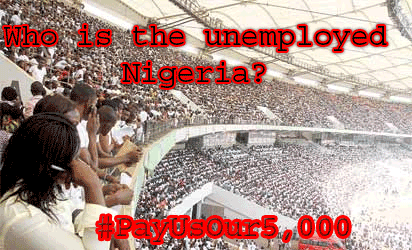
WHY does President Muhammadu Buhari’s N5,000 “dole” issue matter? How do I see the President’s intention not to implement it as contained in the All Progressives Congress (APC) campaign promises based on which many Nigerians voted for him? These and other issues connected thereto I will address shortly.
The truth is that no regime since 1999, from Olusegun Obasanjo to Goodluck Jonathan, was able to implement all its promises (and the programmes of the ruling party) to the electorate. They prioritised and implemented what they could. But in their cases, there were no dramatic moments of outright public denials of promises made. In the case of Buhari and the APC, the President has denied a major programme which his party campaigned with. Coming from a man publicly garbed with the robe of integrity, that is highly disappointing.
The question is: did candidate Buhari and his party, the APC, actually promise to pay N5,000 to unemployed youths”? For the correct answer, all we have to do is turn to their litany of 81 campaign promises. Item number 15 says:
“Creation of Social Welfare Programme of at least N5,000 that will cater for the 25 million poorest and most vulnerable citizens upon demonstration of children’s enrolment in school and evidence of immunisation to help promote family stability”.
Unemployed graduates
It is obvious that even the APC as a party did not specifically promise to pay N5,000 per month to unemployed graduates or youth. If anything, the people targeted were the indigent and destitute Nigerians with families, subject to the proviso that their children must be schooling and have undergone immunisation. Perhaps, in the heat of campaigns, APC stalwarts, mouthpieces, propaganda megaphones and social media hirelings gave it various twists.
In November last year, PDP senators raised a motion in the Senate calling on the APC Federal Government to immediately implement the programme. Vice President Yemi Osinbajo reiterated the government’s intention to do so. In fact, the National Chairman of the APC, Dr. John Oyegun, disclosed that it would be provided for in the 2016 budget. And indeed, it is one of the items in the controversial budget with a hefty sum of N500 billion (the biggest single appropriation) attached to it.
When this was on, I wrote an article entitled: FG’s N5,000 SWP, questions, questions. I pointed out that this APC campaign promise was neither realistic nor based on any think-through because we would need about N1.5 trillion per annum to cover 25 million “poorest and most indigent” Nigerians. Where will the money come from with our economy on its knees? How do you even determine who belongs to the “poorest and most indigent Nigerians” group when the World Bank insists that 58 million Nigerians live below the poverty line (Osinbajo actually used the figure of the Nigerian Bureau of Statistics (NBS), which says there are 110 million poor Nigerians).
In that article, we felt that even if we have the money, it will be wasteful to channel it into a social welfare dole, which is like giving people fish rather than making them fishers:
“If this money is available to be doled out, why not put it into policies that multiply benefits and actually give more enterprising youth a chance to escape poverty? Why not invest it in agriculture and associated value chain, mining, real estate, capacity building, entrepreneurship training and infrastructure and other areas that create gainful employment on a massive scale? Why give fish to the “poorest and most vulnerable” Nigerians rather than teach them how to fish? Why foist this demeaning dependency syndrome on our youth?”
The purpose of that article was to portray the APC Social Welfare Programme as harebrained and unviable at time of alleged “ëmpty treasury” and lack of funds to pay workers’ salaries.
It would seem that the President saw the merits of our argument and has decided that the N500 billion will now be put in improving our infrastructure and capacity building of the youth. It is the only sensible way of spending such a huge sum. You have to bake the cake before you share it.
The sad thing, though, is that the President did not summon the courage to apologise for sidestepping this promise which was one of the litanies of mouth-watering baits the APC used to climb to power. Telling us he never made such a promise is laughable. Even if he did not personally make the promise, he never dissociated himself from it during the campaigns. There is no difference between a party’s published campaign promises and those of its candidate during campaigns.
The flag bearer is the party’s property, and he cannot distance himself from the programmes of the party when he gets elected based on them. It is morally wrong, and it smack of obtaining by false pretences (which we call”419″). It is never too late to make amends, but one must be honourable enough to admit his own mistakes and apologise.
Irony! Abba Moro in prison
I WONDER what Comrade Abba Moro would have done towards improving the Nigerian prisons system if he had imagined, when he was the Minister of the Interior, that he would one day be an inmate of one of his own cells.
Moro was one of the great black spots of the Jonathan administration. The most scandalous recruitment exercise for the Immigration Service, obviously staged for the purpose of extorting hundreds of thousands of job seeking university graduates, took place under Moro’s watch. In the process more than twenty young men and women perished in stampedes in stadiums across the country. Nobody resigned. Nobody was sacked. Nobody paid. Moro continued to answer “Honourable Minister” until the Nigerian people decided they had had enough of the Jonathan regime.
It is obvious that the alleged fraud that extorted N676 million from unemployed youth would have been swept under the carpet if Jonathan had been re-elected. Moro’s “godfather” would have been there to continue to shield him from justice.
Never again shall we keep a ruling party in power for longer than two terms! Routine regime change is healthy not just for our democracy but also for the growth of the nation in so many ways that are now becoming obvious.
Otti’s opposition will help Abia
THE decision by the governorship candidate of the All Progressives Alliance (APGA) in the 2016 election, Dr. Alex Otti, to remain in politics and put up credible opposition to the government of Dr. Okezie Ikpeazu of Abia State is the best thing that can happen to Ikpeazu and Abia State in the next four years.
Some say Ikpeazu has started well. That was how his predecessors, Orji Uzor Kalu and Theodore Orji started, but because there was no one to breathe down their necks, they turned the state into their private estates and successfully transferred power to their cronies in spite of their failure and their rejection at the polls. Good governance came to Anambra State when Governor Chris Ngige turned against his godfathers and used good governance to protect himself from them.
In the same vein, Ikpeazu, who will obviously want a second term, will be forced to continue to do well, knowing that Otti and his mass of followers are waiting in the wings.
When there is no credible opposition in a democracy, the people are always the losers.
Disclaimer
Comments expressed here do not reflect the opinions of Vanguard newspapers or any employee thereof.