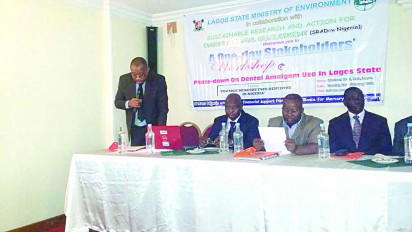
Mr Leslie Adogame (left) addressing participants at the workshop.
By Kingsley Adegboye
Participants at a one-day stakeholders’ workshop on phase down on dental amalgam use in Lagos state with the theme “Towards Mercury-Free Dentistry in Nigeria” organised by Sustainable Research and Action for Environmental Development (SRADev), have called for coordinated collaborative efforts by stakeholders in order to achieve the desired phase down of the harmful substance.
The participants at the workshop which took place place in Lagos last week also clamoured for use of alternatives to amalgam.
Mercury or Amalgam is one of the world’s most ubiquitous heavy metal neuro toxicant. It is a toxic substance of global concern that causes significant harm to human health, wildlife and ecosystems. Once in the body, mercury acts as a neuro toxin, interfering with the brain and nervous system.

Mr Leslie Adogame (left) addressing participants at the workshop.
Exposure to mercury can be particularly hazardous for pregnant women, especially lactating mothers who expose their children to mercury during breast feeding. During the first several years of life, a child’s brain is still developing and rapidly absorbing nutrients. Prenatal and infant mercury exposure can cause mental retardation, cerebral palsy, deafness and blindness.
Even in low doses, mercury may affect a child’s development, delaying walking and talking, shortening attention span and causing learning disabilities. In adults, mercury poisoning can adversely affect fertility and blood pressure regulation and can cause memory loss, tremors, vision loss and numbness of the fingers and toes. A growing body of evidence suggests that exposure to mercury may also lead to heart disease.
Delivering the keynote paper, tagged “Mercury Free-Dentistry in the Public Sector: Towards a phase down action plan” Adolphus Loto, a medical doctor and Consultant, Restorative Dentistry, LASUCOM/LASUTH said the elimination of amalgam involves every sector of the economy, adding that there must be a strategic plan to achieve the phase down.
According to him, the phase-down of the use of dental amalgam in restorative dentistry requires a coordinated holistic and multi-sectorial approach by stakeholders, pointing out that it is an acceptable option as opposed to outright ban on dental amalgam.
“It is feasible and desirable. It should be given a national attention, and a National Strategic Plan (NSP) should be developed and implemented in order to meet the deadline or time-line at which amalgam should cease to be used as a restorative material in dentistry in compliance with the provisions of the Minamata Treaty or Convention”, Loto stated.
The chairman of the occasion, Prof. Godwin Arotiba, remarked that it is difficult for people to change from their habits, adding however, that with willingness and collaborative efforts across all strata of the society, change from amalgam to other alternatives as being clamoured for by the organisers of the one-day event, can be achieved.
In his presentation, Idris Adamu, Deputy Director, Department of Pollution Control and Environmental Health, Federal Ministry of Environment, said “Mercury is one of the most dangerous environmental toxins. Mercury vapour is continuously emitted from amalgam fillings, which means that people are directly exposed to the mercury in their mouths. Introducing timeline to phase down/ban dental mercury would save people and the environment. Satisfactory alternatives to mercury amalgam are available for example, resin composite”. To achieve its phase down, Adamu stated that “Let us all work together to say no to mercury”.
Mr. Leslie Adogame, Executive Director, Sustainable Research and Action for Environmental Development (SRADev Nigeria) in welcome address, pointed out that United Nations Environment Programme (UNEP) and World Health Organization have identified the adverse effects of mercury pollution as a serious global environmental and human health problem.
According to Adogame, the UNEP Governing Council has targeted reducing methyl mercury accumulation in the global environment as a major global priority, stressing that since February 2009 the world’s governments had agreed to establish an Intergovernmental Negotiating Committee to prepare a global legally binding instrument on mercury which came to effect in October 2013. He said Nigeria is now a signatory to this Convention named as Mercury Treaty (Minamata Convention).
SRADev boss who noted that the nervous system is very sensitive to all forms of mercury, disclosed that exposure to high levels of mercury (metallic, inorganic or organic) can permanently damage the brain, kidney and can affect a developing foetus. He said its harmful effects also include mental retardation, blindness, seizures and inability to speak.
Dangerous poison
Lamenting limited awareness of mercury in medicines and generally in healthcare sector in Nigeria while the dangerous poison is causing a lot of health problems unknown to the public, he said the goal of the forum was to facilitate Lagos stakeholders to set the pace and work collectively towards a plan of action to phase down the use of dental amalgam in response to the world’s call for action.
According to him, “mercury is used in dental amalgam, a restorative material that is approximately 50 per cent elemental mercury. Through the newly-adopted Minamata Convention on Mercury, the world recognizes that dental amalgam is a major environmental pollutant.
“The Convention requires each participating nation to phase down the use of dental amalgam and perhaps ultimately phasing it out and switching to mercury-free alternatives. It is significant to let you know that throughout the Minamata Convention negotiations which took place from June 2010 until October 2013, the African Region through Nigerian delegates led the movement to get the strong dental amalgam reduction mandate into the Minamata Convention,”
Disclaimer
Comments expressed here do not reflect the opinions of Vanguard newspapers or any employee thereof.