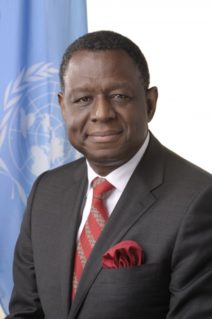
Prof. Babatunde Osotimehin
By Sola Ogundipe
Global leaders have called for greater investment and urgent action towards increasing access to family planning services worldwide, even as an estimated US$9.4 billion is required annually to meet all women’s needs for modern contraception in the developing world. Making the call for more commitment to family planning initiatives Monday at the opening of the 4th International Family Planning Conference, ICFP, in Nusa Dua, Bali, Indonesia, government, health and development leaders from around the world, unanimously agreed that the way to truly ensure sustenance of family planning programmes is to mobilise funds locally.
 Speaking at the event, themed “Global Commitments, Local Actions,” Co-hosted by the Bill & Melinda Gates Institute and the National Population and Family Planning Board of Indonesia, President Joko Widodo of Indonesia,said:? “I wish that at this ICFP, we can discuss the main foundations necessary to build the planet that we want by 2030. A future that ensures all women and girls are empowered to choose whether and when they want to have children and space their births, so that mothers and their babies have a better opportunities for better lives.”
To solve the issues of contraceptive discontinuation that can create major challenges for family planning progress, Jokowi emphasised the importance of investing the “village approach,” increasing access to long acting contraceptives and reducing the cost of family planning by providing free services and peer education programmes. “I believe that to achieve the Sustainable Development Goals (SDGs), we have to take local action.
Family planning
Under-Secretary-General of the United Nations and Executive Director of UNFPA, Prof. Babatunde Osotimehin, “Family planning is about women’s right and their capacity to take decisions about their health and well-being contributing to the objectives of FP2020. “It is a most significant investment to promote human capital development, combat poverty and harness a demographic dividend thus contributing to equitable and sustainable economic development within the context of the Sustainable Development Goals.
Speaking, President of the Global Development Programme at the Bill & Melinda Gates Foundation, Dr. Christopher Elias, said: “The family planning data and evidence point to concrete steps we can take as a community to get back on track to meet our FP2020 goal. “Now we must ask ourselves what more we can do to align our efforts to ensure all women have the information and tools they need to time and space their pregnancies.”
In a report by the Guttmacher Institute entitled: “Adding It Up: Investing in Sexual and Reproductive Health” meeting all women’s needs for modern contraception in the developing world would cost $9.4 billion annually, an increase of $5.3 billion.
According to the report, if all need for modern contraception were met, the annual cost of pregnancy related care for women and their newborns would be $28.0 billion, an increase of $13.8 billion.”The total includes $4.2 billion (a $3.0 billion increase) to provide HIV testing and counseling for all pregnant women, testing for their newborns and antiretroviral therapy for those who need it. The report notes that fully meeting the need for modern contraception, maternal and newborn health care, and antiretroviral care for pregnant women living with HIV and their newborns, and treatment for four major curable STIs would cost $39.2 billion annually, more than a doubling of current spending in 2014.
But, it also argued that fully satisfying women’s modern contraceptive needs would make health care investments more affordable overall. “For every additional dollar invested in contraception, the cost of pregnancy-related care (including HIV care for women and newborns) is reduced by $1.47,” the report noted.
A recent global progress report of the Family Planning 2020 (FP2020), a global partnership focused on enabling an additional 120 million women to access voluntary contraception by 2020, in the last three years, 24.4 million more women and girls who want to avoid or delay a pregnancy have begun using modern contraceptives in the world’s poorest countries. This brings the total of women using a modern method of contraception in FP2020’s 69 target countries to 290.6 million. However annual benchmarks to measure family planning progress, revealed that modern contraceptive use is behind 2015 projections by 10 million.
Disclaimer
Comments expressed here do not reflect the opinions of Vanguard newspapers or any employee thereof.