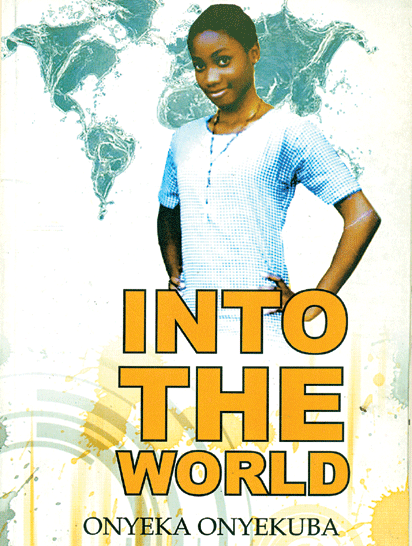
Into The World, Onyeka Onyekuba; Phyleom Publishers, Nigeria; Revised, 2015: PP. 95.
By Japhet Alakam
It is said that a good writer is one who relates intelligibly to his society and, using the society as a base to disseminate his message with a view to contributing positively to that society in particular and the world in general. The above statement can be said to be true of Dr Onyeka Onyekuba, who also writes as Onyeka Iwuchukwu, a literary scholar with bias in drama and theatre, a multidisciplinary researcher, and a playwright with varied experience and author of over eight plays, who has used her plays to highlight and address some compelling issues in the society.

Into The World, Onyeka Onyekuba; Phyleom Publishers, Nigeria; Revised, 2015: PP. 95.
In one of such plays titled Into The World, the playwright joins other Nigerian writers in the reformist role which is of great relevance in our times as she brings to the fore the importance of proper planning which prevents poor performance. In the 95 page book published by Iwuchukwu brings her wealth of experience as a one time student, wife and career woman who has seen it all in different levels to narrate how carelessness can mar one’s future while hard work can make one achieve his/her goals in life.
According to her, “Into the world is instructive to the truant, careless and unserious student; to the lazy, slothful and extravagant housewife; and indeed to the mindless polygamist. It insists that for harmonious relationships to exist, every individual should be hardworking and productive.”
With an interesting plot that moves the action and dialogue, an efficient delineation of characters with believable dialogue and interactions performed by good actors. With other elements, such as background, costumes, lighting, which are theatrical elements that join seamlessly to draw the spectators into the story. Dr. Iwuchukwu, which also published under the name Onyeka Onyekuba, has these attributes.
Divided into three movements, the first movement tells the discussion of four students about moving into the world after graduation. While serious and intelligent Monique was bent on futhering her education, Patsy was interested in moving to America to showcase her talents in the modeling world. On the other side Mercy was also determined to continue with her education and Tessy who was not interested in education decided to marry and be a housewife.
In the second movement, their individual desires manifested. Tessy finally married and settled down with Tim, his wealthy businessman husband who provided her with everything including a maid named Janet. And as fate will have it she did not make any move to be self reliant, rather she depended on his husband for everything, worse still she moved with bad friends who made her to abuse the privilege by spending the husband’s money recklessly.
Things changed when his husband instructed her not to buy things on credit, an order she failed to keep, instead she became antagonistic to Janet, the maid and insisted on her leaving the house. In the course of the drama, she left and in the period of three years, Tim married Janet. When she came back with the parents, it was a surprise and after much pleading by the father, Tim accepted her back but she refused to recognise Janet as a wife.
In the third movement, the book also looks at conflicts in the polygamous family, pertaining to how the man can handle the situation. Tessy who did not recognise Janet’s new status was bent on setting the home on fire, and it was so, until Tessy’s school friends Mercy and Monique who have made it in their various disciplines visited and told her the truth and advised her to get a job or learn a trade, an advice that she eventually took and things changed for good.
A close look at the issues raised by Dr. Iwuchukwu’s plays show that they are set against the background of a society that has thrown morality to the winds. She has, therefore, in plain language highlighted the fundamental problems facing many homes in contemporary Nigerian society. Indeed, the plays will be better appreciated if seen from the Playwright’s belief that people especially women should be hardworking and not rely on their husband for every thing.
Despite the avoidable typographical errors and wrong spellings noticed which can be easily corrected in another version, the book is a must for all, especially, secondary and university students and the younger ones who are coming up.
Disclaimer
Comments expressed here do not reflect the opinions of Vanguard newspapers or any employee thereof.