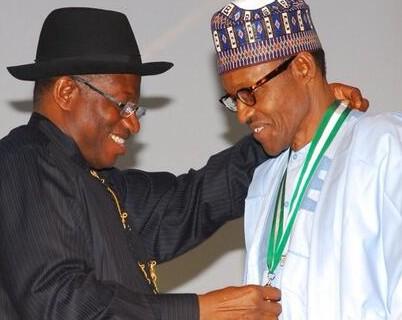
Jonathan and Buhari
By Oghene Omonisa
T he year 2015 is special in the history of Nigeria. So many important events occurred that are worthy to be remembered and recorded, and which will enhance an objective appreciation of future events in Nigeria. Some were political, others economic, sociological, or cultural.
The elections

Former President Goodluck Jonathan (L) With President Muhammadu Buhari, After A Close Door Meeting At The Presidential Villa In Abuja On Monday (2/11/15).
With the then sitting President, Dr. Goodluck Ebele Jonathan, having secured the presidential ticket of his party, the People’s Democrat Party (PDP) the year before, and his leading opponent, General Muhammadu Buhari (rtd.), also clinching the ticket of his party, the All Progressives Congress (APC), the stage was finally set for the campaigns early in the year. Together with other elections, the presidential election had been the subject of anticipation, and political calculations and machinations for the past four years.
Election campaigns
Campaigns for the presidential poll had kicked off on November 16, 2014, following the release of the 2015 general elections time-table by the Independent National Electoral Commission (INEC), Nigeria’s electoral umpire. But the campaigns picked up steam early 2015.
Certificate controversy
As activities toward the election gathered momentum, controversy started trailing Buhari’s qualification. After INEC announced that it did not have his academic credentials, it became a subject that attracted divergent views. His party and supporters insisted that the dust being raised was merely a ploy to unsettle the APC standard-bearer, while others, especially those opposed to him, challenged the former Head of State to come out with clear proof of his qualification.
Buhari had reportedly sworn to an affidavit at the Federal High Court (FCT), Abuja to the effect that all his academic qualifications, documents, as filed in his presidential form for the election, were with the Secretary of the Military Board. The Director, Army Public Relations, Brig. Olajide Laleye, had earlier said the army did not keep the original certificates of its personnel, whether serving or retired.
Section 131(d) of the 1999 Constitution stipulates that a person shall be eligible to contest for the Office of President if “he has been educated up to at least school certificate level or its equivalent.”
The subject attracted so much debate that Buhari finally cleared the air on the controversy when he called a press briefing on January 21, and explained that he had assumed all along that all his records were in the custody of the Military Secretary of the Nigerian Army. However, much to his surprise, he learned that although a record of the result was available, there were no copies of the certificates in his personal file. He had to formally request his old school, the Provincial Secondary School, Katsina (which is presently known as Government College, Katsina) to make available the school’s copy of the result of the Cambridge/West African School Certificate, which would be made available to the press the moment it was available. He would eventually provide a re-issued certificate, which did not completely quell the controversy, but qualified him to contest the election.
PVC/Card reader controversy
Like most things Nigeria, other controversies trailed preparations for the elections, notably the subject of Permanent Voter Cards (PVCs) and card reader. Millions of eligible Nigerians were alleged not to have PVCs, which represented a very significant aspect of the electoral process.
With less than a month to the most crucial in a series of elections, that is the presidential, these Nigerians would definitely be barred from participating, without PVCs. However, while many prospective voters in some regions had difficulties procuring theirs, some politicians in some other regions were alleged to have stockpiled PVCs for their supporters.
Election postponement
The postponement of the elections (by three months) was first mooted by then National Security Adviser (NSA) to President Jonathan, Col. Sambo Dasuki (rtd.), at the London think-tank Chatham House during a lecture on January 22, to enable INEC distribute the PVCs, to about 30 million Nigerians who were yet to obtain the cards.
It was a call which initially drew outrage from many, including the opposition APC and INEC. However, it was high drama that eventually led to the election postponement. First the Council of State meeting, on February 5, failed to propose an election shift, and it was thought INEC had been told to proceed with the elections at all costs.
Then it emerged that the Council had only told INEC to proceed with its “civic responsibility.” A meeting with civil society organisations and his 37 Resident Electoral Commissioners had revealed that security agencies had written Jega to say they were embarking on an intensive anti-Boko Haram operation and they would not be available to provide security during the elections, and were requesting for at least a postponement of six weeks.
Eventually addressing the press, Jega said INEC had had wide-ranging consultations to reach the decision, and had decided to take the advice of the security chiefs and adjust the date of the elections. The presidential and national assembly elections would now hold on March 28; gubernatorial and state house of assembly, April 11.
Violence-free polls, issue-based campaigns
Though Jonathan, Buhari and 12 other presidential candidates had signed an undertaking to ensure free and fair polls as well as run issue-based campaigns during a sensitisation workshop, the campaigns as well as the polls could not be said to completely violence-free. Thugs who converged at the Ibrahim Babangida Square, venue of Jonathan’s campaign in Bauchi, hurled shoes, plastic water bottles and other objects at the canopy where the President and members of his campaign team were delivering their speeches.
Although security operatives intervened to stop the thugs from disrupting the event, several vehicles coming out of the venue, belonging to the PDP presidential campaign team, were stoned while tyres were burnt.
And in Ilorin, the Kwara State capital, where Buhari’s wife, Hajia Aisha Buhari and her team were visiting for a two-day Voters’ Education Summit as part of her campaign, she and her convoy were attacked by suspected political thugs while returning from a visit to the Emir of Ilorin, Alhaji Zulu-Gambari.
Pre-election theatrics: Danjuma/ex-militants’ face-off
Niger Delta ex-militants threatened to declare war against the country if Jonathan lost. This prompted former Defence Minister, Gen. Theophilus Yakubu Danjuma (rtd.) to call for the arrest of Asari Dokubo, High Chief Government Ekpemupolo, alias Tompolo, General Boyloaf and others.
The ex-militants and some other Niger Delta leaders returned fire, with Tompolo accusing Danjuma of sponsoring terrorism in the Northern parts of the country and also calling for his arrest and prosecution, and elder statesman, Chief Edwin Clark saying that Danjuma should have condemned the attacks on Jonathan in several states in the North instead of calling for the arrest of the ex-militants.
Buhari wins, makes history
After the much-awaited presidential poll on Saturday, March 28, Buhari, who received 15,424,921 votes or 53.95 percent of the 28,587,564 total valid votes cast, was declared winner, beating Jonathan, who garnered 12,853,162 (or 44.96 percent) of the votes. Buhari made history by being the first Nigerian to defeat a sitting president or prime minister in the chequered political history of the country. Buhari won in the six Northern geo-political regions and the South-West, while Jonathan took the South-South and the South-East.
Jonathan congratulates Buhari
At 5:05 pm on Tuesday, March 31, with results from all but one state (Borno) counted and Buhari clearly in unassailable lead, Jonathan telephoned Buhari to concede defeat and congratulate him even before the final results were announced and the winner formally declared by INEC, an action which Buhari himself would acknowledge, doused tension, and which reverberated in other elections, with some legislative and governorship candidates congratulating their opponents when victory was clear.
Orubebe’s last fight
Many supporters of the defeated President apparently never expected him to lose. Therefore the election outcome was a shock to them, and not everyone can manage such shock. One of such was Elder Godsday Orubebe, former Minister of Niger Delta Affairs and the PDP agent for the presidential election.
It happened immediately after the Commission reconvened for a continuation of the release of results by Collation Officers. Orubebe called for an observation, and when he was recognized, he began by calling for the INEC Chairman to send a committee to investigate the claims of his party that results from some Northern states were manipulated, saying the PDP had lost confidence in what Jega was doing.
Sitting down on the floor, microphone in one and a sheet of paper in the other, the former minister was beamed to the whole world shouting as he accused Jega of being partial and selective, and even of having been compromised. His agitation was that Jega should set up a committee to go to Kano, Katsina, Jigawa and Kaduna to investigate the PDP objections to the elections there as he did to River State where the APC raised an issue. He even refused to allow the INEC boss to explain, holding onto the microphone.
It was a sight to behold as Jega calmly remained in his seat watching the display. When the opportunity to speak eventually came, he advised Orubebe to always be mindful of his conduct in public, especially as a former minister of the federal republic. A remorseful Orubebe would later apologise to the nation.
“I belong to everybody and belong to nobody”
President Muhammadu Buhari’s inaugural speech on May 29 was the stuff of legend, especially with such a title, “I belong to everybody and belong to nobody”, which reflected his perceived image as a no-nonsense independent leader.
However, not many Nigerians have been impressed with his performance seven months after, with corruption not only perceived but perceived to be growing, non-availability of petroleum products, the continuation of the Boko Haram killings with the Chibok girls yet to be rescued.
No end in sight for Boko Haram
The closest to a difference in how Boko Haram was perceived during Jonathan’s government and Buhari’s seven months was that Buhari appeared to give hope, with his body language. Aside that, news reports on the activities of the terror group did not change in the last seven months. As the year came to an end, apart from the 57 girls, who escaped on their own, nothing has been heard about the remaining 219 girls. That was not good enough. Buhari should not take the goodwill of the Nigerian people for granted.
Subsidy or not, just fuel, affordable fuel
Before his election, Buhari had vehemently stood against fuel subsidy removal, and like most average Nigerians, seen the whole complex scheme as a drainage through which public funds are being siphoned and Nigerians milked through high prices of the product. But it was not “change” that the Nigerian people witnessed towards the end of the year when the product went scarce following his deferment in paying N423.363 billion to oil marketers as subsidy. The President is expected to take a definite position on fuel subsidy this year. Whether he is removing or retaining it, the average Nigerian is not interested. All he desires is available, affordable fuel and other petroleum products, for a change.
Not searching for the corruption monster

File Photo
The past seven months have witnessed Nigerians who voted for the change for public good and not personal benefits, exchange glances. For all these months, the closest to fighting corruption Nigerians have noticed is the Dasuki arm-deal trial, and the setting up of a Presidential Advisory Committee against Corruption, to be headed by prominent professor of law and civil rights activist, Professor Itse Sagay (SAN).
A few days later, Sagay would urge all those who knew their hands were dirty to come forward and confess, assuring that certain lenient terms could be obtained by doing so. No investigation; corrupt public officials and their accomplices should simply come and surrender. Some change!
Presidential assets declaration
It certainly was an uplifting news when President Buhari and Vice President Yemi Osinbajo made known their assets, with the President declaring less than N30 million and his deputy a cash balance of N94 million and US$900,000 in his bank accounts. The President also has two houses in Kaduna and one each in Kano, Daura and in Abuja.
The two mud houses are in his native Daura. One was inherited from his late elder sister, another from his late father. He reportedly borrowed money from the old Barclays Bank to build two of his homes. Then two undeveloped plots of land, one in Kano and the other in Port Harcourt, with location presently unknown.
The President is also reported to have a number of cars, two of which he bought from his savings and the others supplied to him by the Federal Government in his capacity as a former Head of State. The rest were donated to him by well-wishers after his SUV was damaged in a Boko Haram bomb attack on his convoy in July 2014.
And Vice President Osinbajo’s assets include a 4-bedroom residence at Victoria Garden City, Lagos; a 3-bedroom flat at 2 Mosley Road, Ikoyi and a 2-bedroom flat in the Redemption Camp of the Redeemed Christian Church of God along the Lagos-Ibadan Expressway. He also has a 2-bedroom mortgaged property in Bedford, England.
The Vice-President also has shareholdings in his law firm, SimmonsCooper and in six private companies based in Lagos, including Octogenerium Ltd., Windsor Grant Ltd., Tarapolsa, Vistorion Ltd., Aviva Ltd. and MTN Nigeria.
Biafra, a struggle renewed
Not many people knew Nnamdi Kanu and his Indigenous People of Biafra (IPOB) as well as his pirate station, Radio Biafra, until his arrest on October 18 by the Department of State Services (DSS). That was when the agitation for an independent state of Biafra took a renewed form not known since the Nigerian civil war. Joined by forces of Barrister Ralph Uwazuruike’s Movement for the Actualisation of the Sovereign State of Biafra (MASSOB), the protests for his release became tied to a struggle that symbolises the end of long perceived Igbo marginalization since the civil war, with protests in Delta, Enugu, Rivers, Cross River, Abia, Imo, Akwa Ibom, Anambra and even Lagos.
Eventually all the charges preferred against him were dropped and he was released, but rearrested and new charges brought against him. He will be an issue in the new year and a symbol of the agitators’ crave for re-integration or an end to their being part of the Nigerian nation.
Senate, House of Reps leadership tussle
The events leading to the emergence of senators and House members who would lead the legislative arm in 2015 contributed immensely to make the year stand out, demystifying the assumption that the end of the PDP hegemony would lead to the supremacy of the APC in the 8th Senate and House of Reps. The party took over majority in both chambers, from the PDP after winning more legislators.
Senator Bukola Saraki of the APC was returned unopposed as Senate President as the game of intrigues caught the APC leadership on the wrong side. His emergence was facilitated by the solid backing of the 49-member strong PDP caucus with unalloyed support from APC senators from Zamfara, Sokoto, Adamawa, Kogi and Kwara states. As part of the quid pro quo from the PDP, the Saraki elements backed the return of Senator Ike Ekweremadu of the PDP as Deputy President of the Senate, the first time a bipartisan leadership was enthroned in the Senate.
The emergence of Saraki and Ekweremadu bounced off negatively for the official APC candidate in the House of Representatives, Femi Gbajabiamila, who, though he eventually lost, was also widely reported to be strongly backed by the party leader and former Lagos State Governor, Asiwaju Bola Ahmed Tinubu.
Buhari’s ministerial list
While the National Assembly boiled, Nigerians awaited the unveiling of Buhari’s team. However, when he started appointing members of his “inner cycle”, hues and cries emanated from some geo-political zones, especially the South-East over what was termed lopsided appointments.
Speaking with BBC Hausa Service, he pointed out that the Constitution allowed him full control over the choice of his closest officials, explaining that, “If I select people whom I know quite well in my political party, whom we came all the way right from the APP, CPC and APC, and have remained together in good or bad situation, the people I have confidence in and I can trust with any post, will that amount to anything wrong?”
At this time however there was immense lobbying for ministerial positions amidst speculations and name dropping. With complaints of delay over cabinet rising, the President, in a bid to fulfill his pledge to appoint ministers by September, submitted a list of his ministerial nominees to the Senate President, on the last day of that month.
The ministerial list was however an anti-climax of sorts, as many felt that the persons that made up the list were not worth the wait. The names included those of long-time associates of the President, politicians as well as technocrats with no known political affiliations.
However, the nomination of the immediate past Governor of Rivers State, Rotimi Amaechi was opposed by senators from his state as petition was submitted in that regard. Senate’s Public Petitions Committee was mandated to investigate petitions written against Amaechi and others. Intrigues surrounding Amaechi’s nomination continued as PDP senators staged a walk-out having unsuccessfully tried to convince their APC counterparts to heed the recommendations of the Committee by not confirming Amaechi as minister. With Ameachi confirmed alongside his counterparts, President Muhammadu Buhari assigned portfolios to them and the much anticipated Federal Executive Council (FEC) was inaugurated by the President after about five months into his government.
Inconclusive elections and Audu’s demise
As Jega’s tenure as INEC Chairman came to an end, Prof. Mahmoud Yakubu was appointed to replace him. Before then, Mrs. Amina Zakari had held sway albeit in acting capacity. The PDP, raising the alarm that she was somewhat related to Buhari, had vowed not to participate in any election conducted by her. Yakubu was however appointed barely a month to the Kogi and Bayelsa governorship elections. He was thrown into two keenly contested elections which ended inconclusive on first ballot.
In Kogi State, as APC coasted to victory at the November 21 polls, the sad news of the demise of the APC governorship candidate, Prince Abubakar Audu, created a whole new dimension not just to the polls but to constitutional issues with regards to electoral matters.
He was already leading with over 41,353 votes when the election was declared inconclusive by INEC. The Returning Officer, Prof. Emmanuel Kucha declared the election inconclusive because the margin of votes with which Audu defeated his closest rival, Governor Idris Wada, was less than the 49,953 number of cancelled votes.
The permission to APC by INEC to replace Audu with Alhaji Yahaya Bello (first runner-up at the party’s primary) was greeted with resent and legal objection by Wada and even Audu’s running mate, Hon. James Faleke. Wada disagreed with transfer of votes, while Hon. Faleke believed he was the rightful one to continue with the mandate. By December 5, the supplementary polls in Kogi governorship election was concluded.
On same day however, Bayelsa governorship election was held but it was also declared inconclusive by INEC following the violence that was recorded in Southern Ijaw LGA believed to be a swing local government. INEC has however fixed January 9 for supplementary polls.
Cancelled governorship polls
The election tribunals and Appeal Courts cancelled elections in Akwa Ibom, Taraba, and Rivers states, a situation the PDP claimed was targeted at states they control. The party which decried the situation had complained why the tribunals were relocated to Abuja just as the petitioners complained of the security of the tribunal if they were to sit in the states. While the PDP would go further to the Supreme Court in the case of governorship elections, they alongside other parties braced up for elections into federal legislative position which were cancelled.
Dasukigate and anti-corruption war
The prosecution of Col. Dasuki on corruption charges, also came with its political dimension. Revelations showed that some of the funds were given to some PDP chieftains for the last general polls. Moreover, the PDP has decried what it says is the lopsidedness in the fight against corruption, saying members of the APC should also be made to account for their stewardship while in office.
Okonji-Iweala/ Oshiomhole face-off
2015 was also a year former Finance Minister and Co-ordinating Minister of the Economy, Prof. Ngozi Okonjo-Iweala will not forget in hurry. After responding to former CBN Governor, Chukwuma Soludo’s criticsm of the Jonathan government in January, Soludo returned fire in a lengthy over-6,000-word article rejecting her claims that he performed poorly as Governor of the Central Bank. Then he accused her of forging national economics statistics during her tenure.
However, it was the tirades from Edo State Governor, Adams Oshiomhole that really put the former minister on the defence. It almost turned out to be a past-time as he regularly reeled out figures in billions of dollars that either disappeared under her or were not properly accounted for, chief of which was his allegation in June, that about $2.1bn had been withdrawn from the $4.1bn left in the Excess Crude Account (ECA) in November 2014 “without authorization.”
The former Minister was also implicated in the Dasukigate over her authorization of withdrawals made from the Abacha loot.
Bank Verification Number (BVN) palaver
The news of the October 31, 2015 deadline for the Bank Verification Number (BVN) enrollment exercise was greeted with much controversy from bank customers, particularly those whose accounts where frozen for non-compliance to the BVN directives instituted by the Central Bank of Nigeria, Nigeria’s apex bank, before the deadline.
Reports said no fewer than five million Deposit Money Bank (DMB) customers were unable to withdraw cash and transfer funds through Automated Teller Machines(ATM), internet banking platforms and over-the-counter in the banking halls.
Dangote remains Africa’s richest, one of the most influential in the world
The news from Forbes in November that President of Dangote Group, Alhaji Aliko Dangote, retained his number one spot in 2015, as the richest man in Africa was soul-lifting. He was said to be worth $16.7 billion, beating the number two man, South Africa’s diamond merchant, Nicky Oppenheimer, with over $10 billion. Oppenheimer was reportedly worth $6.6 billion.
Football glory year
The failure of the Super Eagles to defend their title which they won in 2013 at the 2015 edition of the African Cup of Nations (AFCON) hosted by Equatorial Guinea still lingers in the hearts of most of the nation’s football lovers. Coach Stephen Keshi-led Eagles failed to pick up the precious ticket after a 2-2 draw with South Africa’s Bafana Bafana at the Akwa Ibom International Stadium. Correspondingly, the former African champions who rose to 5th in April 1994, ended 2015 in lowly 66th on FIFA’s current standings.
However, the women senior national team, Super Falcons and the male U-20 side, Flying Eagles, gave the country a lot to cheer about on the continent, winning their African championships held in Namibia and Senegal, respectively.
However, against all expectations, both sides failed to shine on the world stage. While the Falcons exited the FIFA Women’s World Cup in Canada in the group stage, the Flying Eagles were knocked out of the FIFA Under-20 World Cup in New Zealand after losing 1-0 to Germany in the round of 16. Both teams went to the World Cup as African champions, but they could not deliver when it mattered the most.
The national Under-17 men team, the Golden Eaglets, made history in Chile when they successfully defended the 2013 title they won in UAE, making it a record fifth time they have won the title. The Golden Eaglets produced the best player of the tournament, Kelechi Nwakali, who succeeded Manchester City’s wiz-kid, Kelechi Iheanacho.
The team also made history by producing the second best player in Victor Osimhen, who won the Golden Boot award after scoring 10 goals to set a tournament record for most goals scored by a player in a single event. It was also the first time Nigeria would win the Under-17 world title outside Asia, having previously won in China, Japan, Korea and the UAE.
The nation’s national U-23 male team, ‘Dream Team VI’, led by Coach Samson Siasia, overcame all odds to win the CAF AFCON U-23 tournament in Senegal, after starting on a not-too-convincing display, with a shaky 3-2 victory over Mali and a nervy draw with Egypt. The U-23 Eagles went on to win the competition after a 2-1 victory over Algeria in the final.
Medal hauling at All Africa Games
Team Nigeria’s contingent to the 2015 All Africa Games in Congo Brazzaville, emerged the second best team behind Egypt, the overall winners at the end of the competition. Team Nigeria, against all expectations, raked in 47 gold, 55 silver and 42 bronze medals to place second after Egypt that had an unassailable lead – 85 gold, 41 silver and 40 bronze medals.
Special sports athletes won 12 gold medals, eight from powerlifting and four in para-athletics, while track and field hauled in nine gold, wrestling nine gold while weight-lifting had eight and boxing four. Judo hauled in five gold, while cycling, table tennis and taekwondo had a gold medal each.
Okagbare shines
Though the performance of the nation’s athletes at the 2015 IAAF World Championships in Beijing, China, left a lot to be fixed, Nigerian track queen, Blessing Okagbare, found her way into the Guinness Book of Records for her fantastic run in the Diamond League as the only sprinter with the highest appearances in 2015. She beat world’s fastest man, Usain Bolt.
Keshi out, Oliseh in
Stephen Keshi was given the marching order for the second time in eight months on July 4, 2015. After about three years in the Super Eagles’ hot seat, the African Nations Cup-winning coach was, again, sacked by the Nigeria Football Federation (NFF) after he was earlier dismissed and called back in October 2014.
Oliseh signed a five-year deal to replace Keshi on the Eagles’ hot-seat which will see him earn N60m a year, thanks to his high intellectual capacity in coaching and recommendations by FIFA.
Chimamanda shines again, Arimah too
Award-winning writer, Chimamanda Ngozi Adichie is known world-wide for many things, and by her first, an indication of how much she is loved by all like a daughter, sister and friend. Whenever recognition for her exceptional talents pours in, not a few Nigerians share in her joy. Such was the case in the past year, when she was listed among the ‘100 Most Influential People’ byTime Magazine, ‘100 Dynamic Women’ by Arise Magazine, shortlisted for the International Impac Dublin Award, for her book, Americanah and nominated for the 2015 Forbes Africa Person of the Year Awards. It appears to be the year of the woman as Lesley Nneka Arimah also won the Africa region of the 2015 edition of the Commonwealth Short Story Prize.
Milestones
2015 was also the year some prominent Nigerian passed on, and many marked unique birthdays. Nollywood star, Muna Obiekwe passed on in Lagos, January 18, of kidney disease at 35. So also was the Emir of Gusau, Alhaji Mohammed Kabir Dan Baba, on March 5, in Abuja after a protracted illness. He was 91. Special Adviser to former President Jonathan, Dr. Oronto Douglas, in Abuja, of cancer-related complications, on April 9, at 49. Hausa griot, Dan Maraya Jos, June 20, in Jos, at 69 after a brief illness. Ooni of Ife, Oba Okunade Sijuwade, in London, July 28, at 85, after a brief illness. Olu of Warri, Ogiame Atuwatse II, on September 5, in Lagos, of undisclosed illness. Celebrated wife of former Premier of old Western Region, Chief Obafemi Awolowo, Chief HID Awolowo, September 19, at 99, in Ikenne-Remo, Ogun State, after a brief illness. Boardroom guru, Dr. Gamaliel Onosode, in Lagos, September 29, after a protracted illness, at 82. Former Governor of Bayelsa State, DSP Alamieyeseigha, October 10, in Port Hacourt from complications from a kidney-related ailment. He was aged 63. Former Governor of Kogi State, Abubakar Audu, in Lokoja, November 22, of a heart attack, at 68.
It was also a year of unique birthdays. Perhaps the year of the octogenarians. January 21 was when celebrated media icon, Mr. Peter ‘Pan’ Enahoro turned 80. As with his style, it was low-keyed celebration as a group of friends led by Mr. Ben Asante hosted events to mark the landmark event.
June 13 was the turn of media icon and Publisher of Vanguard Newspaper Mr. Sam Amuka. Leading media professionals and industry chiefs gathered to celebrate and honour him with a book launch and lecture on the future of journalism held at the Nigerian Institute of International Affairs (NIIA), Victoria Island, Lagos, July, 30. The book was titled “Voices from Within: Essays on Nigerian Journalism in Honour of Sam Amuka-Pemu.”
It was the turn of playwright and lawyer, Fred Agbeyegbe who also turned 80, July 22. The special birthday was well celebrated with a carnival tagged “The Theatre Game-Changer Fred Agbeyegbe @ 80 Carnival’’ at the MUSON Centre, Lagos, which featured a conference, presentation of his plays and a host of other activities. Many distinguished Nigerian were present to celebrate him.
And it was the year music star, 2face Idibia began his life, like the saying goes, turning 40, September 18. A concert tagged ‘Fortyfied’ was held at the Eko Hotel Convention Center, Lagos, September 20. Other music stars and celebrities were present to honour him as he began his life.
The year just just gone by
2015 will be remembered for many reasons, but mostly as the year a sitting president was defeated, especially in an election that is accepted by most as free and fair.
Disclaimer
Comments expressed here do not reflect the opinions of Vanguard newspapers or any employee thereof.