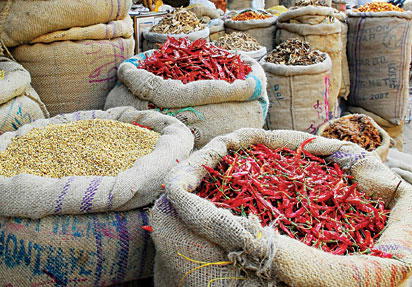
food-items
.As Naira hits 298 per dollar
By udeme Clement
As Nigerians are celebrating this festive period, the prices of food items in the market are skyrocketing beyond the reach of many Nigerians, especially the low income earners and individuals depending on small scale businesses to provide for their families.
When Sunday Vanguard visited some markets in Lagos, it was observed that different parts of the markets were very scanty, notwithstanding the fact that food items were displayed at every corner of the markets. For example, at the popular Ketu market, which serves as a depot for fresh tomato and pepper coming into Lagos from the North and other parts of the country, baskets of tomato were seen on display at high prices. A small size basket of tomato previously sold for N8.000, went for N15,000, while the bigger basket load of tomato sold for N25,000, instead of N15,000, small size tuber of yam increased from N300.00 to abut N700.00, while a basket of pepper increased from N7.000 to over N13,000. Others items with increase in prices include, palm oil, onion, vegetable oil, garri, turkey, chicken and fresh fish.
In some shops visited around Oshodi axis, it was observed that the price of rice per bag increased from, N8,500 to over N13,000, while beans still sold at normal price.
At Ido (Oyingbo) market, located around Yaba area of Lagos, where crayfish and stock-fish are usually sold in bags, the prices of the items increased rapidly by over 30 percent. Even pumpkin commonly used in many homes was also expensive, as most traders attributed the high cost of pumpkin to the festive season.
At Katangua market, where different types of second hand clothes are sold, the prices of clothes and textile materials were not so exorbitant like food items, but the number of buyers seen at the market were very few.
Sunday Vanguard also gathered that the exchange rate is still on the high side. For instance, a visit to some Bureau De Change (BDC ) outfits within the premises of Airport Hotel, Ikeja and Allen Avenue revealed that the local currency has depreciated up to between N298 and N299 to a dollar.
Moreso, fuel scarcity, which started since October, 2015 is still lingering, as some filling stations were seen under lock and key, while the few selling, had long queues, causing heavy traffic on the roads.
In a chat with Sunday Vanguard in Lagos, the National President, Constance Shareholders Association of Nigeria, Mr. Shehu Mallam Mikail attributed the hardship facing Nigerians to policy inconsistency and lack of proper economic planning by the government.
He said, “This is the first time the naira has devalued so much to almost N300 per dollar. That is to show the level of disconnection in the economy. Infact, even during the administration of Ibrahim Babangida, when the Structural Adjustment Programme (SAP) was introduced, the situation was not as bad as what we have today. The major challenge SAP faced was that government tried to deregulate everything at the same time, even when infrastructure was not well developed to support manufacturing and industrial development.
“Why is government saying they want to borrow more money to finance the budget? How long would we continue to borrow to accumulate debt instead of looking inward to diversify our economy for optimum productivity? For example, now, nothing is happening in the capital market anymore, instead of investing in the market, some people are withdrawing their investments, and the economy is experiencing huge investments outflow as a result of this. And government is not doing enough to salvage the situation”.
On why he thinks that government is not doing enough despite the policies, programmes and efforts they are putting in place to rejuvenate the economy, he said, “The policies are not consistent, and uncertainty in the system is alarming, making it seems like nothing is working, For instance, even the 2016 budget that government is talking about appears to be more of a propaganda than reality, because if you look at the level of unemployment and poverty in the land, you can quickly conclude that those in authority are not taking the right steps. Imagine a worker who earns N18.000, with a family of four, how will he cope with such small income, with the present economic situation in the country? Government should not even think of increasing fuel price or removing petrol subsidy, with this type of hardship in the country.”
Disclaimer
Comments expressed here do not reflect the opinions of Vanguard newspapers or any employee thereof.