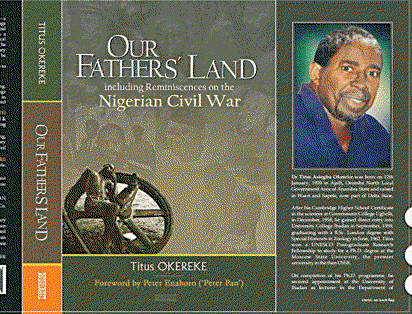
Our Father’s Land by Titus Okereke
By P. D. Cole
Professor Titus Okereke has written an excellent book even if at times it is an unhappy book. His own irrepressible personality shines through the book – he is a friendly man, a thoughtful person who is willing at times to follow the consequences of his thinking. Most people think but allow circumstances to dictate their action. Not so Titus. The book is delightful as it takes us through his first thoughts – not of Ajalli but of a two days water trip to Sapele where he grew up.

Our Father’s Land by Titus Okereke
He later lived in Warri and at Ughelli where he went to Secondary School. He was a flyer, because at age 23 he had finished his first degree from University College, Ibadan and at 26 or so he had his PH.D from the University of Moscow.
Prof. Okereke won many literary awards, as he should, and would have been a noted Parasitelogist had history not played havoc with his life.
The book is a travelogue of one friend to another, most of whom he met at Government College, Ughelli. His classmates were nearly all as brilliant; nearly all went to University and got good jobs. He lived in an age when getting a degree was easy and straight forward. 3 years at Ibadan.
The book reveals the quality of education and the quality of life in the Universities then – one person to a room; being served food at the refectory (no one called it “canteen”), clothes washed by a washer man, shoes polished etc. Prof. Okereke teases us with a few escapades and picaddillos but like the gentleman he is, tells no tales. A likeable easy going person during a likeable easy going period.
I guess what most so called “Biafrans” miss is this facility – to work where you choose, to move when you choose without let or hindrance because the jobs they do were on merit not on privilege. It is worth reflecting that when our parents choose which schools we went to, they had also chosen what our character will be. The friends, you keep for the rest of your lives are those you met at school.
So if Prof. Okereke says he taught at the University of Ibadan, University of Nigeria Nsukka and University of Benin or read at the School of Tropical medicine, London, or at Cornell University, Ithaca, he met other Nigerians who interacted and affected his life. Only our politicians and rulers seem to go to school with no classmates, no dates of schooling or some fictitious Toronto Chicago university or some school which has no records.
Perhaps it should now be mandatory to name at least 5 co-students who would testify that indeed they were at school with you. On second thoughts why? Our intrepid politicians will pay 5 people to testify!! Now to the meat of the book- Biafra. Titus Okereke is not an ideologue and cannot be. But he felt genuine fears in Ibadan which made him go to Nsukka where there was little peace as the Igbo heartland shrung.
He worked in military intelligence agency about which he typically tells us little. But the ferocious rumour mill which drove him from Ibadan continue to pursue him through 1967-1970. Rumour fed on rumour: panic resulted. One of the saving graces of the Nigerian Civil War or the Biafra War of Independence was that it did not, like other civil wars in the world, mean large scale immigration and settlement after settlement.
The war was relatively short and many people were able to return to where they worked before or lived before without too much harassment. Prof. Okereke berates General Gowon as insincere in his 3Rs. You may abuse General Gowon for all kinds of things- insincerity is not one of them. The debates about Biafra would not cease easily but books which merely reaffirm prejudices do an injustice to all of us.
Let’s be clear. There was wide spread pogrom in the North after the death of Sarduana and Tafawa Balewa. It is one of the unhappy fates in life that people will read all kinds of meaning in your action even when you claim that is not what you wanted to do. If all the Premiers and the Prime minister were to be killed then do so.
By sparing Chief Michael Opara and Chief Dennis Osadebey and Dr. Nnamdi Azikiwe but killing those mentioned above including Chief Festus Okotie Eboh and Chief S.L. Akintola the 1966 coupists lost their moral basis or at least opened the door for thinking that this was an Ibo coup.
Should the North have reacted by slaughtering innocent Ibo in their midst-? No. In fact had they come to the table to discuss the future of Nigeria at that time the North would have had a higher moral ground. Prof. Okereke makes much of Aburi. The truth was that in 1966-7 the officers who struck were inexperienced, immature, blood thirsty charlatans who killed their intellectual and moral and leadership betters. The soldiers of 1966/1967 etc were small men, with puny minds dealing with monumentally large issues.
They were bound to fail. Nigeria is a big nation beyond the comprehension of small men with, as my friend would say, the brains of a lizard. Once the cycle of violence began, it could not be easily stopped as Prof. Okereke tells us in his book. Those who thought differently from Col. Ojukwu paid the ultimate price Col. Ijeanuna, Banjo, Sam Agbam, Major Philip Adibe. Prof Okereke makes much about Awolowo’s statements- he understand the suffering of the Igbo, if they seceded so would the West.
All that needs to be said about this was that Col. Ojukwu should have sought greater reliance and action from Chief Obafemi Awolowo and both of them should have declared secession simultaneously.. It is indeed surprising that throughout the mayhem Northerners unleashed on Nigerians, no commander, no leader West or North constantly, asked that Igbos should not be killed. Many Yorubas and non Igbos were also slaughtered.
No one went out of his way to reassure all Nigerians that they were safe and should not be subjects of ethnic cleansing and doing something about that. No one was punished for needlessly killing Igbo. During times of horrors, heroes emerge. There were several Hausas and Northerners who hid and saved Igbo and Yorubas. Many Yorubas also saved Ibo. My friend Kunle Oyenuga was told by his neighbour to leave Jos before 6am otherwise he would kill Kunle. The man fled out of Jos at 3am.
Prof. Okereke makes the point that more could have been done to rehabilitate the Igbo. I believed that Chief Awolowo’s capping of all Igbo account at £20 is unjust and even to-day, where money could be proved to be theirs should be returned to them. In any ease where did their money go to? As for Abandoned Property I am yet to hear that the houses were undervalued as at the time Major Mark did his work.
Many people had been paid twice, three times or four times for the same building. I wrote a little while ago that the people of Rivers State should recall Igbo to teach them how to develop real estate and develop Port Harcourt. The Igbo have to learn one cardinal lesson about Biafra and Abandon Property and the Ikweres. Biafra never, for one moment, considered the fate of the minorities who were not Ibo.
The Attorney General of Biafra when Ojukwu declared secession was Dr. Nabo Graham Douglas. He was not consulted, heard the declaration on the radio, Protested and was promptly jailed. My mother had lived 25 years in Onitsha. When they started shelling Onitsha – others fled. Where was she supposed to go? She left Onitsha for Abonnema.
I have three uncles here in Lagos living at 30 Adebola Street, Surulere. They had a draughts board and loved to listen to Ukonu and Okoko Ndem every evening as these two humorously took apart Gowon and Jeremiah Awolowo. One day the SSS took three of them and locked them up in Kirikiri.
One was a top official at Lagos Town Council; the other was a Deputy Permanent Secretary, Ministry of Internal Affairs, the third was a dental surgeon, a Colonel in the Dental Corp, next to Brig. Da Silva, the commandant. We eventually got them out: their crime- listening to subversive Radio Biafra!!!
The Igbo or Northerners should have sent commandos to kill Osadebey, Okpara and Azikiwe. Then some semblance of justice would have been reached. Moreover, the Igbo bicycle repairer or Igbo mechanic in the North was not the person who killed Sardauna or Balewa or Akintola or Okotie Ebah. Why kill them? They were not soldiers. The Northern revenge for the killing of their leaders was unguided and excessive.
Chukwuma Nzeogwu and the coup plotters were foolish overbearing unthinking young men just as the northern officers were equally unthinking and foolish. Gowon read “two speeches” in July 1967- one for the breakup of Nigeria and the other for unity- so complete was the confusion.
The last two chapters properly do not belong to this book but I am glad Prof. Okereke wrote them- it shows his breadth and depth of knowledge. One is the prerequisite of a University and seeing that his children would not have the privilege of a good university education in Nigeria, took early retirement, sent his children to school in England and set up a private oil and gas company to pay for their education.
In this he was unique- other Nigerians would have stayed in the university become dean or Vice Chancellor and through office pay for his children’s education in the UK. The other chapter is a worthy …….of US $8 billion waste in Ajaokuta. Finally, Prof Okereke has joined us- the lamentators without power.
Let us be clear about one other thing. It is not the job of the Army or the Police to tell us what to say or not say even if what we want to say is that Biafra should be effected. The army and the police should bring back our Chibok girls; crush Boko Haram before anything else. What I have said above does not mean I support or oppose Biafra.
I think Biafra as a concept is exceptional- that is, no one should be killed without due process; all of us should live and move in freedom anywhere in Nigeria; that all in Nigeria should be able to achieve his potent that our country should provide jobs for all qualified and no one should be discriminated against because of his place of origin- all the above is in the constitution which the President, the Judges, the Governors, members of the National and State assemblies swear to.
Finally all are subject to the rule of law: no exceptions. Biafra also means that when a people fell that there rights are trampled upon, they have right to protest even to secede-even this is in the Constitutional Conference Report. A newly wed couple moves next door and that night the neighbours hear an almighty row between the newly weds. The neighbourhood gossip and her friends predict that the marriage will not last.
The quarreling couple continues to shake the neighbourhood nightly but they do not part: instead they produce 5 children but the quarrels continue. Maybe this is how Nigeria is: doom is predicted everyday: we are described as intrinsically unstable but we precariously continue to remain in Nigeria. I do not, despite all our daily criticism; see anyone wanting to break up Nigeria.
Religious differences, yes; tribal discrimination are plenty; prophets of doom inundate the news and airwaves, but we still march on. Perhaps we are more alike than we like to admit. Perhaps more progress had been made on the road of equity than we are willing to admit. The apparent failures- tribalism, corruption, abandoned property and injustice- these have all been internalized and we have developed ways to cope with them and to deal with them gradually if not at a fell swoop.
When old men tell us how good the old days were- was it really good for everybody or good for the few Okerekes, Tomoris, and Coles who succeeded a harrowing childhood? If 30 of us were in the primary school how many millions did not go? Do we remember the names of those who failed along the way? Moreover, we are different peoples.- 560 different ethnic groups. The imperatives of federalism enforce on us the need to respect our differences and that we will progress at different rates. What federalism does not allow is the monopoly of power, real or imagined, by any one set of peoples. The reality of this was the recognition of 6 political zones. But the people still have to believe in this reality and work towards its success.
This reality is what the book, in advertently, is about. An Aro man from Ajalli, grew up in Delta, lived in Lagos, taught in Ibadan, Nsukka and Benin cannot speak Ibo but whose friends are nearly all non Ibos. A man married to an Ijaw woman from Bonny who speaks some bastardized Ibo.
Disclaimer
Comments expressed here do not reflect the opinions of Vanguard newspapers or any employee thereof.