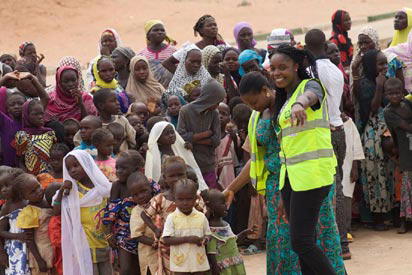
NEMA officials distributing reliefs materials to displaced persons at an IDP camp in Yola
By Mike Ebonugwo
DUE to intermittent attacks, including suicide bombings, from Boko Haram insurgents, major parts of Nigeria’s North East states of Borno, Yobe and Adamawa are generally perceived as often haunted by the spectre of death and destruction, and therefore, no-go-areas. This is why Yola, the Adamawa State capital, which until lately was largely a haven of refuge for residents and the internally displaced or those fleeing the horrors of terrorists attacks, is now regarded as highly endangered on account of some suicide bombings recorded there.
Evidences that the people are no longer at ease are not far seek. Obviously prompted by recent suicide bomb attacks as well as security measures introduced by the military authorities, the populace appear more security consciousness in response to the perceived fear that danger, as represented by the Boko Haram messengers of death, could be lurking around the corner. Which is why one found it puzzling on arriving Yola on a Friday to see Muslim worshippers being frisked or scanned before being allowed into mosques until the imperative of the action dawned. Same pre-emptive safety measure also apply to Christian worshippers before entering their churches.
Days before, suicide bombers, believed to be Boko Haram terrorists, had hit a mosque in Yola, leaving many people dead and several others injured. A similar attack at an Internally Displaced Persons, IDPs, camp in the state capital also took another high toll in lives. Other public places, including markets, have not been spared as the serial suicide bombers seek for the next target.
Part of the disturbing picture is the large army of IDPs accommodated at different camps in Yola. Some of the less fortunate of these were condemned to roaming the streets as mendicants They are seen as living victims and constant reminders of the human tragedy of an insurgency that defies logic and understanding.
Bombs or not, life goes on
But the good news is that, from every indication, the narrative of this unfortunate development does not portend in its climax a triumph of evil. First is the blunt and courageous refusal of the people to bow to the blackmail of terror. Life for them, it would appear, goes on regardless of any perceived threat of bomb attacks. Indeed, but for the security measures introduced for their safety, most people in Yola go about their activities with scant betrayal of fear that their environment harbours a possible threat to their lives. This explains why there has not been reports of mass exodus of people from Yola. Even non-indigenes have not been displaying any hasty desire to leave as exemplified by two brothers from the South Eastern part of Nigeria, Emmanuel and Ikechukwu Ibe. The duo who hail from Abia State said they have lived in Adamawa State for over two decades, which includes schooling and working there. Emmanuel, a teacher who described Yola as his second home, said the bomb blasts in the city are not enough to scare him to relocate to the East. He added thus: “Adamawa has been one of the most peaceful states of the Federation before the Boko Haram insurgency. The people are peaceful and accommodating to the non-indigenes, even as they do not discriminate outrightly on the basis of tribe or religion, except in some cases like in the civil service. So I have no cause to run away because of bomb blasts. After all, death is a necessary end that will come when it will come whether you live in the North East or the South East”.

NEMA officials distributing reliefs materials to displaced persons at an IDP camp in Yola
As for Ikechukwu: “To talk of leaving Adamawa State because of bomb blast or Boko Haram is not at all in my agenda. As a Nigerian, everywhere or any part of Nigeria, not only Adamawa State, is a home to me. I can live and conveniently mix with any other tribe in Nigeria not minding our cultural and religious differences”. IK, as he is popularly known, added that death is in the hands of God. ‘’Whether in the North, West, East or elsewhere, one is surely bound to die when the time comes,’’ he re-stated.
Mr. Tobis Harrision, a resident of Yola, who hails from the Niger Delta part of the country also expressed a similar sentiment. Harrison, owner of one of the major private pharmaceutical firms in Yola, also affirmed that the place had long become a home to him, adding that his belief in one Nigeria prompted him to pick a wife from Adamawa and they are blessed with four children.
“For me to think of running away from Adamawa because of frequent bomb blasts will be childish. People who ran away at the heat of the insurgency in 2014, especially those of the South-East and South-South, have all returned back. There is no cause for alarm because it is only God that gives life and can take it when He wishes”, he concluded philosophically.
AUN’s humanitarian and development response: But particularly remarkable is the heroic and commendable humanitarian response of the American University of Nigeria, AUN, Yola to the immediate needs of the suffering IDPs and other impoverished members of its community. Moved by the pathetic plight of the IDPs, especially children and women among them, the AUN which prides itself as a development university responded with a humanitarian initiative to care for them as part of its community work. According to AUN president, Margee Ensign, for over 18 months, the institution has been taking care of these unfortunate individuals most of whom are very hungry women and children, adding that at the height of the Boko Haram attacks ‘’we had about 76,000 people we were feeding’’. President Ensign was particularly disturbed by the sight of thousands of children begging on the streets of Yola because they lost their parents to Boko Haram attacks.
Humanitarian programme
‘’About six, eight months ago, I and some of my staff members and my driver…We just got tired of driving and seeing these kids begging. So, we said let’s try and do something about it. We started small, about one meal a day…We hired some local women to help with the one meal a day…..So it’s called feed and read. We have up to 125 kids.’’ The take off of this humanitarian programme, she informed, was made possible by AUN Founder and former Vice President, Atiku Abubakar, who kindly made funds available for that purpose. The basis for this, can essentially be traced to a peace initiative established four years ago, long before things got serious. According to President Ensign, under the aegis of the Adamawa Peace Initiative, API, which is a building partner of the university: ‘’We try to protect vulnerable children in our community, to educate them, give them potential for employment, maybe give them some hope. The Peace Initiative has trained over 15000 young people. We can document the young people associated with the API… I must say I’m most proud of that because somehow we kept these young people educated and full of hope. I think we have a model in Yola for how you deal with youth unemployment, lack of education, lack of hope…..’’.
She informed that at a point during the IDP crisis, the community was stretched beyond limits. This is because of an estimated 405,000 IDPs who sought refuge in Yola, only 15,000 were accommodated at the designated IDPs camps. ‘’I don’t know how they have done it ….What the university has done through the API is to make sure they have food and medicine,’’ she said, while expressing pride at what was achieved in the process.
But she is also worried that there’s a feeling and thinking in Nigeria that it is over. ‘’Maybe the worst of the violence is over; I pray it is, but we still have hundreds of very, very hungry, needy people here in Yola, who left places you don’t want to see, I have seen it twice in the Northern part of this country…I have seen the devastation, destruction of infrastructure; the schools are burnt, church and mosques burnt. ‘’They can’t go home, most of them; so they’re still here with us. And now the government says they’re closing the camps in December… That means those that are left have nowhere to go.
So, that’s still a big challenge,’’ she said. But she was impressed that Nigerians had responded to the situation by opening their hearts and their homes to take care of these people, adding that it was a huge model Nigerians should be proud of.
As part of this response process, the AUN through its API peace building partner, last September launched a N1 billion Insurgency Intervention Fund to help provide basic necessities to thousands of displaced people and to assist them return to their homes when the situation is conducive for doing so. The Fund which demands the participation of public-spirited individuals and corporate bodies, is envisaged to be a major boost to the on-going AUN-API empowered process of helping ‘’thousands of vulnerable Nigerian youths obtain an education, develop valuable life skills and resist recruitment by Boko Haram’’.
Explaining why the peace building initiative is dear to her heart, Margee who is the chair of the API, said it agrees with her educational philosophy. ‘’People are asking, why is this university so involved in this community (humanitarian project), isn’t it a kind of distraction from education? But I view education from what we are doing,’’ she said and recommended it as a model for other parts of the country. She did not stop there.
‘’This university is a development university. And that’s our primary mission….And the way we have chosen to implement that vision, is to say first of all without peace you can’t progress as a city… So we brought together all the members of the Adamawa Peace Initiative…all the bishops, all the imams, the community leaders…
Similar indicators
They are the ones we have been working with for the past four years,’’ she informed, adding: ‘’We live in a state where 77 percent of the population can’t read and write. There are other parts of the country with similar indicators’’.
She also said people cannot participate effectively in the development process if they cannot read and write. ‘’So, the challenges here are huge: health, education, infant mortality; the indicators are really frightening,’’ she said but added that AUN-API initiative was an ideal model to respond to the situation. .. She argued that if the university can apply this form of education using students and faculty to improve the lot of the poor kids in the community, the same model can also be applied in similarly afflicted communities in other parts of the country to make things better.
Disclaimer
Comments expressed here do not reflect the opinions of Vanguard newspapers or any employee thereof.