Buhari
By Akintola Omigbodun
The strength of our national economy has been based on revenues from crude oil sales and there have been significant drops in these revenues in recent times. There is the belief in some quarters that revenues from crude oil sales are not moneys we worked for and so there should not be any fuss made about the disappearance of these revenues.

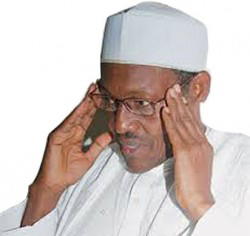
President Muhammadu Buhari attending to some files in his office as he resumed duties at the Presidential Villa, Abuja. Photo by Abayomi Adeshida
However, we often have the situation in which these revenues are used to further impoverish the people and I will give the example of rice farmers in the past and now in 2015.
In the middle of February 1981, I spent some time in the Bida Agricultural Development Project area in Niger State. Rice cultivation was the dominant agricultural activity in the area and for the 1980 – 1985 period, there was a plan with the primary objective of increasing agricultural production, raising farm incomes to improve the welfare and living standards of the farming population. Rice cultivation involves land preparation, planting, fertiliser application, weeding, harvesting, transportation, storage and threshing. These activities usually start between May and September while harvesting is carried out between November and February and the estimated labour usage was put at 169 man days per hectare cultivated.
My visit was in furtherance of a study of rice milling in the area. There was the need to establish at village/community level modern rice mills for the production of parboiled rice. The mills were to be simple in design, small in scope and labour intensive in use. As we travelled from one village/community to the next, we were faced with field after field of rice crop that had been left to rot unharvested. The number of households engaged in farming in the area was put at about 60,000 and these households were brought to these disastrous circumstances through inappropriate government action.
The civilian government that came into office in October 1979 had embarked on a questionable scheme of rice importation that squandered the country’s foreign exchange earnings and at the same time brought rice farmers to ruin within one planting season. What we found very distressing at the time was that the farmers did not understand that their plight was as a result of government policy.
More recently, the national rice policy had the overall objective that there would be self sufficiency in rice production by 2016. There has been put in place a dual tariff that favoured domestic rice producers over rice traders. A supply gap of 782,000 metric tones of rice was identified in 2014 and import quotas allocated to 16 existing rice mills. There have been reports that actual imports were substantially in excess of the quotas and there have also been allegations of unpaid customs duties. Rice farmers should have carried out their planting activities between May and this month with the harvesting of the crop completed by February 2016. Would the excess imports create a situation in which farmers would have their crops unharvested by February 2016?
The previous week in this column, we noted that in June 1984 a team of Catholic bishops at a meeting with the then Head of State, General Muhammadu Buhari, stated that our leaders should be made to account for their stewardship. Going forward, we must have government give account of all revenues and we must ensure that these revenues are not applied in such a manner as to discourage domestic production, especially agricultural production.
DR. AKINTOLA OMIGBODUN,can be reached via omigbodunaa@yahoocom
Disclaimer
Comments expressed here do not reflect the opinions of Vanguard newspapers or any employee thereof.