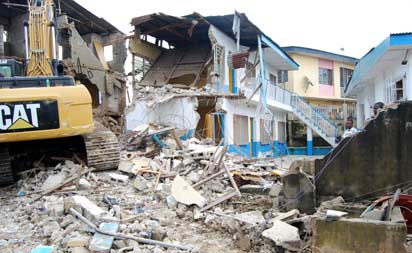
a collapsed building
By Kingsley Adegboye
To ensure a sustainable built environment and enhance national development, the Nigerian Institute of Quantity Surveyors (NIQS), has canvassed a ‘marriage’ between research works by quantity surveyors (QS) in academia and those of their counterparts in practice.

Collapsed building
The cost experts who gathered at their second research conference tagged NIQS ReCon2 which held at the Federal University of Technology (FUTA), Akure, Ondo state last week, said seeking confluence of research between academia and practice had become imperative because of great premium the institute places on the issue of research, and the fact that it recognises the great potentials researches contribute to existing knowledge and resolving man’s enormous challenges in an ever-changing world.
According to the organisers,the three-day event with the theme “Confluence of Research, Theory and Practice in Quantity Surveying Profession for a Sustainable Built Environment” which featured presentation of various papers by cost managers both in practice and academia, is one of the end-products of the research policy of their professional body adopted to create a forum for colleagues in academia to promote sharing of cross-border research experiences necessary to enhance career progression and better results as well as foster closer interaction and collaboration between academics and practitioners in research activities in order to boost their practices and enhance national development.
In his keynote address, Mr. Lance Momodu, a fellow of NIQS and Principal Partner of Abuja-based ARQUENG Consultants, noted that the essence of the Research Conference “is to add value to the existing knowledge of our practice, the profession and the industry at large, especially now that the standard of education has declined sharply in our higher institutions”.
Momodu who is the chairman, Association of Consulting Quantity Surveyors of Nigeria (ACQS), pointed out however, that research carried out without application to practical use, has no value, hence the need to remind members of NIQS that the result of research carried out by members should be made available not only to schools, but also to their practising colleagues.
According to him, “In a country with already abysmally low standard of education, one remains less than fully equipped to face today’s world. Without comparative knowledge and competitive skills, we are faced with a frightening situation where more than 75 per cent of Nigerian graduates cannot compete in the 21st century workplace”.
Speaking earlier during the opening ceremony, the president of NIQS, Mallam Murtala Aliyu disclosed that the Conference was yet another step by his institute to deepen research efforts by entrenching practice-based research and encouraging practice-oriented academic researches.
Aliyu, a former minister of state for Power and Steel said the bulk of researches in the country seem to be domiciled in the academic institutions with little application in practice to solve human problems probably because governments and practitioners are not aware of or are lukewarm to research results. He pointed out that the consequence of this, is that many researches turn out to appear like mere academic rituals.
Academic rituals
Describing this development as rather unfortunate, the NIQS boss revealed that many research findings needed to resolve societal problems are confined to academic shelves, maintaining that generally, the society demands from professionals the use of their intellect and expertise to bail her out of the present predicaments of poor development and unresolved socio-economic challenges.
According to him, “The professionals owe a duty of care to the society. They need to prove their worth and even pay back to the society which trained and fed them. This can be achieved through commitment to, and concerted research efforts. Furthermore, technological enhancements, globalisation and international benchmarking create the need for modernisation of knowledge, continuous improvement and up-grading of information and knowledge base necessary to cut across barriers and boundaries. “These challenges necessitate researches and further researches in order to strengthen existing theories and propound new ones. Knowledge sharing and information dissemination are likely additional results.
Consequence upon this, there is the dire need to re-focus research. It needs to go beyond academic gains to solve enormous problems of the society. The quest for the blend of theory and practice through research is most desirable. Researches therefore need to be encouraged by governments and practitioners alike through funding, commissioning research projects and utilisation of research findings”, Aliyu noted.
While commending NIQS members for the Conference and its theme, Ondo state governor, Olusegun Mimiko who was represented by the Permanent Secretary for Adult and Technical Education in the state, Gray Eshofone, an architect, said as a minister of Lands, Housing and Urban Development, he had interacted with the various professional bodies in the built environment including NIQS.
Mimiko who assured that his administration will not do anything to undermine the built environment, pointed out that to demonstrate his interest in the built sector, he has no less than 10 professionals across the built environment professions in his administration.
In his remark, the Vice Chancellor, FUTA, Prof. Adebiyi Daramola who described the theme of the Conference as contemporary, added that this is because the sustainability of the environment is key to national development. He however, charged the Conference to address the issue of corruption associated with cost management in procurement and construction projects in the the country, as some quantity surveyors had been fingered in corrupt practices relating to projects handled by them.
Disclaimer
Comments expressed here do not reflect the opinions of Vanguard newspapers or any employee thereof.