By Sam Akpe
This is not the best of times for the Niger Delta Development Commission (NDDC). These days, the commission is in the news for all the wrong reasons. From one naughty headline to sensational screamers, almost on daily basis, and the commission seems embattled. Unfortunately, or perhaps, fortunately, most of the stories have little or nothing to do with the present management. But that is not a beautiful excuse because governance, at whatever level, is an unfolding drama or what the policy makers call a continuum.
 Last week, the Auditor-General of the Federation addressed the press on allegations that the commission could not account for a whooping N183.7 billion given to it by the federal government. If that couldn’t make news, then nothing would.
The source of the information was authoritative; we are talking about the Office of the Auditor-General of the Federation. This is where the powers of the constitution lie concerning matters of expenditure and accountability. The Auditor-General is so powerful that he reports to no other personality except the institution called the National Assembly.
As soon as the reports hit the public domain, political jobbers and emergency anti-corruption crusaders sprang into action. They added bites to the accusation even before asking whether the audit report amounts to a case of fraud or were just a case of hasty conclusions. One had also expected that officials of the NDDC would surface with a reaction as soon as the story hit the front pages. This did not happen until last Friday at a public function in Rivers State when one of the executive directors decided to merely, as though in passing, said something in the form of a reaction to the report.
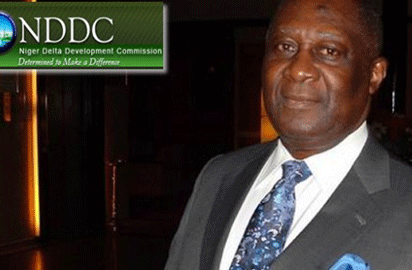
Even then, Henry Ogiri, the commission’s executive director in charge of finance and administration, did not look like a worried man. As I watched him on the website of one of the online media, Ogiri had a smile on his dark face as he told the community people comprising NDDC’s stakeholders that all that they read on the pages of the newspapers did not to amount factual accusation. There was silence in the crowd as the people tried to absorb his disclosure. That was a natural reaction in view of the depth of accusation. He went ahead to explain that the conclusion that N183.7 billion was missing was premature even if it happened at a time the present management was yet to take over.
He sounded authoritative; exuding a silent charisma that seemed to say: you have to believe on this because I should know. Yes, he should know because he is in charge of money at the commission. Although Ogiri did not accuse the Auditor-General of falsifying figures, he said what was presented to the public did not represent the true situation on the ground. It was his belief that the Office of the Auditor-General could have waited a little bit for the detail response to the query on the issues before finalising its findings. If this was done, he said, the story and the conclusions and perhaps the headlines in the media, would have been different.
On a general note, he said the audit query which unfortunately has been made public without waiting for the required response, was just an observation by the statutory body; and not a judgement passed on the commission. He assured that NDDC management has nothing to fear and nothing to hide; and will respond to the query as required. It was clear from his clarification that the audit query was not sent to the commission for reaction before the report was tabled in the public domain. All the same, the commission, he said was already responding.
On the issue of N70.4 billion which the audit report said was unaccounted for but was used to mobilise various contractors that never reported to site, Ogiri, said the conclusion was based on inadequate understanding of the procedure of contract mobilisation by the commission; a situation that would have been adequately taken care of in their reply to the query. He explained that all of the commission’s Advance Payment Guarantee or mobilisation facilities granted to contractors are covered or backed by bank guarantees. In other words, the NDDC does not just sign a check and give directly to the contractor. Such payments are made through the bank which will in turn release the money to deserving contractors who must have satisfied certain stringent conditions.
He assured that so far, the process has worked for the good of the commission; and that the legal department have been fully involved in ensuring that any breach of the procedure whether by the contractors or the banks is dealt with through the legal process. Based on this, he noted that there was no N70.4 billion mobilisation fee unaccounted for by the NDDC; and that the banks involved the process are in a position to confirm this. He said no bank would pay any contractor who has not taken the project to a certain level and is so certified by competent bodies, not to talk of getting paid without mobilising to site.
Quite unthinkable, he said was the issue of alleged N5.8 billion paid to contractors by the commission for projects not executed or abandoned. He said even the contractors were complaining of non-payment at the completion of jobs while the auditors are alleging payment for jobs not executed. It was his view that although all the claims contained in the report concerned management teams that were in office prior to the appointment of the current team, most of the non-payment to contractors was caused by funding challenges caused by a breach of statutory commitments by the stakeholders.
His position confirmed what the immediate past chairman of the commission, Senator Bassey Ewa-Henshaw said a few weeks ago that from inception till date, the NDDC is being owed not less than N800 billion by the federal government. With such huge indebtedness which may never be redeemed, he noted that the functions of the commission have been seriously hampered. Under the present management, Ogiri said payment of mobilisation fees for jobs doesn’t exist; except under the process discussed above.
The commission’s finance chief said he was not in any way comfortable with the report that N90.5 billion was recorded under extra-budgetary expenditure which allegedly attracted no approval from the legal authorities. He said most of the times, budgetary approvals by such legal authorities do drag on till the end of the financial year. When that happens, the commission obtain authorisation to continue with their statutory functions pending when the budget would be signed into law; and that it was possible that certain spending have been made in the past while waiting for the budget to be passed by relevant authorities but doubted if that can properly be captured under extra-budgetary expenditure.
He said further, “delay in budget approval by the relevant authorities account for the delay in timely meeting of financial obligations to relevant bodies. This ultimately could lead to some spending while waiting for the budget to be passed but not over-budgetary spending. As we speak, the 2015 budget is yet to be approved.”
Ogiri later explained that the question of non-deduction of taxes from contractors was laughable. In addition, he said the issue of N10.07 billion tax deductions allegedly made without evidence of remittance to the Federal Inland Revenue Service, has no proof. He based his position on the fact that “the FIRS has carried out thorough audit of all transactions covered by this report. We have remitted all liabilities to appropriate tax offices up to December 2013 and all the documents are available. Right now, as we pay the contractors, we deduct taxes and pay them to the appropriate bodies to avoid any outstanding inconveniences. For now, we have cleared all the outstanding payments.”
Then he added: “There is nothing like unauthorised account in this commission. Who opened it; who are the signatories; and where is it domiciled?” He was making specific reference to the accusation that the commission has an unauthorised account which it is hiding N3.1 billion. He said the onus of proof regarding the existence of such account was on the auditors who must have evidence of the existence of such account. He described as premature and hasty, certain conclusions drawn by the auditors describing some of them as lacking in evidence and proofs.
All the same, Ogiri said relevant authorities whose duty it is to examine and act on the audit report can use all the machineries at their disposal to confirm the existence of such accounts and the money lodged there. One of the commission staff was quoted as asking rhetorically: “how do you define unauthorised account?”
Another staff who spoke with an online reporter, unofficially, was quoted as saying that the issue of staff advances was not properly handled and interpreted in the report. He said, “Staff advance is a moving account which they retire or are retired as soon as the task is accomplished. That is, if I give you money as advance, you are expected to retire on completion of the mission to which the money is attached. Some of these advances have been retired accordingly. All these things have procedures. How can somebody say N1.7 billion could not be accounted for?”
The audit report had also indicted the commission over N785 million being a part of N1.1 billion allegedly paid to contractors for the supply of furniture to various schools in Delta State. In the same online report, a staff identified as someone involved in the project said: “In our records, we have evidence of full delivery and acknowledgment by the school authorities or the beneficiaries. The conclusion is like playing to the gallery. We were not even given any opportunity to respond to this kind of faulty findings before making it public.”
However, whatever the position of NDDC, the auditors have done their job; and so are the self-employed political jobbers who are already calling for the sack of the management. Certainly, there are procedures that must be employed in the execution of the report to ensure that justice is done. For now, it is a mere report; not a judgement.
- Akpe, a public affairs
analyst is based in Abuja
Disclaimer
Comments expressed here do not reflect the opinions of Vanguard newspapers or any employee thereof.