Nigerian Stock Exchange
By Peter Egwuatu
The Nigerian Stock Exchange, NSE, has identified investor education as a veritable tool towards protecting investors in the capital market.
A knowledgeable investor knows the basics of investment and when he engages the services of a professional, knows how, when and where to invest in the capital market, but for a non-knowledgeable investors, he lacks the basics and even when the services of a professional is engaged, he may not be able to take decisions on how to maximize the gains from his investment.

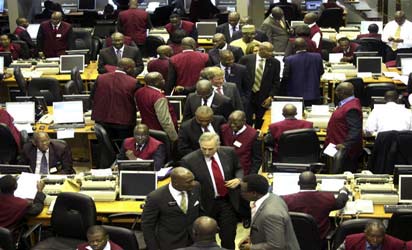
File photo: The floor of Stock exchange
It will be recalled that the NSE kicked off its financial literacy programme as a first step in protecting investors in February, 2012. This programme was aimed to enhance investors’ understanding of the basics of investing around portfolio construction, asset allocation and risk diversification.
Investor clinic, an aspect of the financial literacy programme designed by the exchange to address low investor confidence and create better informed investors, is targeted at particular segments of the investing community to discuss the finer details of investing and to shed more light on the capital market ecosystem. These clinics were delivered in partnership with stellar organizations such as Morgan Stanley, Stanbic IBTC, Greenwich Trust and FBN Capital, just to name a few.
In addition to the investor clinics, the NSE has organized over 500 investor education workshops for “grassroots level” investors (civil servants, students, SMEs, etc.) across Nigeria via its thirteen branch offices.
Domestic and foreign investor drive
Financial Literacy: The exchange conducted approximately 200 investor education outreach programmes in 2014, empowering thousands of retail investors to make more informed investment decisions. It also hosted a road show to increase Asian foreign portfolio investments (FPI) into Nigeria. Asia is currently Nigeria’s largest trading partner.
Also as part of its effort to educate investors, the NSE in July 2014, launched a new web site. The user friendly site provides a richer experience in terms of accessibility, for both listed company information and other key data points relating to the business of the Exchange. The site runs smoothly on mobile platforms, and allows the Exchange to scale up its web services in line with user demand.
WFE Membership
The NSE was admitted to full membership in the World Federation of Exchanges (WFE) in October 2014, following a multi-year process that included a two-day onsite inspection in September 2014. Full membership in the Federation bestows a higher level of credibility and visibility upon the NSE, enabling it to promote higher standards. It also provides an avenue for increased international cooperation, as well as increased investment flows.
Corporate governance
Corporate Governance Rating System (CGRS): The NSE, in partnership with the Convention on Business Integrity (CBi), launched the CGRS in November 2014. Using a holistic multi-stakeholder approach and a diverse set of information collection and verification processes, the CGRS is designed to rate companies listed on the Exchange based on their corporate governance practices, thereby improving the overall perception of and trust in Nigeria’s capital market. Participation by listed companies will become mandatory in 2015, and the NSE National Council has committed to lead by example by completing the required CGRS company directors’ assessment.
Staying the Course
The NSE is also unwavering in its commitment to solidify its leadership position as Africa’s foremost securities exchange, and is committed to initiatives that will position the bourse as an attractive listing and investment destination. In support of the federal government’s reforms, the NSE has pledged to continue to provide a viable platform to support the financing and sustainable development of the real economy.
Therefore, this year 2015, the Exchange has focused on delivering several initiatives in support of its revised strategy. Key amongst these initiatives are the following themes: Promote the Nigerian capital market as an African hub for growth companies; Attract more domestic flows into the market; Implement a more competitive price structure in conjunction with the Regulator and other market participants; and Intensify its efforts towards developing a more sustainable market.
Disclaimer
Comments expressed here do not reflect the opinions of Vanguard newspapers or any employee thereof.