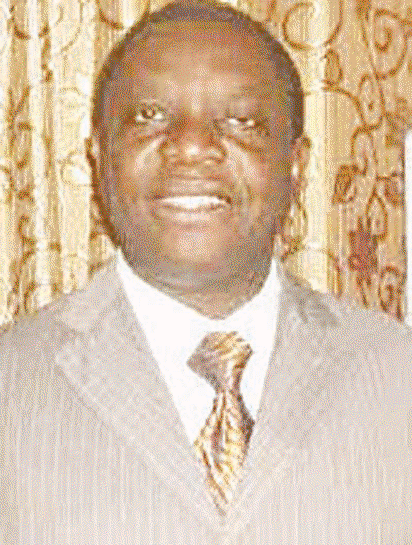
*Professor Charles Esimone… funding is a major limitation
PRofessor Charles Okechukwu Esimone is the Deputy Vice-Chancellor (Academic), Nnamdi Azikiwe University, Awka. The Professor of Biopharmaceutics and Pharmaceutical Microbiology and former dean of Faculty of Pharmaceutical Sciences spoke with Vanguard Learning in Awka recently on some of his research works on vaccine and how to make them work better. Excerpts:

*Professor Charles Esimone… funding is a major limitation
HIV: We have had so many claims by people of medicinal plants with anti-HIV activities but we had no means of screening them so in 2003/2004, we developed a technique called Vector-based Assay technique whereby we can actually screen large number of medicinal plants for anti-HIV activities.
Using that technique, we have been able to screen over 100 medicinal plants that people claim are effective against HIV. We have been able to delineate them and know the ones that are effective and the ones that are not.
Power problem: The major problem is power because we need 24 hours uninterrupted power supply. I believe that if we get funding, we can establish that facility here because I have been able to train post-doctoral fellows and one PhD in that technique and they are all here.
Drug discovery: In the Faculty of Pharmacy, we use a bio-informatics model for drug discovery for ebola virus. One of our staff has that expertise. We can use computer bioinformatics and develop compounds and get plausible targets.
Plausibletargets
The only limitation is that you need to test those target drugs again in a wet laboratory. So if I am able to establish that laboratory, we can test some of these things. That is how it is done abroad. Once they get those hits using bioinformatics, they test them in the wet lab to confirm the ones that are good because sometimes, they don’t work out and sometimes bioavailability is a problem.
In other words, it may not penetrate cells very well even though in the computer, it can target well but in real life, it may not penetrate those cells and there may be some other enzymes that may attack them. So bioinformatics is a shorter way of drug discovery which my colleague in pharmacy, Dr Uzochukwu, has been able to do.
Recently, we tried to use the same bioinformatics for malaria diagnosis. I did that study in India in 2013 while on a fellowship to develop malaria diagnosis.
Malaria diagnosis: Right now, we only diagnose malaria from blood and in some cultures in Africa, it is a taboo to collect blood so we want to develop diagnostic kits based on urine and saliva but to do that, we need to know the biomarkers of malaria in urine and saliva so we are trying to use bioinformatics and proteomase to identify biomarkers from urine and saliva.
The study is still ongoing. We have seen some putative biomarkers from urine so some of my post-graduate students are working on that to confirm whether those things we saw in bioinformatics can be found in the urine of subjects who have malaria.
In all these, funding is a major limitation because assuming I was doing this work in the US or India, I will get funding but to tell them to fund it for you to do it here is a big problem so we need to get our own indigenous funding. For now, we sponsor the work ourselves. International agencies are skeptical if the work is going to be done here.
Disclaimer
Comments expressed here do not reflect the opinions of Vanguard newspapers or any employee thereof.